

Views: 2
Table of Contents
- 1 Introduction
- 2 Why Do Companies Change Their Names?
- 3 Legal Framework Governing Company Name Change in India
- 4 Restrictions on the New Company Name
- 5 Documents Required for Company Name Change
- 6 Step-by-Step Process for Company Name Change in India 2026
- 7 Government Fees for Company Name Change
- 8 Post-Approval Updates: What You Must Change After Getting the New Name
- 9 Name Change for LLP: Key Differences
- 10 Important Points to Remember
- 11 FAQs
- 12 Conclusion
- 13 Get Expert Help With Company Name Change
Introduction
A company name is one of the most important business decisions an entrepreneur makes. It represents the brand, the identity, and the market positioning of the entire enterprise. But businesses evolve. Strategies change. Mergers happen. Brands are repackaged. And sometimes, the name that made perfect sense at incorporation simply no longer fits the business that has grown out of it.
Changing a company name in India is more common than most people realise. Whether it is a rebranding exercise, a change in business direction, a conflict with another brand, a post-merger identity update, or simply the founders deciding they want a stronger name in the market, the Companies Act, 2013 provides a clear and structured process for changing the name of a registered company.
However, the process involves multiple regulatory steps, board and shareholder approvals, amendments to constitutional documents, filings with the Ministry of Corporate Affairs, and updates across a wide range of registrations and documents. It is not something that can be done casually or quickly, and every step must be executed in the correct sequence.
This guide covers the complete company name change process in India in 2026, including the legal requirements, the reasons a name change may be allowed or rejected, the step-by-step procedure, the documents required, the government fees involved, the time it takes, and all the post-approval updates you must make after the new name is approved.
For expert assistance with company name change and all related MCA filings, the corporate compliance team at LegalTax.in offers complete end-to-end support.
Why Do Companies Change Their Names?
Before understanding the process, it is useful to understand the most common reasons companies in India apply for a name change:
Rebranding and Market Repositioning A company that has evolved significantly from its original business focus may find that the old name no longer reflects its current identity or market positioning. A technology company that started as a hardware firm but pivoted to software services, for example, may want a name that better communicates its current offering.
Conflict with an Existing Trademark or Company Name The Trade Marks Registry or the Registrar of Companies may identify that the existing company name is identical or deceptively similar to an already registered trademark or another company’s name. In such cases, the company may be directed to change its name or may proactively choose to do so to avoid legal disputes.
Merger, Acquisition, or Change of Ownership When a company is acquired by a larger group or merges with another entity, a name change is often part of the integration process to align the company’s identity with the new parent or merged entity.
Negative Brand Association A company involved in a controversy, a regulatory action, or a public relations crisis may choose to change its name as part of a broader effort to rebuild its reputation.
Business Expansion into New Sectors A company expanding significantly beyond its original business domain may find its existing name too narrow or sector-specific, prompting a broader, more inclusive name.
Director or Promoter’s Personal Choice Sometimes the reason is simply that the founders want a different name. This is entirely valid and the Companies Act does not require companies to justify their name change beyond compliance with the applicable rules.
Legal Framework Governing Company Name Change in India
Company name changes for private limited companies, public limited companies, and one person companies are governed by:
📋 Section 13 of the Companies Act, 2013 — which deals with alteration of the Memorandum of Association (MOA), the document in which the company name appears 📋 Rule 29 of the Companies (Incorporation) Rules, 2014 — which specifies the procedure for name change 📋 MCA Circular Guidelines — for restrictions on names that cannot be used 📋 Trade Marks Act, 1999 — to ensure the new name does not conflict with existing registered trademarks
For LLPs, name change is governed by the Limited Liability Partnership Act, 2008 and the LLP Rules, 2009, and involves a slightly different procedure through the LLP portal.
Restrictions on the New Company Name
Not every name a company proposes will be approved. The Registrar of Companies (RoC) will reject a proposed name if it:
🚫 Is identical or too similar to an existing registered company name 🚫 Infringes on a registered trademark under the Trade Marks Act, 1999 🚫 Contains words suggesting government patronage such as “National,” “Union,” “Central,” “Republic,” “Federal,” or “Indian” without specific approval 🚫 Contains words that are offensive, obscene, or contrary to public policy 🚫 Suggests a connection with a foreign government or international organisation without appropriate approval 🚫 Is too generic or descriptive to function as a distinctive company name 🚫 Contains words like “Insurance,” “Bank,” “Stock Exchange,” “Financial Institution,” or similar regulated terms without the required regulatory approval from the relevant authority
Before applying for a name change, it is strongly advisable to conduct a comprehensive search on both the MCA portal and the IP India trademark database to check for conflicts. The compliance experts at LegalTax.in conduct this dual search before filing any name change application to avoid rejection.
After your new company name is approved, you should immediately file for Trademark Registration in the relevant classes to protect the new name. The trademark specialists at LegalTax.in, LegalIP.in, and OnlineTrademark India can file your trademark application alongside the name change process so both proceed simultaneously.
Documents Required for Company Name Change
Board and Shareholder Resolution Documents: 📄 Board Resolution approving the name change and authorising the filing 📄 Special Resolution passed by shareholders in a General Meeting (or through postal ballot) 📄 Explanatory statement annexed to the notice of the General Meeting
For the Name Reservation Application: 📄 Board Resolution specifically authorising the proposed new name 📄 Declaration from a director confirming compliance with all applicable rules
For Filing with MCA After Name Approval: 📄 Amended Memorandum of Association (MOA) incorporating the new name 📄 Amended Articles of Association (AOA) if the name appears there as well 📄 Copy of the Board Resolution 📄 Copy of the Special Resolution 📄 Certificate of Incorporation (existing) 📄 Proof of registered office address
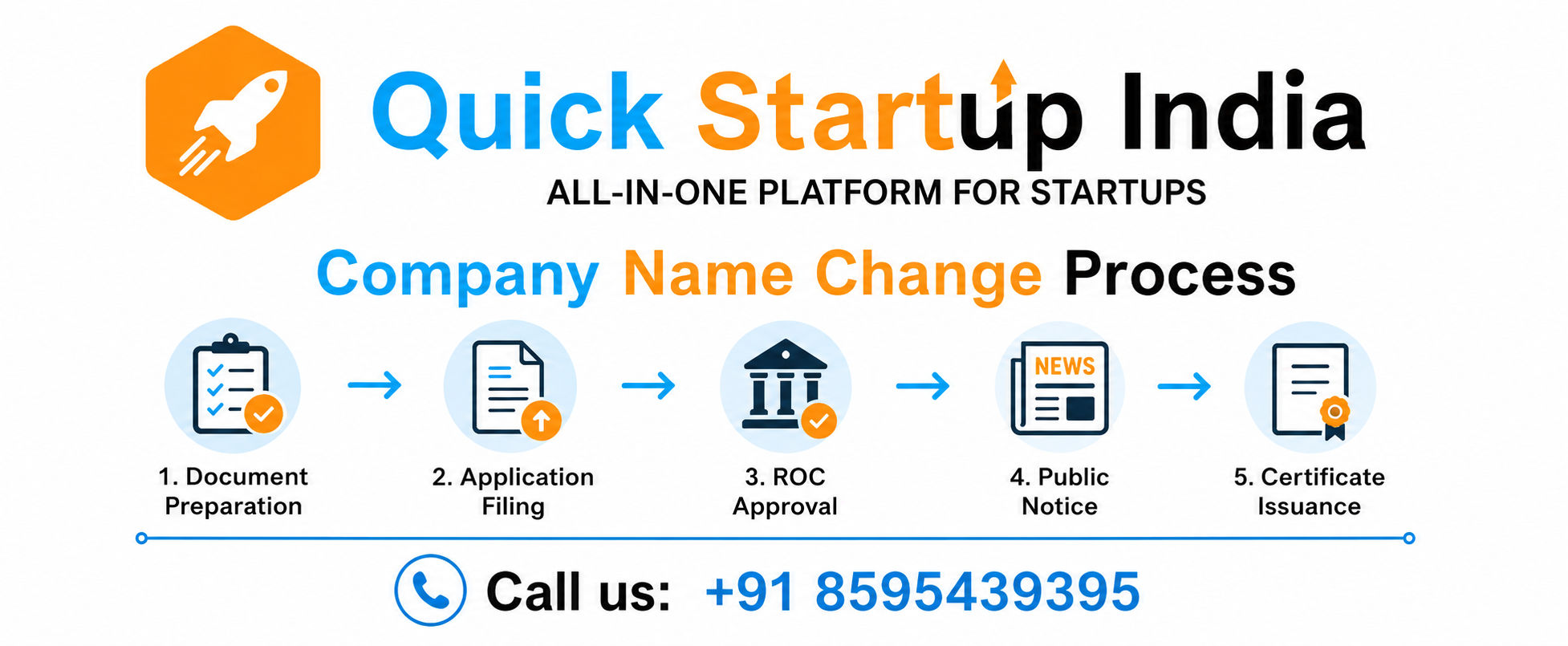
Step-by-Step Process for Company Name Change in India 2026
Step 1: Conduct a Name Availability Search
Before anything else, search for the availability of your proposed new name on the MCA21 portal at mca.gov.in. Also search the IP India trademark database at ipindiaonline.gov.in to ensure the proposed name does not conflict with any registered trademark.
This step is critical. A name that passes the MCA search but conflicts with a registered trademark can still lead to legal disputes after the name change is approved.
Step 2: Hold a Board Meeting and Pass a Board Resolution
Call a Board of Directors meeting with proper notice (minimum two days advance notice under the Companies Act, though the articles may specify a longer period). In the board meeting, pass a resolution:
🔹 Approving the proposed new name 🔹 Authorising the filing of the name reservation application (RUN form) on the MCA portal 🔹 Directing that a General Meeting of shareholders be convened to pass the Special Resolution required under Section 13
The Board Resolution must be properly documented and entered in the board minutes register.
Step 3: File the RUN (Reserve Unique Name) Form on the MCA Portal
After the board resolution, file the RUN (Reserve Unique Name) form on the MCA21 portal. In this form, you can propose up to two names in order of preference. The RoC will approve one name or reject both with reasons.
The RUN form approval is typically received within 1 to 3 working days. The approved name reservation is valid for 20 days from the date of approval, within which you must complete all subsequent steps and filings.
Step 4: Issue Notice for an Extraordinary General Meeting (EGM)
Once the name is reserved, issue a formal notice for an Extraordinary General Meeting (EGM) of shareholders with a minimum of 21 clear days advance notice. The notice must include the proposed special resolution for the name change and an explanatory statement explaining the reasons for the change.
In certain situations where all shareholders agree, a shorter notice period may be used with unanimous written consent.
Step 5: Conduct the EGM and Pass the Special Resolution
Hold the EGM and pass the Special Resolution approving the change of name under Section 13 of the Companies Act, 2013. A Special Resolution requires the approval of at least three-fourths (75%) of the shareholders voting on the resolution.
The resolution must be properly recorded in the minutes of the EGM. The minutes must be signed by the Chairman of the meeting within 30 days of the meeting.
Step 6: File Form MGT-14 with the RoC
Within 30 days of passing the Special Resolution, file Form MGT-14 on the MCA portal with the following attachments:
📄 Copy of the Special Resolution 📄 Copy of the explanatory statement 📄 Copy of the notice of the EGM 📄 Minutes of the EGM
Failure to file MGT-14 within 30 days attracts a penalty of Rs. 500 per day of delay with a maximum of Rs. 5 lakhs. This deadline must be met without exception.
Step 7: File Form INC-24 with the RoC
After filing MGT-14, file Form INC-24 on the MCA portal, which is the formal application to the Central Government (delegated to the RoC) for approval of the name change. Attachments include:
📄 Amended Memorandum of Association with the new name 📄 Copy of the Special Resolution 📄 Copy of the Board Resolution 📄 Minutes of the EGM 📄 Any other document specifically required by the RoC
The government fee for Form INC-24 depends on the authorised share capital of the company and ranges from Rs. 1,000 to Rs. 5,00,000.
Step 8: Receive the Fresh Certificate of Incorporation
If the RoC is satisfied with the application and all documents are in order, the RoC issues a fresh Certificate of Incorporation in the new company name. This certificate confirms that the name change has been officially approved and is effective from the date mentioned in the certificate.
The Company Identification Number (CIN) of the company remains the same. Only the name changes.
The entire process from board resolution to fresh Certificate of Incorporation typically takes 20 to 45 working days when all documents are properly prepared and filed on time.
Government Fees for Company Name Change
RUN Form (Name Reservation): Rs. 1,000
Form MGT-14 (Filing of Special Resolution): The fee depends on the authorised share capital of the company: 💰 Up to Rs. 1,00,000 — Rs. 200 💰 Rs. 1,00,001 to Rs. 5,00,000 — Rs. 300 💰 Rs. 5,00,001 to Rs. 25,00,000 — Rs. 400 💰 Rs. 25,00,001 to Rs. 1,00,00,000 — Rs. 500 💰 Above Rs. 1,00,00,000 — Rs. 600
Form INC-24 (Name Change Application): 💰 Authorised capital up to Rs. 1,00,000 — Rs. 1,000 💰 Rs. 1,00,001 to Rs. 5,00,000 — Rs. 2,000 💰 Rs. 5,00,001 to Rs. 25,00,000 — Rs. 4,000 💰 Rs. 25,00,001 to Rs. 1 crore — Rs. 5,000 💰 Above Rs. 1 crore — Rs. 5,000 plus additional fees
These are government fees only. Professional charges for preparation of board and EGM minutes, amended MOA and AOA drafting, and MCA portal filings are separate.
Post-Approval Updates: What You Must Change After Getting the New Name
Receiving the fresh Certificate of Incorporation is not the end of the process. It is the beginning of a substantial update exercise across every document, registration, and platform associated with the company. Here is a comprehensive list of everything that must be updated:
Government Registrations and Documents:
📋 PAN Card — Apply for a new PAN card in the new company name at the Income Tax Department 📋 TAN — Update the TAN registration in the new company name 📋 GST Registration — Update the company name on the GST portal through the amendment process 📋 MSME Registration — Update the MSME Udyam registration certificate with the new name 📋 Shop and Establishment Registration — Update the Shop and Establishment certificate with the local municipal authority 📋 Import Export Code — Update the IEC registration with DGFT if your company is involved in import-export 📋 ISO Certification — Inform your ISO certification body and get the ISO certificate reissued in the new name 📋 FSSAI License — Update FSSAI registration if your company operates in the food business 📋 Startup India Registration — Update the Startup India DPIIT registration if applicable 📋 GEM Registration — Update GEM portal registration if your company sells to government entities
Banking and Financial:
🏦 All company bank accounts must be updated with the new name. Submit the fresh Certificate of Incorporation, amended MOA, and board resolution to each bank. 🏦 Cheque books in the old name must be replaced 🏦 All loan agreements and credit facilities must be updated 🏦 Investment accounts and demat accounts must be updated
Trademark and IP:
🏷 Trademark registrations in the old company name must be updated through Trademark Assignment or a change of name endorsement with the Trade Marks Registry. The IP specialists at LegalTax.in, LegalIP.in, and OnlineTrademark India can handle this process alongside the name change. 🏷 Copyright registrations must be updated 🏷 If the new name is not already trademarked, file for Trademark Registration immediately
Contracts and Commercial Relationships:
📝 All vendor and client contracts must be updated or novated to reflect the new company name 📝 Employment contracts and offer letters must be updated 📝 Lease agreements and property documents must be updated with the landlord or property authority 📝 Insurance policies must be updated with the insurance provider
Digital and Marketing:
🌐 Company website must be updated throughout including domain name if it contains the old company name 🌐 Email addresses if they include the company name 📱 Social media profiles on LinkedIn, Instagram, Facebook, Twitter, and other platforms 📣 Google Business Profile and other local directory listings 📦 Product packaging, labels, and marketing materials must be reprinted in the new name 🪟 Signboards, office name plates, and letterheads must be replaced
This post-approval update exercise is extensive and must be completed systematically. The compliance team at LegalTax.in provides a detailed post-name-change checklist and can assist with the GST amendment, trademark update, and other government registration updates.
Name Change for LLP: Key Differences
If you want to change the name of a Limited Liability Partnership (LLP) rather than a company, the process is slightly different:
📋 The LLP partners must pass a resolution approving the name change 📋 The proposed new name must be reserved through the RUN-LLP form on the MCA portal 📋 After name approval, Form 5 must be filed with the RoC within 30 days, along with the amended LLP Agreement reflecting the new name 📋 The RoC then issues a fresh Certificate of Incorporation for the LLP in the new name
The post-approval update requirements for an LLP are similar to those for a company, covering GST, bank accounts, contracts, and other registrations.
For complete LLP Registration and LLP name change support, visit LegalTax.in.
Important Points to Remember
✅ The CIN (Company Identification Number) of the company does not change when the name changes. Only the name component of the CIN changes.
✅ All past contracts, filings, and legal documents in the old name remain valid. The company’s legal continuity is not affected by a name change.
✅ Pending litigation in the old name continues in the old name until formally amended by the court.
✅ The existing shareholders and directors remain unchanged. A name change does not affect ownership or governance structure in any way.
✅ The annual compliance calendar (AGM, board meetings, MCA filings) continues without any interruption.
✅ The name change must be reflected in all future invoices, contracts, and official communications from the effective date of the fresh Certificate of Incorporation.
✅ Failure to update GST registration with the new name can create complications in GST return filing and input tax credit claims.
FAQs
What is the Company Name Change process in India?
Company Name Change is the legal process of changing the registered name of a company under the Companies Act, 2013 through approval from the Ministry of Corporate Affairs (MCA). The business structure remains the same; only the company name changes.
Why do companies change their name in India?
Companies may change their name due to rebranding, business expansion, merger, change in business activity, trademark issues, market positioning, or to create a stronger brand identity.
Is MCA approval mandatory for changing a company name?
Yes. Approval from the Ministry of Corporate Affairs (MCA) is mandatory for changing the name of a Private Limited Company, LLP, or other registered company entities in India.
How long does the Company Name Change process take in India?
The complete process generally takes around 15 to 30 working days depending on MCA approval timelines, document verification, and ROC processing.
Does changing the company name affect existing business contracts or GST?
No. The legal identity of the company remains the same. However, businesses must update the new company name in GST registration, PAN, TAN, bank accounts, invoices, agreements, licenses, and other legal records.
Conclusion
Changing a company name in India is a structured, multi-step process governed by the Companies Act, 2013. It requires board and shareholder approvals, MCA filings, RoC approval, and a comprehensive update of all registrations and documents associated with the company. None of these steps can be skipped or taken out of sequence.
The process is manageable with the right professional support, and completing it correctly from the beginning avoids the delays, penalties, and complications that come from errors in documentation or missed deadlines.
Whether you are rebranding, expanding, resolving a conflict, or simply choosing a stronger name, the most important thing is to do it right and do it completely.
Get Expert Help With Company Name Change
🟡 LegalTax.in provides complete company name change support including name availability search, board and EGM documentation, RUN filing, MGT-14, INC-24, amended MOA and AOA drafting, and post-approval registration updates. 👉 Private Limited Company Services at LegalTax.in 👉 LLP Registration and Compliance 👉 GST Registration Amendment 👉 MSME Registration Update 👉 Trademark Assignment after Name Change 👉 Trademark Registration for New Name 👉 Legal Documentation and Drafting
🟡 Protect Your New Company Name with Trademark Registration 👉 LegalTax.in Trademark Registration 👉 LegalIP.in Trademark Services 👉 OnlineTrademark India
📞 Call Now: +91 8595439395 📧 Email: info@legaltax.in 🕐 Free Consultation: Monday to Saturday, 9 AM to 6 PM
Disclaimer: This article is for informational purposes only and does not constitute legal advice. Please consult a qualified company law professional for guidance specific to your situation.
Word Count: ~2,400 words

Anjali is a Digital Marketing Expert at Quick Startup India who builds websites that rank and convert. She specializes in SEO-driven web development, helping people find the right legal help online.


