

Views: 0
Table of Contents
- 1 Introduction
- 2 Benefit 1: Access to Government Tenders and Corporate Supply Chains That Were Previously Closed to You
- 3 Benefit 2: Lower Error Rates, Reduced Rework, and Measurably Better Operational Efficiency
- 4 Benefit 3: Significantly Stronger Access to Bank Loans, Credit Lines, and Export Financing
- 5 Benefit 4: A Measurable and Lasting Improvement in Customer Satisfaction and Retention
- 6 Benefit 5: The Ability to Scale the Business Without Losing Quality or Control
- 7 Benefit 6: Stronger Brand Credibility and Market Differentiation That Goes Beyond Marketing Claims
- 8 Benefit 7: A Structured Framework for Continuous Improvement That Drives Long-Term Business Growth
- 9 The Benefits Stack: How ISO Certification Creates a Compounding Advantage
- 10 Which ISO Standard Delivers the Greatest Benefits for Your Business?
- 11 FAQs
- 12 Conclusion
- 13 Start Your ISO Certification Journey Today
Introduction
Most articles about ISO certification focus on one thing: how to get the certificate. They walk you through the process, the documents, the audit stages, and the fees. What they rarely discuss in any depth is the question that actually matters most to a business owner making the decision: what does ISO certification actually do for my business once I have it?
The honest answer is: far more than most people expect.
Yes, the certificate helps you win tenders. Yes, it satisfies a client’s vendor requirement. Yes, it gives you something to display on your website and company profile. But if that is all ISO certification did, it would not be worth the investment of time, money, and organisational effort it demands.
The businesses that benefit most from ISO certification are not the ones that pursue it to tick a box. They are the ones that implement the management system genuinely, embed it into how the organisation actually works, and then discover something remarkable: the certification process itself fundamentally changes how well the business operates.
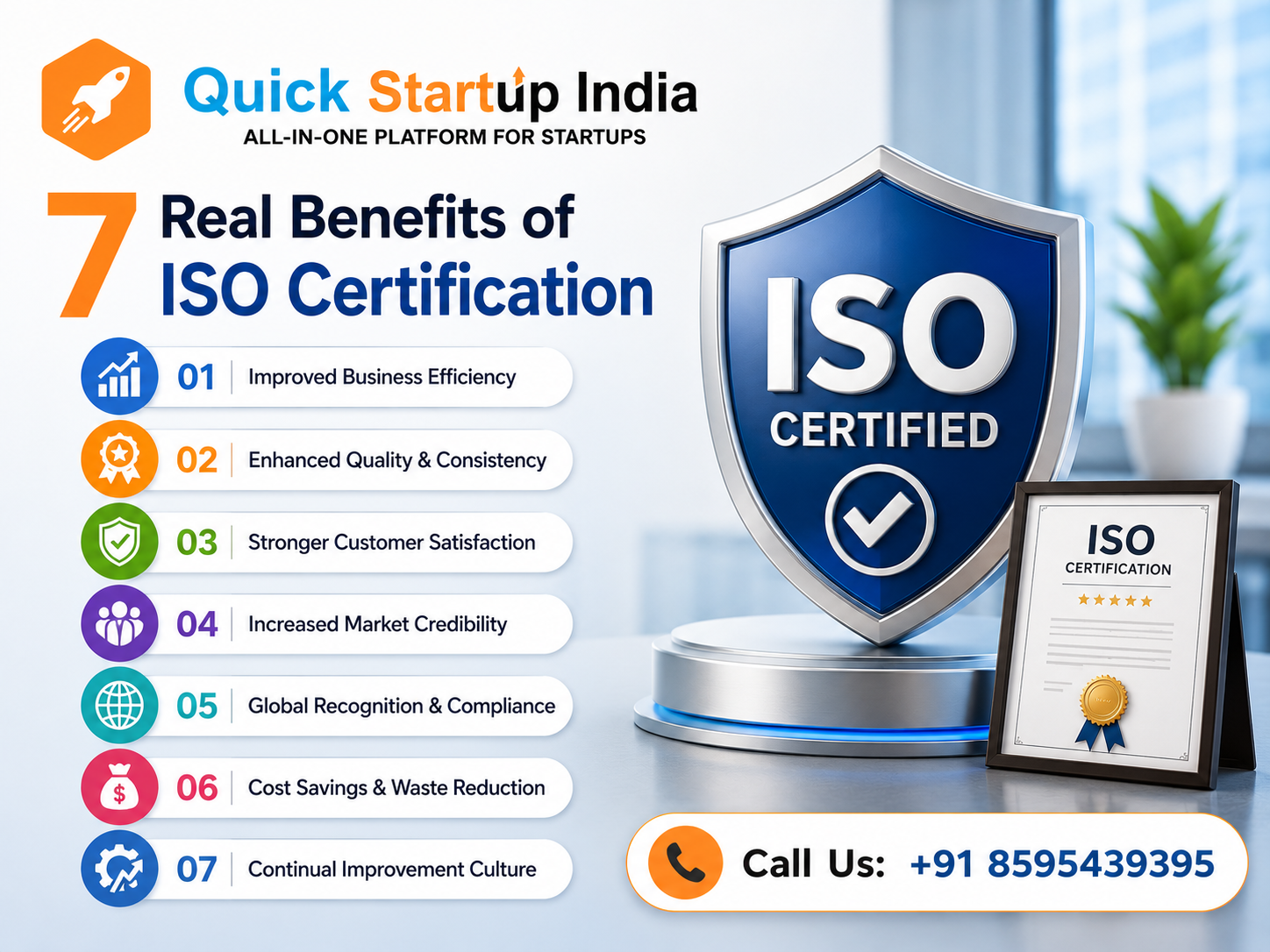
This guide focuses on the seven most significant real-world benefits of ISO certification for Indian businesses in 2026. Not the marketing benefits. Not the certificate-on-the-wall benefits. The actual, tangible changes that happen inside and outside a business when ISO certification is done right.
For expert ISO certification support across all major standards, the certification specialists at LegalTax.in are available for a free consultation.
Benefit 1: Access to Government Tenders and Corporate Supply Chains That Were Previously Closed to You
This is the most immediately tangible and financially significant benefit for most Indian businesses, and it deserves to be understood in its full scope.
India’s government procurement system, managed through portals like the Government e-Marketplace (GEM Registration), and the tender systems of public sector undertakings, defence organisations, railways, and state government departments, routinely lists ISO certification as a mandatory eligibility criterion. A business without the required ISO certification does not even qualify to submit a bid, regardless of how competitive its pricing or how strong its product quality actually is.
The ISO certificate is not just a preference in these contexts. It is a gate. Either you have it and you can enter, or you do not have it and you cannot. For a small manufacturer or service provider that has spent years trying to break into government business, obtaining the right ISO certification can instantly open a procurement market worth crores of rupees that was simply inaccessible before.
The same dynamic applies to large private sector corporations. Major Indian conglomerates, multinational companies operating in India, and export-oriented buyers all maintain approved vendor lists that require suppliers to hold specific ISO certifications. An auto parts manufacturer wanting to supply to a major car company, or an IT firm wanting to join the approved vendor list of a bank, will almost always find ISO certification is a prerequisite.
In practical terms, ISO certification does not just improve your chances of winning business. It makes you eligible for categories of business that your non-certified competitors cannot even enter.
Once your business is ISO certified, registering on the GEM portal and obtaining your Import Export Code through LegalTax.in positions you to access both government procurement and export markets simultaneously.
Benefit 2: Lower Error Rates, Reduced Rework, and Measurably Better Operational Efficiency
This benefit is internal and invisible to the outside world, but for most businesses it turns out to be the one that generates the greatest long-term financial value.
When a business implements an ISO management system genuinely, it is forced to examine every core process with a level of rigour that most organisations never apply in the normal course of business. Every process is documented. Every step is questioned. Every hand-off between departments or team members is examined for clarity and accountability. Every recurring problem is analysed for its root cause rather than just its immediate symptom.
The result of this examination is almost always the same: the organisation discovers a substantial number of inefficiencies, redundancies, error-prone steps, and communication gaps that were generating waste, rework, customer complaints, and cost without anyone ever having clearly identified them.
A manufacturing company that implements ISO 9001 typically discovers that a significant proportion of its production defects trace back to a small number of specific process steps or supplier-related issues. By documenting and standardising those steps and putting controls in place, defect rates fall. Rework costs fall. Customer returns fall. Material wastage falls. Each of these is a direct cost saving that recurs every month after the management system is implemented.
A service business that implements ISO 9001 typically discovers that a significant proportion of its customer complaints or delivery delays trace back to unclear communication between teams, undefined responsibilities, or inconsistent procedures. Standardising these eliminates the recurring problems and frees up management time that was previously spent firefighting.
The ISO management system does not create this improvement by magic. It creates it by forcing the organisation to answer a question it had never formally asked before: exactly how do we do what we do, and how do we know we are doing it correctly? Answering that question systematically, for every core process, is what drives the efficiency improvements.
Benefit 3: Significantly Stronger Access to Bank Loans, Credit Lines, and Export Financing
Access to formal credit is one of the most persistent and damaging challenges facing Indian MSMEs. Banks and financial institutions are cautious about lending to small and medium businesses because of the perceived risk associated with businesses that lack formal management systems, consistent financial records, and documented operational processes.
ISO certification directly addresses several of the risk factors that make banks hesitant. A business with an ISO-certified quality management system has, by definition, documented its processes, implemented controls, demonstrated the ability to consistently meet customer requirements, and subjected itself to independent third-party verification of its management practices. This is exactly the kind of evidence that risk-conscious lenders look for when evaluating a business loan application.
In practice, ISO-certified MSMEs report meaningfully better outcomes when approaching banks and NBFCs for credit facilities. Some specific advantages:
🏦 Priority sector lending — MSME-registered businesses that are also ISO certified are viewed more favourably under priority sector lending guidelines
🏦 Export financing — Banks providing pre-shipment and post-shipment export credit look at ISO certification as a strong positive indicator of the exporter’s ability to meet international quality standards consistently
🏦 Working capital credit lines — The combination of MSME Registration and ISO certification significantly improves the terms and ease of access to working capital credit
🏦 Collateral-free loans under government schemes — Several government credit guarantee schemes for MSMEs give preference to or are more readily accessible by businesses with formal quality certifications
If you have not yet obtained your MSME registration, doing so through LegalTax.in before or alongside your ISO certification journey is strongly recommended. The combination of MSME status and ISO certification is one of the most powerful combinations available to small and medium businesses seeking formal credit in India.
Benefit 4: A Measurable and Lasting Improvement in Customer Satisfaction and Retention
ISO standards, particularly ISO 9001, place the customer at the absolute centre of the management system. One of the seven quality management principles on which ISO 9001 is built is customer focus, and the standard requires organisations to actively determine, understand, and meet customer requirements, monitor customer satisfaction, and take action on the insights gained.
What this means in practice is that an ISO-certified business is required, not just encouraged, to have formal mechanisms for:
📊 Capturing customer feedback regularly and systematically 📊 Analysing customer satisfaction data to identify trends and problem areas 📊 Investigating and resolving customer complaints in a documented, timely manner 📊 Using customer feedback as an input to management review and process improvement decisions
For most Indian small and medium businesses, this level of systematic customer feedback management simply does not exist before ISO certification. Businesses respond to complaints when they arise but do not proactively measure satisfaction, do not analyse complaint trends, and do not formally feed customer insights back into process improvement decisions.
The discipline of implementing these mechanisms, even in a basic form, typically produces a noticeable improvement in customer satisfaction scores and a measurable reduction in customer churn within 12 to 18 months of implementation. Customers notice the difference. Response times improve. Complaints are resolved more consistently. Product or service quality becomes more predictable. And a customer who experiences consistent, reliable quality is a customer who stays.
For businesses in competitive markets where customer acquisition costs are high, improved customer retention is one of the most financially valuable outcomes of ISO certification.
Benefit 5: The Ability to Scale the Business Without Losing Quality or Control
This is perhaps the most underappreciated benefit of ISO certification, particularly for growing businesses.
Every entrepreneur who has tried to scale a business without documented processes has encountered the same problem: what worked when there were five employees stops working when there are twenty-five. Knowledge that lived in one person’s head needs to be communicated to ten people consistently. Decisions that one person used to make need to be delegated, but there are no clear criteria for how to make them. Quality that was easy to control in a small team becomes inconsistent as the team grows. Customer expectations that were easy to meet with personalised attention become harder to deliver at scale.
An ISO-certified management system solves this scaling problem directly. Because every core process is documented, every decision criterion is defined, and every quality standard is specified, a growing business can bring in new employees and have them operating to the same standard as experienced staff much more quickly. Delegation becomes possible because the criteria for good decisions are written down. Quality control becomes scalable because the standard is defined and measurable rather than residing in any individual’s judgment.
The ISO management system is, in essence, a documented operating model for the business. And a documented operating model is what separates businesses that can scale from businesses that plateau because they cannot replicate their quality beyond a certain team size.
For businesses planning to open additional branches, enter new geographies, or build a franchise model, ISO certification creates the operational foundation that makes consistent quality replication possible. For Private Limited Company and LLP structures planning to expand, this scalability benefit is particularly valuable and pairs naturally with the corporate governance framework that these structures provide.
Benefit 6: Stronger Brand Credibility and Market Differentiation That Goes Beyond Marketing Claims
In a market crowded with businesses making identical claims about their quality, reliability, and customer focus, ISO certification provides something that marketing copy cannot: independently verified proof.
Any business can write “highest quality” or “trusted by hundreds of clients” on its website. Only an ISO-certified business can display a certificate from an accredited third-party body confirming that its management system has been audited and found to meet an internationally recognised standard. These are categorically different statements in the eyes of sophisticated buyers.
For business development and sales teams, ISO certification is a powerful conversation opener and objection closer. When a potential client raises concerns about your organisation’s ability to deliver consistently at scale, pointing to your ISO certification immediately shifts the conversation from assertion to evidence. You are not asking them to take your word for it. You are pointing to the conclusion of an independent professional audit.
This credibility advantage compounds over time. As your ISO-certified business builds a track record of consistent quality backed by the management system, the certificate becomes part of the brand identity rather than just a compliance document. It becomes an expectation that clients have of you and a standard that differentiates you from competitors who have not made the same commitment.
Protecting that brand identity requires trademark registration alongside ISO certification. The trademark specialists at LegalTax.in, LegalIP.in, and OnlineTrademark India can ensure that your brand name and logo are legally protected so that the credibility you build through ISO certification cannot be copied by competitors.
Benefit 7: A Structured Framework for Continuous Improvement That Drives Long-Term Business Growth
Every ISO management system standard is built on the Plan-Do-Check-Act (PDCA) cycle, a simple but profoundly powerful framework for continuous improvement. The PDCA cycle means that every process in the management system is planned, implemented, measured, and then revised based on the measurement results. Nothing is assumed to be good enough indefinitely. Everything is assessed periodically and improved systematically.
This continuous improvement orientation, when genuinely embedded in a business, creates a culture where problems are seen as improvement opportunities rather than embarrassments, where data is collected and used to make decisions rather than ignored, and where the organisation is always moving forward rather than standing still.
The compounding effect of this culture over three to five years is remarkable. A business that implements continuous improvement systematically in year one, two, and three does not improve linearly. Each improvement creates the foundation for the next improvement. Processes that were average become good. Processes that were good become excellent. Costs that seemed fixed are found to be reducible. Customer satisfaction that seemed acceptable is found to be improvable.
This is the benefit that ISO-certified businesses most commonly report being surprised by. They expected the certificate. They expected the tender opportunities. They did not expect that five years after certification, their business would be so fundamentally more efficient, more consistent, and more capable than it was before they started the process.
The ISO management system framework also pairs powerfully with the AI tools and digital business management platforms discussed in other guides on this blog. When processes are documented and measured as ISO requires, the data generated is readily available for AI-powered analytics tools to analyse and optimise further.
The Benefits Stack: How ISO Certification Creates a Compounding Advantage
The seven benefits described in this guide do not operate independently. They reinforce each other in ways that create a compounding competitive advantage over time.
Better processes (Benefit 2) lead to fewer defects and complaints, which lead to better customer satisfaction (Benefit 4), which leads to stronger client retention and referrals, which supports business growth, which is enabled by the scalability the management system provides (Benefit 5).
Access to government tenders and corporate supply chains (Benefit 1) brings in larger contracts, which requires the organisation to scale, which is supported by the documented management system (Benefit 5), which maintains the quality standards that keep those large clients satisfied (Benefit 4).
Stronger brand credibility (Benefit 6) attracts better clients, who generate more consistent revenue, which improves the business’s financial profile, which improves access to credit (Benefit 3), which funds further growth and improvement.
The continuous improvement culture (Benefit 7) drives all the other benefits forward every year, so that the gap between your ISO-certified business and your non-certified competitors widens over time rather than narrowing.
This is why businesses that pursue ISO certification seriously, rather than just as a box-ticking exercise, consistently describe it as one of the best business decisions they ever made.
Which ISO Standard Delivers the Greatest Benefits for Your Business?
The benefits described in this guide apply most fully to ISO 9001, the universal quality management standard. But other ISO standards deliver the same core benefits in the context of their specific focus areas:
📋 ISO 14001 delivers these benefits while simultaneously reducing environmental impact and positioning your business for green procurement opportunities
📋 ISO 27001 delivers these benefits in the information security domain, protecting client data, reducing the risk of cyber incidents, and opening doors to clients with strict data security requirements
📋 ISO 22000 delivers these benefits in the food safety domain, reducing the risk of food safety incidents and opening doors to retail chains and export buyers with mandatory food safety certification requirements
📋 ISO 13485 delivers these benefits in the medical device sector, enabling access to regulated markets and demonstrating compliance with the quality requirements of healthcare procurement
📋 GMP Certification delivers these benefits for pharmaceutical and cosmetic manufacturers, demonstrating manufacturing quality compliance to regulators and buyers
FAQs
What are the main benefits of ISO certification for businesses?
ISO certification helps businesses improve credibility, customer trust, operational efficiency, product quality, and compliance management. It also increases opportunities for government tenders, corporate contracts, and international business expansion.
Does ISO certification help small businesses and startups?
Yes, ISO certification is highly beneficial for startups, MSMEs, and small businesses. It helps create professional business processes, improves brand reputation, and builds trust among customers, investors, and business partners.
Can ISO certification increase sales and customer trust?
Yes, many customers prefer working with ISO-certified companies because certification reflects quality, reliability, and professionalism. This can improve customer confidence, repeat business, and overall sales growth.
Is ISO certification useful for government tenders?
Yes, many government tenders and corporate projects either require or prefer ISO-certified businesses. Certification improves eligibility and increases the chances of winning larger contracts.
Is ISO certification only about getting a certificate?
No, ISO certification is much more than a certificate. It promotes continuous improvement, better quality management, customer satisfaction, risk control, and long-term business growth through structured operational systems.
Conclusion
ISO certification is not a certificate. It is a transformation. The businesses that understand this going in are the ones that extract its full value, and those businesses consistently find that the return on their ISO investment, measured in new contracts won, costs reduced, customers retained, credit accessed, and growth enabled, far exceeds the cost of certification.
The seven benefits covered in this guide, access to new markets, operational efficiency, credit access, customer satisfaction, scalability, brand credibility, and continuous improvement, are not theoretical. They are what actually happens when Indian businesses implement ISO management systems with genuine commitment and maintain them properly over time.
The question is not whether ISO certification is worth it. For most serious Indian businesses, it clearly is. The question is which standard is right for you and when you will begin.
Start Your ISO Certification Journey Today
🟡 LegalTax.in provides complete ISO certification support across all major standards including gap analysis, documentation, internal audit, certification body selection, and ongoing surveillance support. 👉 ISO Certification at LegalTax.in 👉 ISO 9001 Certification 👉 ISO 14001 Certification 👉 ISO 27001 Certification 👉 ISO 22000 Certification 👉 ISO 13485 Certification 👉 GMP Certification
🟡 Build Your Complete Business Compliance Foundation 👉 MSME Registration 👉 GST Registration 👉 GEM Registration 👉 Import Export Code 👉 Startup India Registration 👉 Private Limited Company Registration 👉 LLP Registration
🟡 Protect Your Brand Alongside Your ISO Certification 👉 LegalTax.in Trademark Registration 👉 LegalIP.in Trademark Services 👉 OnlineTrademark India
📞 Call Now: +91 8595439395 🕐 Free Consultation: Monday to Saturday, 9 AM to 6 PM

Anjali is a Digital Marketing Expert at Quick Startup India who builds websites that rank and convert. She specializes in SEO-driven web development, helping people find the right legal help online.


