

Views: 3
Table of Contents
- 1 Introduction
- 2 The Core Distinction: What Each IP Protection Actually Protects
- 3 Copyright: Protecting Original Creative Expression
- 4 Trademark: Protecting Brand Identity
- 5 Patent: Protecting Technical Inventions
- 6 The Complete Comparison: Copyright vs Trademark vs Patent
- 7 Real-World Scenarios: Which Protection Do You Need?
- 8 The Fourth IP Protection: Design Registration
- 9 Can You Have All Three Protections on the Same Product?
- 10 IP Enforcement: What Happens When Someone Infringes?
- 11 FAQs
- 12 Conclusion
- 13 Protect Every Aspect of Your Business with Expert IP Support
Introduction
Every business owner in India who creates something — a product, a brand, a piece of content, a piece of software, a process, or an invention — needs to protect it. But the intellectual property system offers three very different types of protection, and choosing the wrong one, or assuming one covers what it does not, leaves your most valuable business assets exposed.
Copyright, trademark, and patent are the three foundational pillars of intellectual property law. They are frequently mentioned together, frequently confused with each other, and frequently misapplied. A musician who tries to trademark a song. A startup founder who thinks their company name is automatically copyrighted. An inventor who believes a trademark protects their technical invention. These are all real mistakes that real business owners make, and they are mistakes that can be extraordinarily expensive to discover after the fact.
This guide explains clearly and precisely what each of these three IP protections covers, what it does not cover, how it is obtained and maintained, and how long it lasts. It also covers the most common real-world scenarios where Indian business owners need to understand which protection applies, and what to do when you need more than one.
For expert guidance on any or all of these IP protections, the specialists at LegalIP.in cover the complete intellectual property spectrum including copyright, trademark, patent, and design registration.
The Core Distinction: What Each IP Protection Actually Protects
Before going into detail, here is the clearest possible summary of what each protection does:
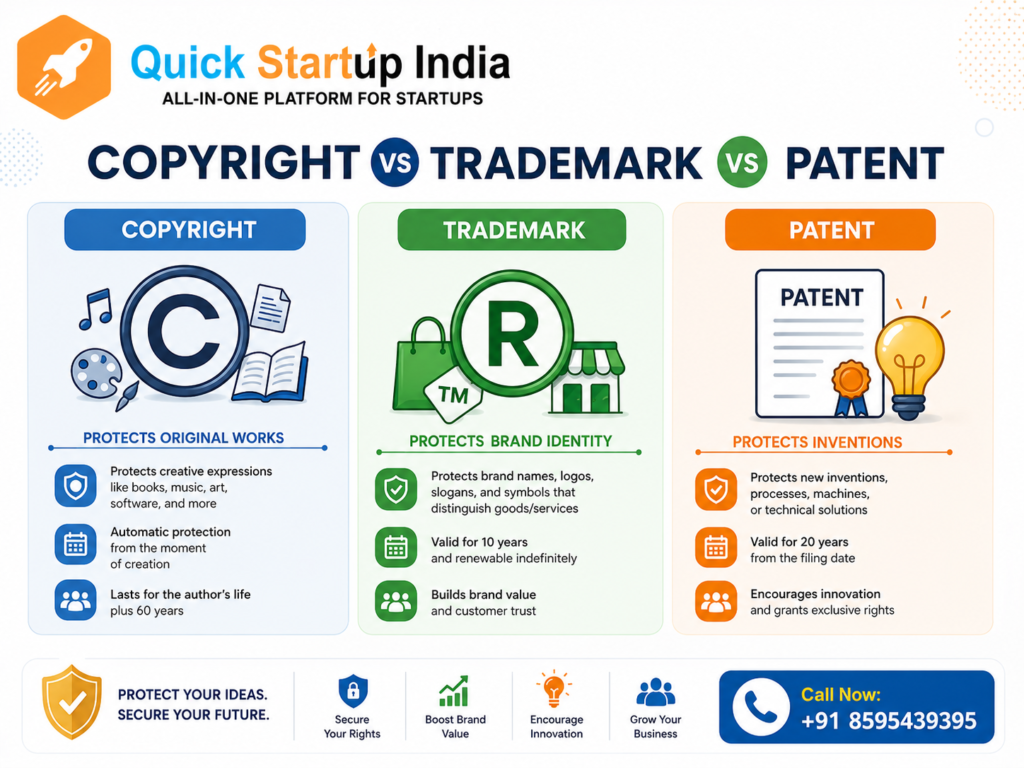
Copyright protects original creative expression — what you created and how you expressed it.
Trademark protects brand identity — the name, logo, or other source identifier that distinguishes your business from others in the marketplace.
Patent protects technical inventions — a novel, non-obvious, industrially applicable innovation in how something works or how something is made.
These three types of protection operate independently, have different legal frameworks, different durations, different registration requirements, and protect fundamentally different things. A single product or business can legitimately need all three simultaneously, and understanding why is the heart of what this guide covers.
Copyright: Protecting Original Creative Expression
What Copyright Protects
Copyright protects original works of authorship — creative works that are expressed in a tangible form. The operative word is original, which in copyright law means that the work was independently created by the author and contains at least a minimal degree of creativity. It does not mean the work must be novel or unique in the patent sense.
In India, copyright is governed by the Copyright Act, 1957 and protects the following categories of works:
🎨 Literary works — novels, stories, poems, articles, essays, lyrics, computer programs, and databases 🎵 Musical works — musical compositions including the music and any accompanying lyrics 🎬 Dramatic works — plays, scripts, screenplays, and choreography 🖼 Artistic works — paintings, drawings, photographs, sculptures, architectural designs, and maps 📽 Cinematograph films — films and other audio-visual works 🔊 Sound recordings — recorded music, podcasts, and any other audio recording 💻 Computer programs and software — source code and object code
What Copyright Does Not Protect
Copyright protects the expression of an idea, not the idea itself. This is the fundamental limitation of copyright that most people misunderstand.
If you write a novel about a young wizard attending a school of magic, your specific text is protected by copyright. But the idea of a young wizard attending a school of magic is not protected. Someone else can write a completely different novel about a young wizard at a magic school without infringing your copyright, as long as they do not copy your specific text.
Copyright also does not protect:
🚫 Names, titles, slogans, or short phrases (these may be protectable as trademarks) 🚫 Facts, news, information, or data (though the creative arrangement or selection of data may be protected) 🚫 Ideas, concepts, methods, or systems (even if original) 🚫 Procedures, processes, or discoveries (these may be protectable as patents) 🚫 Works in the public domain
How Copyright Arises in India
This is the most important thing to understand about copyright: in India, copyright arises automatically at the moment an original work is created and fixed in a tangible form. Registration is not required for copyright to exist. The moment you write a piece of code, paint a picture, compose a song, or record a podcast, copyright in that work belongs to you automatically.
However, registration provides crucial evidentiary advantages. A registered copyright creates a public record of your ownership, provides prima facie evidence of the validity of the copyright in legal proceedings, and significantly strengthens your position in infringement disputes and licensing negotiations. Registration through LegalIP.in is strongly recommended for any commercially valuable creative work.
Duration of Copyright in India
Copyright protection in India lasts for:
📅 Literary, dramatic, musical, and artistic works — the lifetime of the author plus 60 years 📅 Photographs, cinematograph films, and sound recordings — 60 years from the year of publication 📅 Computer programs — treated as literary works; lifetime of the author plus 60 years
After expiry, the work enters the public domain and anyone can use it freely.
Who Owns the Copyright?
The general rule is that the author is the first owner of copyright. However, there are important exceptions:
👔 Works created by an employee in the course of employment — the employer is the first owner, not the employee 📝 Works created under a contract for specific commissioned works — ownership depends on the specific contract terms 🏛 Government works — copyright belongs to the Government of India
This means that if your employees are creating software, marketing content, or other creative works as part of their jobs, your company owns the copyright, not the individual employees. This distinction must be clearly reflected in employment contracts, which the legal drafting team at LegalTax.in can review and strengthen.
Trademark: Protecting Brand Identity
What a Trademark Protects
A trademark is a sign, symbol, word, name, logo, tagline, colour, shape, sound, or combination thereof that distinguishes the goods or services of one business from those of other businesses in the marketplace. The fundamental function of a trademark is to act as a source identifier — it tells consumers who made the product or provided the service.
In India, trademarks are governed by the Trade Marks Act, 1999 and registered through the Trade Marks Registry of India.
A trademark can consist of:
🔤 Word marks — brand names, product names, company names, slogans (Amul, Tata, Zomato) 🖼 Device marks — logos, symbols, graphic elements 🔤🖼 Composite marks — combinations of words and logos 🎨 Colour marks — specific colours or colour combinations used as identifiers 🔊 Sound marks — distinctive sounds associated with a brand (jingles, sonic logos) 📦 Shape marks — distinctive product shapes or packaging shapes 💡 3D marks — three-dimensional shapes of products or packaging
What a Trademark Does Not Protect
A trademark does not protect:
🚫 The underlying product or service itself (that is what patents and trade secrets protect) 🚫 Generic names or purely descriptive terms (you cannot trademark “Bakery” for a bakery) 🚫 Deceptive marks (marks that mislead consumers about the nature, quality, or geographic origin of goods) 🚫 Marks identical or similar to already registered marks in the same or related classes 🚫 Government emblems, national flags, and official symbols
How Trademark Registration Works in India
Unlike copyright, trademark rights in India are established primarily through registration. While common law rights can arise from actual use of a mark in commerce (passing off rights), registered trademark rights are significantly stronger and easier to enforce.
Trademark registration in India involves:
📋 Filing an application with the Trade Marks Registry specifying the mark, the applicant’s details, and the class or classes of goods or services to be covered 📋 Examination by the Trademark Examiner who may issue an objection (examination report) 📋 Publication in the Trade Marks Journal for a four-month opposition period 📋 If no opposition is filed or opposition is successfully overcome, registration is granted
For a complete guide to trademark classes and the registration process, refer to the dedicated trademark class guide on this blog.
The trademark specialists at LegalTax.in, LegalIP.in, and OnlineTrademark India handle the complete trademark registration process including objection replies, opposition proceedings, and hearings.
Duration of Trademark Protection in India
A registered trademark in India is valid for 10 years from the date of application and can be renewed indefinitely for successive 10-year periods as long as the renewal fees are paid and the mark continues to be used in commerce. The Trademark Renewal specialists at LegalIP.in ensure your trademark is never allowed to lapse.
Trademark protection can theoretically last forever, which makes it the most commercially durable form of IP protection available. Brands like Tata, Amul, and Lifebuoy have been protected by trademark for decades and will continue to be protected for as long as the brand owner maintains and renews the registration.
The Use Requirement
A registered trademark in India must be used in commerce. A trademark that is not used for a continuous period of five years from the date of registration can be removed from the register on an application by any person on grounds of non-use. This is why trademark registration must go hand in hand with active commercial use of the mark.
Patent: Protecting Technical Inventions
What a Patent Protects
A patent protects a technical invention — a new, non-obvious solution to a technical problem that is capable of industrial application. Patents protect how something works, how something is made, or how a process is performed.
In India, patents are governed by the Patents Act, 1970 (as amended in 2005) and granted by the Indian Patent Office.
Patents can protect:
⚙ Product inventions — novel physical products, devices, machines, compositions of matter, or materials (a new pharmaceutical compound, a new type of solar cell, a new medical device) 🔄 Process inventions — novel methods or processes for making something or doing something (a new manufacturing process, a new chemical synthesis method, a new method of data processing that produces a technical effect) 🌿 Biotechnology inventions — novel microorganisms, biotechnology processes, and related innovations (subject to specific restrictions) 💊 Pharmaceutical inventions — novel drug compounds, formulations, and combinations (subject to Section 3(d) restrictions)
What a Patent Does Not Protect
As discussed in the patent filing guide on this blog, Indian patent law has specific exclusions under Sections 3 and 4, including:
🚫 Discoveries and scientific theories 🚫 Mathematical methods 🚫 Computer programs per se (software without a technical effect) 🚫 Business methods 🚫 Methods of medical treatment 🚫 Plants, animals, and essentially biological processes 🚫 Inventions contrary to public order or morality 🚫 New uses of known substances without enhanced efficacy (Section 3(d))
How Patent Registration Works in India
Unlike copyright, patents do not arise automatically. They must be actively applied for and granted through a formal examination process. The complete step-by-step patent filing process in India is covered in detail in the dedicated patent filing guide on this blog. In summary:
📋 Provisional or complete application filed with the Indian Patent Office 📋 Publication after 18 months 📋 Request for Examination filed within 48 months 📋 First Examination Report (FER) issued and responded to 📋 Grant issued if all requirements are satisfied
The patent filing and prosecution specialists at LegalIP.in handle the complete process from prior art search to grant.
Duration of Patent Protection in India
A patent in India is valid for 20 years from the filing date (or the priority date in the case of a PCT application entering the national phase). Unlike trademarks, patents cannot be renewed beyond this 20-year term. After expiry, the invention enters the public domain.
Annual renewal fees must be paid from the third year onwards to maintain the patent for its full 20-year term. The Patent Renewal specialists at LegalIP.in manage renewal payments and deadlines.
The Complete Comparison: Copyright vs Trademark vs Patent
What It Protects Copyright: Original creative expression (books, music, art, software, films) Trademark: Brand identity (name, logo, slogan, sound, colour) Patent: Technical inventions (products, processes, methods)
Governing Law in India Copyright: Copyright Act, 1957 Trademark: Trade Marks Act, 1999 Patent: Patents Act, 1970
Registration Required? Copyright: No — arises automatically; registration recommended Trademark: Yes — registration strongly recommended for full rights Patent: Yes — mandatory; no protection without grant
When Protection Begins Copyright: At the moment of creation Trademark: From date of application (for registered rights) Patent: From date of grant (though rights relate back to filing date)
Duration of Protection Copyright: Life of author plus 60 years (for most works) Trademark: 10 years, renewable indefinitely Patent: 20 years from filing date, not renewable
What It Prevents Others From Doing Copyright: Copying, reproducing, distributing, or adapting the protected work Trademark: Using an identical or similar mark in a way that causes confusion Patent: Making, using, selling, or importing the patented invention
Geographic Scope Copyright: International (through Berne Convention); India is a member Trademark: Country-specific; must be filed separately in each country (or through Madrid Protocol) Patent: Country-specific; must be filed separately in each country (or through PCT)
Primary Benefit Copyright: Prevents copying and reproduction of creative works Trademark: Protects brand recognition and consumer trust Patent: Creates temporary monopoly over technical innovation
Can It Be Licensed? Copyright: Yes Trademark: Yes Patent: Yes
Can It Be Sold or Assigned? Copyright: Yes Trademark: Yes — through Trademark Assignment Patent: Yes — through Patent Assignment
Government Fee Range (India) Copyright: Rs. 500 to Rs. 5,000 depending on the type of work Trademark: Rs. 4,500 per class (individuals/MSMEs); Rs. 9,000 per class (others) Patent: Rs. 1,600 to Rs. 20,000 per stage (individuals vs large entities)
Real-World Scenarios: Which Protection Do You Need?
Scenario 1: You Are a Software Startup
You have developed a mobile application with a unique algorithm, a distinctive brand name and logo, and an original user interface design.
Your algorithm and technical method of processing data may be patentable if it produces a technical effect beyond the software itself. File a Patent to protect the technical innovation.
Your brand name and logo are protectable as a trademark. Register your trademark in Class 42 (software services) and Class 9 (downloadable software) through LegalTax.in, LegalIP.in, and OnlineTrademark India.
Your source code, app design, and user interface elements are protected by copyright automatically. Register your copyright through LegalIP.in to strengthen your evidentiary position.
You need all three.
Scenario 2: You Are an Author or Content Creator
You have written a book, created a YouTube channel with original videos, or developed an online course with original educational content.
Your book, videos, and course content are protected by copyright automatically from creation. Register your copyright through LegalIP.in for evidentiary strength.
Your channel name, pen name, or course brand is protectable as a trademark in Class 41 (education and entertainment). Register through LegalTax.in or LegalIP.in.
You almost certainly do not need a patent unless your course uses a genuinely novel technical delivery method.
You need copyright and trademark.
Scenario 3: You Are a Product Manufacturer
You have invented and manufactured a new type of household appliance with a unique mechanical mechanism, a distinctive product design, and a brand name.
Your unique mechanical mechanism is potentially patentable. File a Patent through LegalIP.in.
Your product’s distinctive visual appearance (shape, ornamentation) is protectable as a Design Registration under the Designs Act, 2000.
Your brand name and logo are protectable as a trademark in Class 11 (household appliances). Register through LegalTax.in, LegalIP.in, and OnlineTrademark India.
Your product packaging design and marketing materials are protected by copyright.
You need patent, design registration, trademark, and copyright.
Scenario 4: You Are a Restaurant or Food Business
You have developed a unique recipe, created a distinctive brand name and logo, and designed an original menu with food photography.
Your recipe itself is generally not patentable (unless it involves a novel food processing method with a technical effect) and is not protected by copyright (recipes as lists of ingredients are not copyrightable, though the creative expression around a recipe can be). Trade secret protection through confidentiality agreements is the typical approach for recipes.
Your brand name and logo are protectable as a trademark in Class 43 (restaurants and food services). Register through LegalTax.in or LegalIP.in.
Your original menu design, food photography, and marketing materials are protected by copyright through LegalIP.in.
You need trademark and copyright. Patent is generally not applicable.
Scenario 5: You Are a Pharmaceutical Company
You have developed a new drug compound with a novel molecular structure and a brand name under which it will be sold.
Your novel drug compound may be patentable subject to the requirements of Section 3(d) of the Patents Act. File a Patent through LegalIP.in as early as possible before any public disclosure.
Your brand name for the drug is protectable as a trademark in Class 5 (pharmaceutical products). Register through LegalTax.in, LegalIP.in, and OnlineTrademark India.
Your scientific research papers, clinical trial reports, and marketing materials are protected by copyright.
You need patent and trademark, with copyright applying to creative works.
The Fourth IP Protection: Design Registration
While this guide focuses on the three primary IP protections, Indian businesses should also be aware of a fourth important protection: Design Registration under the Designs Act, 2000.
Design registration protects the visual appearance of a product — its shape, configuration, pattern, ornamentation, or combination of lines or colours that gives the product a unique visual appeal. This is distinct from the technical function of the product (protected by patent) and the brand identity (protected by trademark).
Examples of what design registration protects:
🏺 The distinctive shape of a perfume bottle 👟 The unique sole pattern of a shoe 📱 The visual layout of a smartphone 🚗 The exterior styling of a car 🪑 The distinctive form of a piece of furniture
Design registration in India is valid for 10 years from the date of registration and can be renewed for one further period of 5 years. The Design Registration specialists at LegalIP.in handle the complete filing and prosecution process.
Can You Have All Three Protections on the Same Product?
Yes. And for most significant commercial products and brands, having all three (or all four including design registration) working together provides the most comprehensive and commercially robust IP protection available.
Consider a successful technology product like a smartphone. The device manufacturer protects:
🔒 The technical innovations inside the device through patents (display technology, battery chemistry, processing methods) 🔒 The brand name and logo through trademarks (in multiple classes and multiple countries) 🔒 The software, operating system, and user interface through copyright 🔒 The distinctive physical design and shape of the device through design registration
Each layer of protection covers a different aspect of the product and provides protection that the others do not. Removing any one layer leaves a gap that competitors can exploit.
The IP strategy specialists at LegalIP.in can help you develop a comprehensive, coordinated IP protection strategy that combines the right mix of copyright, trademark, patent, and design registration for your specific business and product portfolio.
IP Enforcement: What Happens When Someone Infringes?
Obtaining IP registrations is only half the battle. The other half is actively monitoring and enforcing your rights when someone infringes them.
Copyright Infringement When someone copies your original work without permission, you can seek civil remedies (injunction, damages, account of profits, delivery up of infringing copies) and in serious cases criminal prosecution. The Copyright and Anti-Piracy enforcement specialists at LegalIP.in handle copyright enforcement including digital takedowns, cease and desist letters, and litigation.
Trademark Infringement When someone uses an identical or deceptively similar mark in a way that causes confusion, you can seek an injunction, damages, and criminal prosecution under the Trade Marks Act. The Brand Protection and Anti-Counterfeiting team at LegalIP.in handles trademark enforcement across online and offline channels.
Patent Infringement When someone makes, uses, sells, or imports your patented invention without authorisation, you can seek civil remedies through the District Court or High Court. Urgent injunction applications can be filed to stop infringement immediately while the case is pending. The IP Litigation team at LegalIP.in represents patent holders in infringement proceedings.
Complex and Multi-IP Enforcement When infringement involves multiple IP rights simultaneously (for example, a counterfeit product that infringes both your trademark and your design), the Complex IP Enforcement specialists at LegalIP.in coordinate comprehensive enforcement action across all affected rights.
FAQs
What is the difference between copyright, trademark, and patent?
Copyright protects original creative works such as books, music, videos, software code, and artwork. Trademark protects brand identity elements like logos, business names, and slogans. Patent protects new inventions, technologies, machines, and innovative industrial processes. Each intellectual property right serves a different purpose for businesses and creators.
Is copyright automatically protected in India?
Yes. Copyright protection generally arises automatically once an original work is created and fixed in a tangible form. However, registering the copyright with the Copyright Office India provides stronger legal evidence and helps during infringement disputes.
How long do trademark and patent protections last in India?
A trademark is valid for 10 years and can be renewed indefinitely every 10 years as long as it remains in use. A patent usually remains valid for 20 years from the filing date, subject to annual renewal fees. Copyright protection generally lasts for the author’s lifetime plus 60 years.
Can one business use copyright, trademark, and patent together?
Yes. Many businesses use multiple forms of intellectual property protection simultaneously. For example, a technology company may patent its invention, trademark its brand name and logo, and copyright its software code, website content, and marketing materials.
Where can businesses register trademarks, patents, and copyrights in India?
Businesses can register intellectual property online through official government portals managed by the Controller General of Patents, Designs & Trade Marks (CGPDTM) and the Copyright Office. The official filing portals include the Trademark e-Filing Portal, Patent e-Filing Portal, and Copyright Registration Portal.
Conclusion
Copyright, trademark, and patent are not interchangeable. They protect fundamentally different things, arise in different ways, last for different durations, and serve different commercial purposes. Understanding which protection applies to which aspect of your business is not a legal technicality. It is a commercial necessity.
The most sophisticated businesses treat IP protection as an integrated strategy rather than a series of unrelated registrations. They identify everything worth protecting, apply the right protection to each asset, register proactively rather than reactively, monitor for infringement continuously, and enforce aggressively when their rights are violated.
Your creative works deserve copyright. Your brand deserves a trademark. Your inventions deserve a patent. And your business deserves all three working together.
Protect Every Aspect of Your Business with Expert IP Support
🟡 LegalIP.in provides the complete range of intellectual property services across copyright, trademark, patent, and design registration. 👉 Copyright Registration at LegalIP.in 👉 Trademark Registration at LegalIP.in 👉 Patent Registration at LegalIP.in 👉 Design Registration at LegalIP.in 👉 IP Enforcement at LegalIP.in 👉 Brand Protection and Anti-Counterfeiting 👉 Copyright and Anti-Piracy 👉 IP Litigation at LegalIP.in 👉 IP Transaction and Licensing 👉 Trademark Assignment 👉 Patent Assignment 👉 Trademark Renewal 👉 Patent Renewal
🟡 Also Protect Your Brand Through 👉 LegalTax.in Trademark Registration 👉 OnlineTrademark India
🟡 Register Your Business 👉 Private Limited Company Registration 👉 LLP Registration 👉 Startup India Registration 👉 MSME Registration
📞 Call Now: +91 8595439395 🕐 Free Consultation: Monday to Saturday, 9 AM to 6 PM

Anjali is a Digital Marketing Expert at Quick Startup India who builds websites that rank and convert. She specializes in SEO-driven web development, helping people find the right legal help online.


