

Views: 4
Table of Contents
- 1 Introduction
- 2 The Foundational Distinction
- 3 Design Registration in India: The Full Picture
- 4 Trademark Registration in India: The Full Picture
- 5 Side-by-Side Comparison
- 6 When Design Registration Is the Right Choice
- 7 When Trademark Registration Is the Right Choice
- 8 The Overlap Zone: When Both Registrations Are Appropriate
- 9 Common Mistakes in Choosing Between Design and Trademark Protection
- 10 The Section 15 Interaction: Design Registration and Copyright
- 11 The Role of Copyright in the Design-Trademark Framework
- 12 Frequently Asked Questions
- 13 Conclusion
- 14 Get Expert Design Registration and Trademark Protection Support
Introduction
When a business creates a distinctive visual element, whether it is the shape of a product, a logo, a packaging design, or a brand symbol, it faces a question that even experienced businesspeople sometimes struggle to answer clearly: should this be protected as a design registration, a trademark, or both? The confusion is understandable. Both design registration and trademark registration deal with visual elements. Both are forms of intellectual property protection. Both can be enforced against competitors who copy what you have created. But they protect fundamentally different things, they operate under entirely different legal frameworks, and the consequences of choosing the wrong form of protection, or failing to obtain the right protection at the right time, can be significant.
The terminology adds to the confusion. In India, what is commonly called a “design patent” in everyday business conversation is technically a design registration under the Designs Act, 2000. India does not use the term “design patent” as a formal legal category, though the phrase is widely used informally, particularly by people familiar with the US patent system where design patents are a distinct category. In India, the design registration system and the patent system are separate, governed by different statutes, administered through overlapping but distinct offices, and protecting different types of innovation.
This guide is written for business owners, product designers, brand managers, founders, and IP practitioners who need a clear, precise understanding of how design registration and trademark registration differ in India, what each protects, when each is appropriate, how the two can and should be used together, and how to build a protection strategy that maximises the value of both.
For design registration, trademark registration, and complete IP portfolio strategy, the IP team at Quick Startup India works with businesses across all sectors and product categories.
The Foundational Distinction
Before any detailed analysis, the single most important distinction between design registration and trademark registration must be understood clearly.
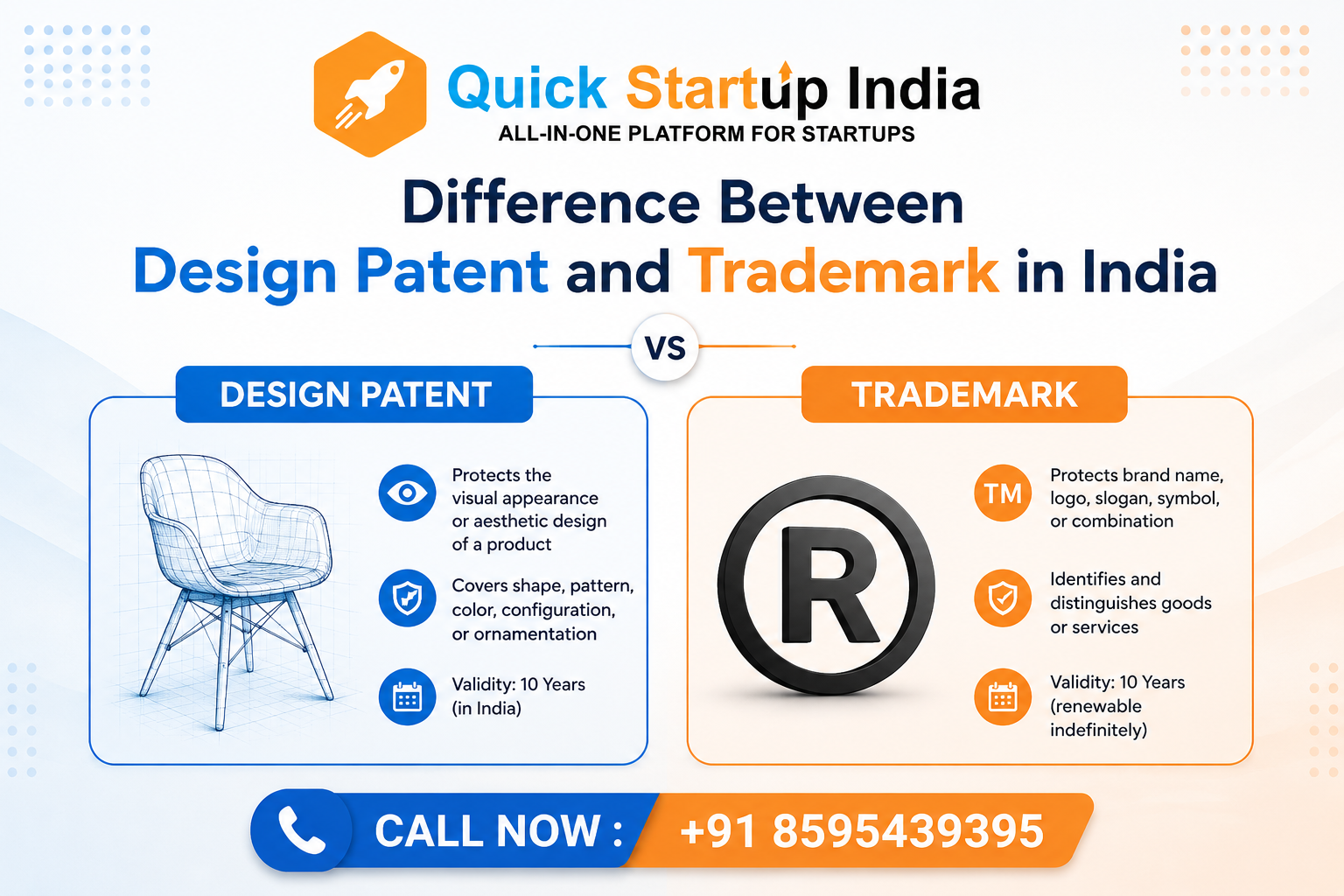
Design registration protects the visual appearance of a product for a limited period to give the creator a commercial head start in the market. It is fundamentally about the aesthetic features of an article as a manufactured object.
Trademark registration protects a distinctive sign that functions as an identifier of commercial origin for an indefinite period through successive renewals. It is fundamentally about the consumer’s ability to identify whose goods or services they are purchasing.
This foundational distinction explains almost every other difference between the two systems. Design registration rewards creative investment in product aesthetics with a temporary exclusive right. Trademark registration rewards investment in brand building by permanently protecting the consumer’s ability to identify and trust a specific commercial source.
Design Registration in India: The Full Picture
Governing Law
Design registration in India is governed by the Designs Act, 2000 and the Designs Rules, 2001 as amended. The Act came into force on 11 May 2001, replacing the Designs Act, 1911. Applications are processed by the Design Wing of the Patent Office, with the Patent Office headquarters in Kolkata and branch offices in Mumbai, Delhi, and Chennai.
What Design Registration Protects
Under the Designs Act, a registrable design is the features of shape, configuration, pattern, ornamentation, or composition of lines or colours applied to any article by any industrial process, whether in two dimensions, three dimensions, or both, that in the finished article appeal to and are judged solely by the eye.
The key elements of this definition deserve attention.
Shape and configuration cover the three-dimensional form of a product: the curved body of a smartphone, the ergonomic grip of a kitchen knife, the distinctive silhouette of a luxury handbag, the unique form of an automobile door handle.
Pattern and ornamentation cover surface decoration applied to an article: a textile print, a wallpaper design, a decorative motif on ceramics, a repeating graphic element on packaging.
Composition of lines or colours covers two-dimensional design elements: a colour combination applied to a product, a line pattern on flooring, a graphic arrangement on a fabric.
Applied to an article is a critical phrase. The design must be applied to a physical manufactured article. A standalone artistic work that is not applied to any article is protected by copyright, not design registration.
Judged solely by the eye means the features being protected must be aesthetic, not functional. A shape that is dictated entirely by the technical function of the article cannot be registered as a design. The purpose of design registration is to protect aesthetic creativity, not technical solutions.
What Cannot Be Registered as a Design
- Designs that are not new or original at the date of application; prior public disclosure destroys registrability.
- Designs that consist of or contain scandalous or obscene matter.
- Designs that incorporate the flag or emblem of any country.
- Features of shape or configuration that are solely dictated by the technical function of the article.
- Designs that are not visible in the finished article during normal use.
- Designs that are essentially literary or artistic works protected by copyright rather than features of an article.
Duration and Renewal
A design registration is initially valid for 10 years from the date of registration. It can be renewed once for an additional 5 years, giving a maximum total protection period of 15 years. After the maximum 15-year term, the design enters the public domain permanently. There is no mechanism to extend protection beyond 15 years under the Designs Act.
This fixed maximum term is one of the most important practical differences between design registration and trademark registration, which can be renewed indefinitely.
Rights Conferred by Design Registration
The registered proprietor has the exclusive right to apply the registered design to any article in the registered class. Any person who applies the registered design or any fraudulent or obvious imitation of it to an article for the purpose of sale without the licence of the registered proprietor is guilty of piracy of the registered design.
Remedies for design piracy include injunction, damages, and a statutory penalty of up to Rs. 50,000 per registered design per infringement, payable to the registered proprietor in lieu of damages.
For design registration services across all product categories, We handles complete design registration applications including responses to examination objections.
Trademark Registration in India: The Full Picture
Governing Law
Trademark registration in India is governed by the Trade Marks Act, 1999 and the Trade Marks Rules, 2017. The Trade Marks Registry operates under the Office of the Controller General of Patents, Designs and Trade Marks, with Registry offices in Mumbai, Delhi, Chennai, Kolkata, and Ahmedabad.
What Trademark Registration Protects
A trademark is any sign capable of being represented graphically and capable of distinguishing the goods or services of one person from those of others. The sign can be a word, a name, a device (logo or graphic), a label, a numeral, a colour or combination of colours, a shape of goods, a packaging, a combination of colours, or any combination of these.
The critical concept in trademark law is distinctiveness: the mark must function as a badge of origin, identifying to consumers the commercial source of the goods or services and distinguishing them from goods or services from other sources.
Word marks protect the brand name in plain text across all fonts and styles.
Device marks protect logos, graphic elements, and visual designs as source identifiers.
Three-dimensional marks protect distinctive shapes of products or packaging that have acquired the ability to identify commercial origin.
Colour marks protect distinctive colour combinations that consumers associate with a specific brand.
Sound marks and smell marks are registrable under the Act in theory, though these are rare in practice.
What Cannot Be Registered as a Trademark
- Marks devoid of any distinctive character.
- Marks that describe the quality, quantity, kind, geographical origin, or other characteristics of the goods or services.
- Marks that have become generic through common use in the trade.
- Marks that are deceptive or likely to cause confusion.
- Marks that are contrary to public policy or morality.
- Marks that incorporate state emblems, national flags, or official signs.
- Marks identical or similar to earlier registered marks for identical or similar goods or services.
- The shape of goods that results solely from the nature of the goods, is necessary for a technical result, or gives substantial value to the goods.
Duration and Renewal
A trademark registration is initially valid for 10 years from the date of application. It can be renewed indefinitely for successive 10-year periods on payment of the renewal fee. A trademark that is consistently used and renewed never expires. The oldest trademarks in commercial use today are centuries old.
This indefinite renewable duration is one of the most powerful features of trademark registration, distinguishing it fundamentally from design registration’s 15-year maximum term.
Rights Conferred by Trademark Registration
The registered proprietor has the exclusive right to use the mark in relation to the goods or services for which it is registered, and to prevent third parties from using an identical or similar mark for identical or similar goods or services in a manner likely to cause confusion among the public.
For well-known marks, protection extends further: even for dissimilar goods or services, use of a mark that takes unfair advantage of or is detrimental to the distinctive character or reputation of the well-known mark can be prevented.
Remedies for trademark infringement include injunction, damages or account of profits, delivery up and destruction of infringing goods, and criminal prosecution for trademark counterfeiting.
Side-by-Side Comparison
| Dimension | Design Registration | Trademark Registration |
|---|---|---|
| Governing law | Designs Act, 2000 | Trade Marks Act, 1999 |
| Administering authority | Design Wing, Patent Office (Kolkata) | Trade Marks Registry (5 offices) |
| What is protected | Visual appearance of a product: shape, pattern, ornamentation, colour composition | Sign that identifies commercial origin: word, logo, shape, colour as brand identifier |
| Core requirement | Novelty and originality of the design | Distinctiveness of the mark as a source identifier |
| Purpose of protection | Protects aesthetic creativity in product design | Protects consumer ability to identify commercial origin |
| Duration | 10 years initially, renewable once for 5 years; maximum 15 years total | 10 years initially, renewable indefinitely |
| Post-expiry status | Design enters public domain permanently | Can be restored through restoration application; if lapsed beyond restoration window, fresh application required |
| Registration authority | Patent Office (Kolkata head office) | Trade Marks Registry (Mumbai, Delhi, Chennai, Kolkata, Ahmedabad) |
| Number of registrations | One registration per article per design | Can register same mark in multiple classes |
| Use requirement | No requirement to use the design after registration | Risk of cancellation for non-use for 5 consecutive years |
| Protection against functional shapes | No; purely functional shapes cannot be registered | No; shapes that give substantial value to goods are excluded |
| Protection against independent creation | Yes; independent creation of the same design is still infringement | Yes; independent adoption of a similar mark is still infringement |
| International protection | National filing in each country; India not yet a Hague System member | Madrid Protocol available for international trademark filings |
| Enforcement remedy | Injunction, damages, Rs. 50,000 penalty per design per infringement | Injunction, damages, account of profits, criminal prosecution |
When Design Registration Is the Right Choice
Design registration is the right tool when the primary objective is to protect the aesthetic appearance of a specific product during its commercially relevant life.
Product Launches in Imitation-Prone Markets
In product categories where competitors quickly copy successful designs, design registration provides immediate, strong protection that is easier to enforce than passing off claims. Consumer goods, furniture, fashion accessories, electronic device enclosures, packaging, and industrial components are all categories where design piracy is common and design registration provides meaningful protection.
Short to Medium Commercial Lifespan Products
For products with commercial lives of 5 to 15 years, design registration’s maximum 15-year term may cover the entire relevant period. Fashion-driven categories, technology accessories, and trend-sensitive consumer goods fall into this category.
Protection Against Obvious Copies
Design registration allows enforcement against any fraudulent or obvious imitation of the registered design. The standard for infringement in design law focuses on the visual impression created by the designs on an informed user, not on the likelihood of consumer confusion about commercial origin. This makes design registration effective against obvious product copying even where the copying does not create confusion about brand identity.
Creating a Protectable Asset Before Trade Mark Distinctiveness Is Established
A new product design can be registered as a design immediately. A shape trademark requires evidence that the shape has acquired distinctiveness as a source identifier through use, which takes time. For the early years of a product’s commercial life, design registration provides the protection while the trademark distinctiveness is being built.
When Trademark Registration Is the Right Choice
Trademark registration is the right tool when the primary objective is to protect a brand identifier that distinguishes the business’s goods or services from those of competitors, with an indefinite duration that grows in value as the brand builds recognition.
Logo and Brand Name Protection
Every business needs trademark protection for its core brand name and logo. This is not a situation where design registration is an alternative; trademark registration is the appropriate and necessary form of protection for brand identifiers.
Distinctive Shapes That Function as Brand Identifiers
When a product shape is so distinctive and so strongly associated with a specific brand that consumers use it to identify the brand’s goods, it may be protectable as a three-dimensional trademark. Classic examples include distinctive bottle shapes, product configurations, and packaging forms that consumers recognise as brand indicators without seeing any logo or name. Trademark protection for such shapes requires establishing that the shape has acquired distinctiveness through use; it is not available from the date of product launch in the way design registration is.
Long-Term Brand Asset Protection
A trademark that is consistently used and renewed becomes more valuable over time. Brand recognition builds, consumer association deepens, and the mark’s distinctive character strengthens. Trademark registration preserves and protects this accumulated value indefinitely. For any brand element that the business intends to use for the long term, trademark registration is essential.
Protection Across a Range of Goods and Services
A trademark can be registered in multiple classes covering all the goods and services the business offers or intends to offer. Design registration is specific to the particular article to which the design is applied. For businesses with broad product and service portfolios, trademark registration’s multi-class coverage is a significant advantage.
The Overlap Zone: When Both Registrations Are Appropriate
The most sophisticated IP protection strategy for distinctive product designs uses both design registration and trademark registration in combination, each for what it does best.
The Classic Overlap Scenario
Consider a consumer goods company that launches a product with a highly distinctive shape, such as an unusually shaped bottle for a premium beverage, or an ergonomically distinctive kitchen appliance. At launch:
Design registration is filed immediately to protect the visual appearance of the product from day one, providing strong protection against obvious imitation during the critical commercial launch period.
Simultaneously, the company begins using the shape consistently, prominently, and exclusively, building consumer recognition of the shape as a brand identifier.
After several years of consistent use, when the shape has acquired the distinctiveness necessary to function as a trademark, a three-dimensional trademark application is filed. Evidence of acquired distinctiveness, including sales figures, advertising materials, and consumer surveys, supports the application.
The design registration protects the shape during the early years when trademark distinctiveness is being established. The trademark registration then provides indefinite protection going forward. By the time the design registration’s 15-year term expires, the trademark registration is firmly in place, ensuring continuity of protection.
This layered approach is the gold standard for protecting distinctive product shapes and represents the strategy adopted by many leading consumer brands.
Protecting Logo Designs
A new logo created by a business should be protected both as a device trademark (protecting it as a source identifier) and potentially as a design registration (protecting the visual appearance of the logo as an artistic work applied to any article bearing the logo). In practice, copyright protection (which arises automatically) combined with trademark registration is typically sufficient for logos. Design registration for logos is less commonly pursued because trademark registration usually provides adequate protection for the source-identifying function of a logo.
Common Mistakes in Choosing Between Design and Trademark Protection
Relying on design registration alone for a brand-building element. A business that registers only the design of its distinctive product shape and does not pursue trademark registration faces the loss of all protection when the 15-year design term expires. If the shape has become central to the brand’s identity, the loss of protection is commercially significant and permanently irreversible.
Attempting to trademark a purely functional shape. The Trade Marks Act specifically excludes shapes that result solely from the nature of the goods, are necessary for a technical result, or give substantial value to the goods. A shape that is entirely functional cannot be trademarked; protection for functional innovations must be sought through the patent system.
Not registering the design before public disclosure. The Designs Act requires the design to be new at the date of registration. Publicly displaying, selling, or publishing the design before filing destroys novelty and makes the design ineligible for registration. Design registration must be filed before any public disclosure.
Assuming trademark registration covers the product design without evidence of distinctiveness. A shape trademark requires either inherent distinctiveness (rarely achievable for product shapes) or acquired distinctiveness through use. Filing a shape trademark application without adequate evidence of acquired distinctiveness typically results in examination objection and may ultimately fail. Build the evidence of use before filing.
Confusing the Designs Act registration with a patent. Design registration does not protect the functional or technical aspects of a product. A design that is also technically innovative needs both design registration (for aesthetic protection) and patent protection (for functional protection). These are separate registrations under separate statutes.
The Section 15 Interaction: Design Registration and Copyright
An important interaction between design registration and copyright that affects both frameworks is worth understanding. Section 15 of the Designs Act provides that once a design has been registered and applied industrially to more than 50 articles, the copyright in the corresponding artistic work ceases to be available in relation to those articles.
This means that for a business that registers its product design and produces it industrially, the copyright that originally subsisted in the design drawing or artwork is extinguished as a basis for protection of the industrial article. The design registration becomes the only statutory protection available for the article’s appearance during the 15-year term. After the term expires and the design enters the public domain, neither the design registration nor the copyright in the underlying artistic work (in relation to the industrial article) remains available.
This makes the timely filing and management of trademark registration for distinctive product shapes even more important: trademark registration may be the only form of registered IP protection available for the shape after the design term expires.
The Role of Copyright in the Design-Trademark Framework
Copyright completes the IP protection framework for creative visual elements in contexts where design registration and trademark registration each have limitations.
Copyright protects original artistic works automatically from creation, without registration, for the author’s lifetime plus 60 years. For works that have not been applied industrially to more than 50 articles (the Section 15 threshold), copyright continues to subsist alongside any design registration.
For logos, marketing materials, packaging artwork, and other visual elements that are not primarily applied to manufactured articles, copyright protection is available without any registration requirement and provides the initial layer of protection from the moment of creation.
For full protection of a distinctive visual brand element, the optimal approach is copyright (automatic from creation), design registration (for the article’s visual appearance during the commercial launch period), and trademark registration (for the brand identity function, indefinitely renewable).
Frequently Asked Questions
What is the main difference between a design registration and a trademark?
The primary difference is that a design registration protects the appearance of a product, while a trademark protects the brand identity associated with goods or services. A design focuses on how a product looks, whereas a trademark focuses on how consumers recognize and identify a business or its offerings in the marketplace.
What types of features are protected by each?
A design registration protects aesthetic features such as shape, patterns, contours, and ornamental aspects of a product. A trademark protects distinctive identifiers such as names, logos, labels, taglines, symbols, and other elements that indicate the commercial origin of goods or services.
How long does protection last?
In India, a registered design is protected for an initial period of 10 years from the registration date and can be extended by an additional five years, providing a maximum protection period of 15 years. A trademark registration is initially valid for 10 years and can be renewed indefinitely every 10 years as long as it remains in use and renewal requirements are met.
Can the same product have both design and trademark protection?
Yes. Many businesses use both forms of intellectual property protection. For example, a company may register the unique shape or appearance of a product under design law while simultaneously protecting its brand name and logo through trademark registration.
Which protection is better for my business?
The choice depends on what you want to protect. If the commercial value lies in the product’s unique appearance, design registration may be appropriate. If the value lies in brand recognition and customer goodwill, trademark protection is usually more suitable.
Conclusion
Design registration and trademark registration are complementary tools in the IP protection toolkit, not alternatives between which a business must choose. They protect different things, operate over different timeframes, and serve different strategic purposes.
Design registration is the right first step for any new product with a distinctive visual appearance that needs protection from copying during its commercial launch period. It provides immediate, strong protection that does not require evidence of consumer recognition, and it is available from the first day the design exists, provided the application is filed before any public disclosure.
Trademark registration is the right long-term strategy for any visual element that functions or will function as a brand identifier. It provides indefinitely renewable protection that grows in value as the brand builds recognition, and it is the only form of registered IP protection that can last as long as the brand itself.
For distinctive product shapes, packaging designs, and visual elements that serve both functions simultaneously, the combination of design registration followed by trademark registration, with the transition planned from the outset, delivers the most comprehensive and commercially valuable IP protection available in India.
Understanding the distinction between these two forms of protection, and building an IP strategy that uses each for its specific strengths, is one of the most practically valuable things a business can do to protect the visual assets it has worked hard to create.
Protect the appearance with design registration. Protect the brand identity with trademark registration. Use both together where the visual element serves both purposes.
Get Expert Design Registration and Trademark Protection Support
🟡 Legal Tax provides complete design registration, trademark registration, copyright protection, patent filing, and IP portfolio strategy services for businesses across all industries and product categories.
👉 Design Registration 👉 Trademark Registration 👉 Trademark Renewal 👉 Trademark Objection Reply 👉 Trademark Hearing 👉 Trademark Opposed 👉 Trademark Assignment 👉 Patent Registration 👉 Patent Renewal 👉 Copyright Registration 👉 IP Transaction 👉 Brand Protection and Anti-Counterfeiting 👉 Litigation 👉 Arbitration 👉 Mediation
🟡 IT and Digital Services
👉 Website Development 👉 SEO Services 👉 Social Media Marketing 👉 Logo Design 👉 Google and Facebook Ads 👉 Branding Services
📞 Call Now: +91 8595439395 🕐 Free Consultation: Monday to Saturday, 9 AM to 6 PM

Anjali is a Digital Marketing Expert at Quick Startup India who builds websites that rank and convert. She specializes in SEO-driven web development, helping people find the right legal help online.


