

Views: 5
Table of Contents
- 1 Introduction
- 2 The FSSAI Framework: Why Three Tiers Exist
- 3 Tier 1: FSSAI Basic Registration
- 4 Tier 2: FSSAI State Licence
- 5 Tier 3: FSSAI Central Licence
- 6 Documents Required for Each Tier
- 7 FSSAI Licence Fee Structure
- 8 Determining the Correct Tier: A Decision Framework
- 9 Upgrading Your FSSAI Registration or Licence
- 10 Consequences of Non-Compliance
- 11 Ongoing Compliance Obligations After Registration or Licensing
- 12 Special Categories and Their FSSAI Requirements
- 13 Frequently Asked Questions
- 14 Conclusion
- 15 Get Expert FSSAI Registration and Licensing Support
Introduction
Every business in India that manufactures, processes, stores, distributes, imports, or sells food products must be registered or licensed under the Food Safety and Standards Authority of India framework. This is not an optional compliance. It is a legal requirement under the Food Safety and Standards Act, 2006, and operating a food business without the appropriate FSSAI registration or licence is a criminal offence that attracts prosecution, fines, and closure of the business.
Yet the FSSAI framework has three distinct tiers, and one of the most common compliance errors made by food business operators is obtaining the wrong tier of registration or licence for their scale and nature of operations. A business that needs a State Licence operating under a Basic Registration is exposed to regulatory action. A business that has grown beyond the Central Licence threshold and is still operating on a State Licence is in violation. A business that has obtained a Central Licence when a State Licence would suffice has incurred unnecessary compliance costs.
The three tiers are Basic Registration, State Licence, and Central Licence. They are differentiated primarily by the annual turnover and production capacity of the food business, and by certain specific categories of business activity that require a particular tier regardless of turnover. Understanding which tier applies to your specific business, what the registration and licensing process involves for each, what ongoing compliance obligations each creates, and what the consequences of operating at the wrong tier are is the foundation of FSSAI compliance for any food business operator.
This guide is written for food business owners, restaurant operators, food manufacturers, traders, importers, e-commerce food sellers, cloud kitchen operators, and compliance managers who need a clear, practical understanding of the FSSAI registration and licensing framework in India in 2026.
For complete FSSAI registration and licensing support across all tiers and all states, the compliance team at Quick Startup India works with food businesses across all sectors.
The FSSAI Framework: Why Three Tiers Exist
The Food Safety and Standards Act, 2006 established the Food Safety and Standards Authority of India as the apex regulatory body for food safety in India. The Act and the regulations made under it prescribe that all food business operators must be registered or licensed before commencing food business operations.
The three-tier structure exists because the regulatory burden and scrutiny appropriate for a roadside vendor selling home-made snacks is fundamentally different from the scrutiny appropriate for a large food manufacturer supplying products across India or exporting internationally. The framework calibrates the compliance obligation to the scale and nature of the business.
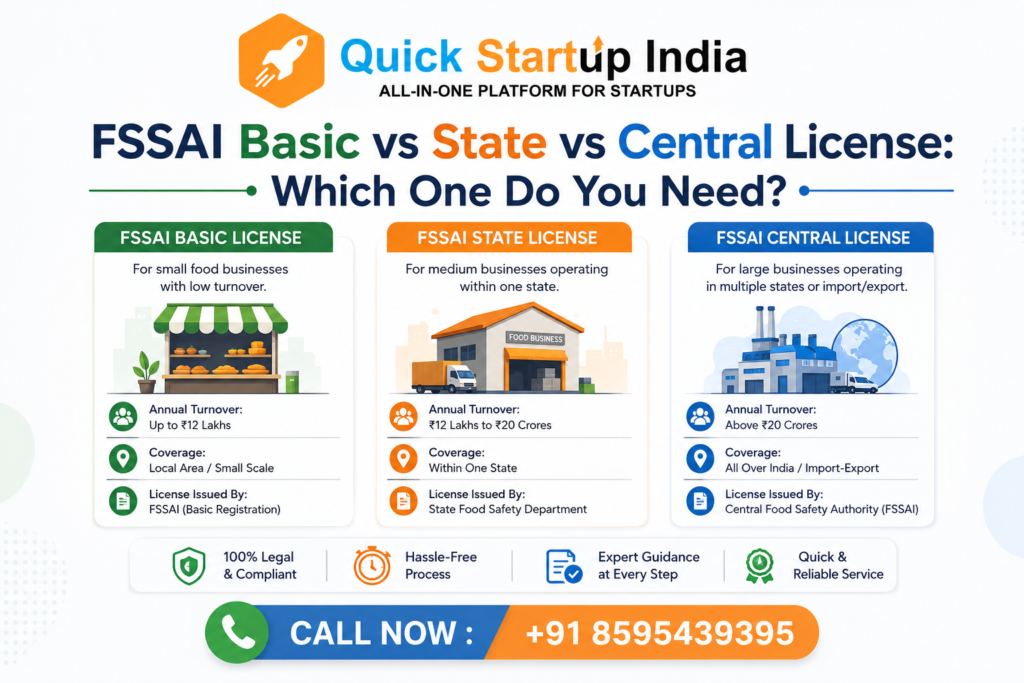
The three tiers are:
FSSAI Basic Registration for small food businesses below the prescribed turnover threshold.
FSSAI State Licence for medium-scale food businesses operating within a single state above the Basic Registration threshold, or for specific categories of business at any scale within a state.
FSSAI Central Licence for large-scale food businesses, businesses operating in multiple states, businesses operating from centrally administered locations, importers, exporters, and certain specific categories of food business regardless of scale.
Each tier is issued by a different authority: Basic Registration and State Licences are issued by the State Food Safety authorities, while Central Licences are issued by the FSSAI at the central level.
Tier 1: FSSAI Basic Registration
Who Qualifies for Basic Registration
Basic Registration is the entry-level tier designed for small food business operators with limited turnover and local operations.
A food business operator qualifies for Basic Registration if their annual turnover from food business activities does not exceed Rs. 12 lakh per year.
Categories of businesses typically operating under Basic Registration include:
- Petty food manufacturers producing food products at home or in small premises for local sale.
- Small retail shops, grocery stores, and provision stores with turnover below the threshold.
- Hawkers and street food vendors.
- Temporary stallholders at local fairs, exhibitions, or markets.
- Small caterers serving limited local customers.
- Small food storage operators below the threshold.
- Dhaba operators and small eateries below the turnover threshold.
What Basic Registration Does Not Cover
Basic Registration is not available for:
- Businesses with annual turnover exceeding Rs. 12 lakh.
- Businesses engaged in manufacturing activities above the prescribed daily production capacity.
- Businesses operating in multiple states, which always require at least a State Licence in each state of operation.
- Any business category that specifically requires a State or Central Licence regardless of turnover.
The Basic Registration Process
Basic Registration is obtained from the Designated Officer (DO) of the Food Safety Department of the relevant state or union territory. The process:
- Submit Form A (the application for Basic Registration) to the designated officer.
- Attach required documents: identity proof of the proprietor, address proof of the business premises, and a passport-size photograph.
- Pay the prescribed registration fee, which varies by state but is typically modest.
- The designated officer examines the application and may conduct an inspection of the premises.
- If satisfied, the registration certificate is issued.
The registration certificate must be displayed prominently at the food business premises. The registration number must be displayed on all food products manufactured or packaged under the registration.
Validity and Renewal of Basic Registration
Basic Registration is valid for a period of 1 to 5 years as chosen by the applicant at the time of application. A business that anticipates remaining in the basic registration category for several years can apply for a 5-year registration at the outset, reducing the administrative burden of annual renewal.
Renewal must be filed before the expiry date. Operating after expiry without renewal is a compliance violation.
For FSSAI Basic Registration support, We handles the complete registration process for small food businesses across all states.
Tier 2: FSSAI State Licence
Who Requires a State Licence
A State Licence is required for food business operators that exceed the Basic Registration threshold but do not meet the criteria for a Central Licence, and for specific categories of business that require State Licence regardless of turnover.
Annual turnover-based threshold. A food business with annual turnover exceeding Rs. 12 lakh and not exceeding the Central Licence threshold requires a State Licence.
Production capacity thresholds. Businesses engaged in food manufacturing or processing with daily production capacity above specified limits require a State Licence. The capacity thresholds vary by product category and are prescribed in the Food Safety and Standards (Licensing and Registration of Food Businesses) Regulations, 2011.
Specific business categories requiring State Licence. The following categories require a State Licence regardless of whether the turnover-based threshold is met:
- Hotels with 1 to 4 stars.
- Restaurants, dhabas, canteens, and food service establishments above the small operator threshold.
- Boarding houses serving food.
- Food service operations in religious institutions serving more than 100 persons daily on a regular basis.
- Retail shops above the Basic Registration threshold.
- Vegetable oil processing and production units (by expeller process) with a certain capacity.
- Slaughterhouses not requiring Central Licence.
- Milk chilling units handling specified quantities.
- Proprietary food manufacturing up to specified capacity.
What State Licence Covers
A State Licence covers all food business activities of the licensed entity within the state that issued the licence. A business that manufactures, warehouses, and distributes within a single state under a State Licence is fully covered for those operations in that state.
If the same business establishes operations in another state, a separate State Licence (or Central Licence if applicable) must be obtained for the operations in that other state.
The State Licence Application Process
State Licences are applied for through the FSSAI’s Food Licensing and Registration System (FLRS) portal at foscos.fssai.gov.in. The process is conducted online:
- Create an account on the FLRS portal.
- Select the appropriate licence type (State Licence) and the state of operation.
- Complete the application in Form B, providing details of the food business including the nature of business, products handled, production capacity, premises details, and key persons.
- Upload required documents (detailed in the documents section below).
- Pay the prescribed licence fee online.
- The application is processed by the State Food Safety authority; an inspection of the premises may be conducted.
- If the application is found to be in order and the premises meet the required standards, the State Licence is issued.
Validity and Renewal of State Licence
A State Licence is valid for 1 to 5 years as chosen by the applicant. Renewal applications must be filed at least 30 days before the licence expiry date. Operating after licence expiry without renewal is a compliance violation attracting penalties.
For FSSAI State Licence registration and renewal, We provides complete State Licence application and renewal services across all states.
Tier 3: FSSAI Central Licence
Who Requires a Central Licence
A Central Licence is required for food business operators in any of the following categories, regardless of whether the state licence thresholds are met in individual states.
Turnover threshold. Any food business with annual turnover exceeding Rs. 20 crore requires a Central Licence.
Production capacity thresholds. Food manufacturers with daily production capacity above the prescribed thresholds for their specific product category require a Central Licence. The thresholds are prescribed in the FSSAI regulations and vary significantly by product.
Multi-state operations. Any food business that has manufacturing, processing, or storage operations in more than one state requires a Central Licence for its head office and a licence or registration for each state of operation.
Importers and exporters. Every business that imports food products into India or exports food products from India requires a Central Licence. This requirement applies regardless of the volume or value of import or export activity.
E-commerce food businesses. Food businesses operating through e-commerce platforms, including online food delivery aggregators and businesses selling food products through their own websites to customers across India, require a Central Licence.
Specific location-based categories. The following categories require a Central Licence based on their location or nature rather than solely on scale:
- Food businesses operating from or in central government premises.
- Food businesses operating in airports and seaports.
- Food businesses on railways.
- Food businesses in defence establishments.
- Food businesses operating in the premises of central government agencies.
- Hotels with 5 stars or above.
- Large food manufacturers and processors above the prescribed production capacity thresholds.
- Milk and milk product businesses above specified processing capacities.
- Vegetable oil processing and production units above specified capacities.
- Meat processing and packaging units above specified capacities.
- Food businesses engaged in the processing of proprietary food above specified capacity.
- Wholesale markets with a turnover above the Central Licence threshold.
What Central Licence Covers
A Central Licence covers the food business activities of the licensed entity for the specific premises and activities mentioned in the licence. For a business with operations in multiple states, the Central Licence covers the head office or principal place of business; separate registrations or licences are needed for branch premises in different states.
For importers, the Central Licence covers all import activities regardless of the port of import, provided the importer applies to the FSSAI central office.
The Central Licence Application Process
Central Licences are applied for through the same FLRS portal (foscos.fssai.gov.in) as State Licences, but the application is routed to and processed by the Central Licensing Authority at FSSAI headquarters in Delhi.
- Create or log into an account on the FLRS portal.
- Select Central Licence as the licence type.
- Complete Form B with detailed information about the food business, including all premises, products, production capacities, and key management persons.
- Upload required documents.
- Pay the Central Licence fee, which is higher than the State Licence fee.
- The application is reviewed by the Central Licensing Authority; premises inspections may be conducted.
- If satisfied, the Central Licence is issued.
Validity and Renewal of Central Licence
Central Licences are valid for 1 to 5 years as chosen. Renewal must be filed at least 30 days before expiry.
Documents Required for Each Tier
Documents for Basic Registration
- Form A (application for registration).
- Photo identity proof of the proprietor (Aadhaar, PAN, passport, voter ID).
- Address proof of the business premises (rent agreement, utility bill, or ownership document).
- Passport-size photograph of the proprietor.
Documents for State Licence
- Form B (application for licence).
- Photo identity proof of the proprietor, partners, or directors.
- Proof of possession of the business premises (rent agreement or ownership document).
- Partnership deed, certificate of incorporation, or other entity constitution document as applicable.
- List of food products to be manufactured or handled.
- Food safety management system plan or certificate, if available.
- Source of water supply for the business premises.
- Recall plan (for manufacturers).
- Form IX: Nomination of persons by a company or firm.
- Authority letter from the proprietor, partners, or board of directors nominating a responsible person.
- Analysis report of water used in the food business, if applicable.
- Declaration by the proprietor or authorised signatory.
- Certificate from the Ministry of Tourism (for hotels applying on the basis of star rating).
- Blueprint or layout plan of the food processing unit, if applicable.
Documents for Central Licence
All documents required for State Licence, plus:
- Certificate of incorporation and Memorandum and Articles of Association (for companies).
- List of directors with DIN and contact details.
- Import Export Code (for importers and exporters).
- NOC from the municipality or local body.
- Proof of turnover such as audited financial statements or CA certificate, where turnover is the basis of Central Licence requirement.
- Food safety management system documentation (more detailed than for State Licence).
- Details of technical staff including food safety supervisors.
- List of all food products with their specifications.
- Declaration of compliance with FSSAI regulations.
FSSAI Licence Fee Structure
The fee for FSSAI registration and licence varies by tier and by the duration chosen. The following represents the standard fee structure as of 2026; verify current fees on the FSSAI portal as fees are periodically revised:
| Licence Type | Annual Fee (Approximate) |
|---|---|
| Basic Registration | Rs. 100 per year |
| State Licence (manufacturer) | Rs. 2,000 to Rs. 5,000 per year depending on production capacity |
| State Licence (trader, retailer) | Rs. 2,000 to Rs. 3,000 per year |
| Central Licence (manufacturer) | Rs. 7,500 per year |
| Central Licence (importer) | Rs. 7,500 per year |
| Central Licence (large retailer, e-commerce) | Rs. 7,500 per year |
For multi-year registrations, the total fee is the annual fee multiplied by the number of years.
Determining the Correct Tier: A Decision Framework
Step 1: Identify Your Annual Turnover
Annual turnover from food business activities is the starting point for determining the correct tier. Calculate or estimate your annual turnover:
- Below Rs. 12 lakh: Basic Registration may be appropriate, subject to step 2.
- Rs. 12 lakh to Rs. 20 crore: State Licence is likely appropriate, subject to step 2.
- Above Rs. 20 crore: Central Licence is required, subject to confirmation in step 2.
Step 2: Check Category-Specific Requirements
Regardless of turnover, certain activities always require a specific tier:
If your business imports or exports food: Central Licence is required.
If your business sells food products across multiple states through e-commerce or direct distribution: Central Licence is required.
If your business operates a 5-star or above hotel: Central Licence is required.
If your business operates a 1 to 4-star hotel: State Licence is required.
If your business operates from central government premises, airports, seaports, or railways: Central Licence is required.
If your production capacity exceeds the Central Licence thresholds for your specific product category: Central Licence is required regardless of turnover.
Step 3: Verify Multi-State Requirements
If your business has premises or operations in more than one state:
- A Central Licence is required for the head office or principal manufacturing unit.
- A State Licence or Basic Registration (as appropriate based on the scale of operations in that state) is required for each additional state of operation.
Step 4: Apply for the Correct Tier
Once you have determined the correct tier through steps 1 to 3, apply for that tier from the outset. Do not apply for a lower tier with the intention of upgrading later; the regulatory risk of operating at the wrong tier during the interval before upgrade is not worth the short-term saving.
Upgrading Your FSSAI Registration or Licence
As a food business grows, it may reach thresholds that require upgrading from Basic Registration to State Licence, or from State Licence to Central Licence.
When to Upgrade
- When annual turnover crosses the Rs. 12 lakh threshold: upgrade from Basic Registration to State Licence.
- When annual turnover crosses the Rs. 20 crore threshold: upgrade from State Licence to Central Licence.
- When production capacity exceeds the State Licence thresholds for your product category: upgrade to Central Licence.
- When operations expand to a second state: Central Licence becomes required for the principal premises.
- When the business begins importing or exporting: Central Licence is required.
How to Upgrade
Upgrading requires applying for the higher tier of licence through the FLRS portal and cancelling or not renewing the lower tier registration or licence once the higher tier licence is obtained. The business must not operate under the lower tier once it has crossed the threshold requiring the higher tier.
Consequences of Non-Compliance
Operating a food business without the appropriate FSSAI registration or licence, or operating at a lower tier than required, carries serious consequences under the Food Safety and Standards Act, 2006.
Penalties for Operating Without Registration or Licence
- Operating a food business without registration or licence: Fine up to Rs. 5 lakh.
- Manufacturing or selling unsafe food: Imprisonment up to 6 months and fine up to Rs. 1 lakh for minor violations; more serious penalties for cases involving death or grievous hurt.
- Misleading advertisement relating to food: Fine up to Rs. 10 lakh.
Closure and Seizure
Food Safety Officers have the power to inspect food business premises, take samples, seize and destroy unsafe food, and recommend closure of premises that operate without appropriate registration or licence or that do not meet food safety standards.
Impact on Business Operations
Unregistered or unlicensed food businesses cannot:
- Legally supply to registered retailers, hospitality establishments, and institutional buyers who require valid FSSAI documentation from their suppliers.
- List products on major e-commerce platforms that require FSSAI licence numbers on product listings.
- Export food products (Central Licence required).
- Obtain APEDA registration for agricultural and food product exports.
- Access many government procurement and institutional supply contracts.
Ongoing Compliance Obligations After Registration or Licensing
Obtaining the FSSAI registration or licence is the beginning of compliance, not its end.
Displaying the Licence Number
The 14-digit FSSAI licence number must be displayed on all food product packaging, labels, and marketing materials. For restaurants and food service establishments, the licence must be displayed prominently at the premises.
Food Safety Management
Licensed food businesses, particularly those with State and Central Licences, must implement food safety management systems appropriate to their scale and nature of operations. Central Licence holders are required to have a documented food safety management system and may be required to obtain HACCP or ISO 22000 certification depending on the nature of their products and the requirements of their buyers.
Record Maintenance
Food businesses must maintain records of:
- Raw material purchases and sources.
- Production records (for manufacturers).
- Distribution and sales records.
- Pest control records.
- Equipment calibration and maintenance records.
- Food safety training records for employees.
- Any complaints received and actions taken.
Records must be maintained for the period specified in the FSSAI regulations and made available to Food Safety Officers on inspection.
Return Filing
Annual returns must be filed by certain categories of licensed food businesses. Manufacturers and importers are typically required to file an annual return in the prescribed form with the licensing authority.
Renewal
All registrations and licences must be renewed before expiry. Renewal applications must be filed at least 30 days before the expiry date. Operating after expiry is a violation regardless of whether a renewal application is pending.
Special Categories and Their FSSAI Requirements
Cloud Kitchens and Online Food Delivery
Cloud kitchens operating food businesses and delivering through Swiggy, Zomato, or their own platforms require FSSAI registration or licence based on their turnover. A small cloud kitchen below Rs. 12 lakh may qualify for Basic Registration; most established cloud kitchens require State Licences. Platforms that aggregate multiple restaurants and food businesses require Central Licences as e-commerce food businesses.
Home-Based Food Businesses
Individuals selling home-prepared food through social media, WhatsApp groups, or local community channels are food business operators and require FSSAI registration. Most home-based food businesses qualify for Basic Registration if their annual turnover is below Rs. 12 lakh. As the business grows and turnover crosses the threshold, upgrading to State Licence becomes necessary.
Importers
Every importer of food products requires a Central Licence from FSSAI regardless of the volume or value of imports. The Import Export Code must also be linked to the FSSAI application. Imported food products must comply with FSSAI standards and labelling requirements. We also provides IEC registration services for businesses that require both an IEC and FSSAI Central Licence for import operations.
E-Commerce Sellers
Businesses selling food products through their own websites or through third-party e-commerce marketplaces require FSSAI registration or licence appropriate to their scale. A small home baker selling through Instagram and WhatsApp requires Basic Registration. A business selling packaged food products nationally through Amazon or Flipkart requires at minimum a State Licence and potentially a Central Licence depending on turnover and multi-state operations.
Catering Companies
Catering businesses operating at events, corporate offices, and institutions require FSSAI licences based on their scale. Small caterers serving local events below the turnover threshold require Basic Registration. Established catering companies with significant turnover require State Licences. Catering companies operating across multiple states require Central Licences.
Frequently Asked Questions
What is an FSSAI Basic Registration?
FSSAI Basic Registration is designed for small food businesses, startups, home-based food operators, petty retailers, and small-scale manufacturers with an annual turnover of up to ₹12 lakh. It is the simplest form of FSSAI registration and is suitable for businesses operating on a limited scale.
What is an FSSAI State License?
An FSSAI State License is required for medium-sized food businesses with an annual turnover exceeding ₹12 lakh but not exceeding ₹20 crore (for most businesses). It is issued by the respective state authority and applies to food manufacturers, restaurants, storage units, distributors, transporters, and other food-related businesses operating within a state.
What is an FSSAI Central License?
An FSSAI Central License is mandatory for large food businesses with an annual turnover exceeding ₹20 crore, importers, exporters, e-commerce food operators, large manufacturers, and businesses operating in multiple states. It is issued by the Central Licensing Authority and is generally required for businesses with a broader operational footprint.
What documents are required for FSSAI registration or licensing?
The documents generally include identity proof, address proof, passport-size photographs, business registration documents, proof of premises, food safety management plan, list of food products, equipment details, and other documents depending on the category of license. State and Central Licenses usually require more extensive documentation than Basic Registration.
How do I determine which FSSAI license I need?
The correct FSSAI category depends on factors such as annual turnover, business activities, production capacity, number of states of operation, and whether the business is involved in importing or exporting food products. Businesses should carefully evaluate their operations before applying to ensure compliance with FSSAI regulations.
Conclusion
The FSSAI registration and licensing framework is designed to calibrate compliance obligations to the scale and nature of food businesses. Basic Registration is appropriate for very small, locally operating food businesses. State Licence covers the broad middle range of food businesses operating within a single state. Central Licence covers large-scale operations, multi-state businesses, importers, exporters, e-commerce businesses, and specific categories of food business that require central regulatory oversight.
The most important compliance decision for any food business is to identify the correct tier from the outset and to monitor the business’s growth to upgrade when the relevant thresholds are crossed. Operating at the wrong tier, whether too low through oversight or misclassification, creates regulatory exposure that is entirely avoidable with proper compliance planning.
For businesses at any stage of growth, the FSSAI registration or licence is not merely a compliance checkbox. It is the legal foundation of the food business, a prerequisite for supply chain relationships, e-commerce listings, institutional contracts, and export activity, and the document that demonstrates to regulators, buyers, and consumers alike that the business takes food safety seriously.
Identify your correct tier. Register or licence before you operate. Renew before expiry. And upgrade when your business grows beyond the current tier’s limits.
Get Expert FSSAI Registration and Licensing Support
🟡 Quick Startup India provides complete FSSAI Basic Registration, State Licence, and Central Licence application, renewal, and compliance support for food businesses across all states and all sectors.
👉 FSSAI Registration 👉 FSSAI State Licence 👉 FSSAI Central Licence 👉 Import Export Code Registration 👉 MSME Registration 👉 GST Registration and Filing 👉 Private Limited Company Registration 👉 LLP Registration 👉 Startup Registration 👉 ISO Certification 👉 Legal Documentation and Drafting 👉 Income Tax Return
🟡 IT and Digital Services
👉 Website Development 👉 SEO Services 👉 Social Media Marketing 👉 Logo Design 👉 Google and Facebook Ads 👉 Branding Services
📞 Call Now: +91 8595439395 🕐 Free Consultation: Monday to Saturday, 9 AM to 6 PM

Anjali is a Digital Marketing Expert at Quick Startup India who builds websites that rank and convert. She specializes in SEO-driven web development, helping people find the right legal help online.


