

Views: 4
Table of Contents
- 1 Introduction
- 2 Step One: Assess the Situation Before Choosing a Route
- 3 Route One: The UDRP for Generic Top-Level Domains
- 4 Route Two: The INDRP for .in Domains
- 5 Route Three: Court Proceedings for Urgent or Comprehensive Relief
- 6 Recovering a Domain from a Former Employee or Partner
- 7 Negotiating Directly with the Registrant: When and How
- 8 Practical Steps After Recovering the Domain
- 9 Frequently Asked Questions
- 10 Conclusion
- 11 Get Expert Domain Name Recovery and Trademark Protection Support
Introduction
Losing access to a domain name, or discovering that someone else has registered a domain that incorporates your brand, is one of the more disorienting IP problems a business can face. The domain may have been registered by a cybersquatter waiting to sell it back at a premium, by a competitor deliberately diverting your traffic, by a former employee or partner who registered it before the relationship ended, or by someone who simply registered it in bad faith before your brand gained its current recognition. Whatever the specific scenario, the question the affected business needs answered quickly is: what can actually be done to get it back?
The answer depends on several factors that run through every domain name recovery case: whether you hold a registered trademark, how the domain registrant has been using it, which extension the domain was registered under, whether the registrant is identifiable, and how quickly you need resolution. In some cases, an administrative dispute resolution process can recover the domain within sixty days without court proceedings. In others, court action is needed for the full range of relief or for urgency that administrative processes cannot deliver. In still others, direct negotiation with the registrant, structured carefully to avoid creating a perverse incentive for future squatting, is the most practical first step.
This guide explains the specific legal routes available for domain name recovery in India, the criteria that must be met under each route, the practical steps involved, and how to approach each scenario including squatting, competitor diversion, expired domain recovery, and recovery from former employees or business partners.
For domain name dispute resolution, trademark registration, and IP enforcement support, Quick Startup India provides comprehensive domain and brand protection services.
Step One: Assess the Situation Before Choosing a Route
Before initiating any formal recovery process, a clear-eyed assessment of the specific facts shapes which route is actually available and which is most likely to succeed.
Who Registered the Domain and When
The identity of the registrant and the date of registration relative to the brand’s establishment are both significant. A registrant who registered a domain incorporating a well-known brand years after the brand was established, has no evident legitimate use for the domain, and is offering to sell it is a classic cybersquatting scenario with a relatively clear legal path. A registrant who registered the domain before the trademark was filed or the brand became known is in a considerably stronger position and the available routes are correspondingly narrower.
How the Domain Is Currently Being Used
Whether the domain is actively used (pointing to a website with content), passively held (registered but not pointing to any active content), or parked (pointing to an advertising or placeholder page) affects the bad faith analysis under the administrative dispute resolution frameworks and the urgency of the legal response. A domain being used to host a competing business, counterfeit products, or defamatory content about the brand creates more immediate harm than a passively held domain, making urgent court action more relevant in the former case.
Which Extension Is Involved
Whether the domain is registered under a generic top-level domain such as .com, .net, or .org (where the UDRP applies), the .in country code domain (where the INDRP applies), or a newer generic top-level domain, determines which administrative dispute resolution mechanism is available, with the procedural rules and timelines differing between the UDRP and INDRP processes as discussed in the broader guide to domain name trademark disputes.
Whether a Registered Trademark Exists
As discussed throughout the IP enforcement guides in this series, a registered trademark provides a significantly stronger and cleaner basis for domain recovery than relying on unregistered trademark rights or passing off principles, both under the administrative processes (where trademark rights are the standard basis of the complainant’s claim) and in court proceedings. Where no trademark registration exists, the strength of evidence needed to establish reputation and goodwill sufficient to support an unregistered rights claim is considerably higher.
For trademark registration to strengthen a domain recovery claim, We provides complete trademark registration services.
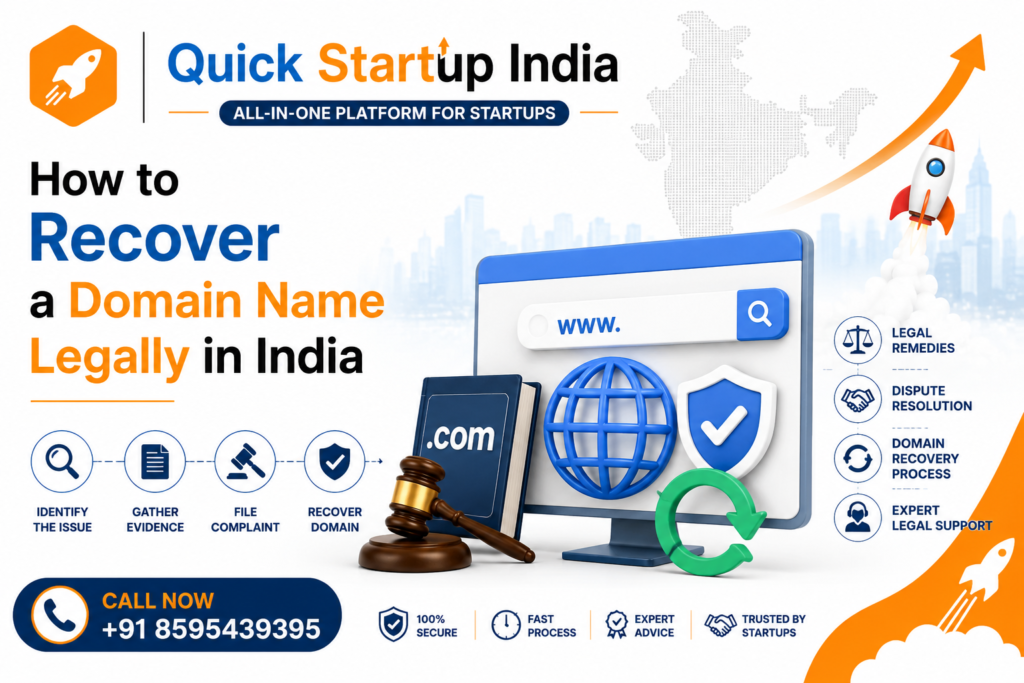
Route One: The UDRP for Generic Top-Level Domains
For domains registered under .com, .net, .org, and most new generic top-level domains, the Uniform Domain Name Dispute Resolution Policy provides the most commonly used route for domain recovery, offering a relatively fast, documents-only process that does not require court appearances.
The Three-Part Test the Complainant Must Satisfy
As explained in the domain name trademark disputes guide, a UDRP complainant must establish three elements: that the domain name is identical or confusingly similar to a trademark in which the complainant has rights; that the registrant has no rights or legitimate interests in the domain; and that the domain was registered and is being used in bad faith. All three must be established for the complaint to succeed.
Proving Bad Faith: The Most Contested Element
The bad faith element requires showing that the registrant registered and is using the domain with the intention of exploiting the complainant’s trademark rights, whether by selling it back to the trademark owner, disrupting the trademark owner’s business, attracting users for commercial gain by creating confusion, or another bad faith purpose recognised in UDRP jurisprudence. Passive holding of a domain that incorporates a well-known mark without any plausible legitimate use has been held to constitute bad faith use in many UDRP decisions, addressing the scenario where a squatter simply parks a domain rather than actively using it.
Building the UDRP Complaint
An effective UDRP complaint includes clear identification of the trademark rights on which the complaint is based, with registration details or evidence of unregistered rights, a detailed analysis of the similarities between the trademark and the domain name, evidence demonstrating the registrant’s lack of any plausible legitimate interest in the name, and evidence establishing bad faith, which may include screenshots of the domain’s use, evidence of the trademark’s reputation, any communications between the complainant and the registrant (such as a demand to purchase the domain), and in cases of deliberate diversion, evidence of the registrant’s awareness of the trademark.
Selecting the Right UDRP Provider
UDRP proceedings are administered by approved dispute resolution service providers, of which the World Intellectual Property Organization Arbitration and Mediation Center is the most widely used globally and the most relevant for Indian trademark owners filing complaints involving .com and other generic top-level domains. WIPO provides experienced panelists, a well-developed body of UDRP decisions for reference, and an online filing process accessible to parties anywhere in the world.
Outcome and Implementation
A successful UDRP complaint results in an order for transfer of the domain to the complainant, which the accredited registrar is required to implement after a brief waiting period (during which the losing respondent can challenge the decision in a court of competent jurisdiction if they wish to do so). Transfer of the domain is the standard remedy, and the entire process from filing to implementation typically takes sixty to ninety days for a standard proceeding without complications.
For UDRP complaint preparation and filing, We provides IP enforcement support including domain dispute proceedings.
Route Two: The INDRP for .in Domains
For domains registered under the .in country code top-level domain, the .IN Dispute Resolution Policy provides the applicable administrative dispute resolution mechanism, with proceedings administered by the .IN Registry.
Key Differences from the UDRP
As discussed in the broader domain disputes guide, the INDRP is structured similarly to the UDRP but with some procedural distinctions, including that INDRP proceedings result in an arbitral award rather than an administrative recommendation, giving the outcome the legal character of an arbitral award under Indian arbitration law, which can be challenged or enforced accordingly.
The Substantive Test Under the INDRP
The substantive test under the INDRP mirrors the UDRP’s three-part structure: identity or confusing similarity with the complainant’s trademark, lack of rights or legitimate interests in the registrant, and registration or use in bad faith. The INDRP’s formulation of the bad faith element has been noted to use “or” (registration or use in bad faith) rather than the UDRP’s “and” (registration and use in bad faith), which in some circumstances provides a slightly broader basis for establishing the bad faith requirement, though the practical significance of this distinction varies between cases.
Why .IN Recovery Matters for Indian Businesses
For businesses targeting the Indian market, securing and recovering the .in version of their domain is strategically important alongside the .com version, since Indian consumers and search engines increasingly treat the .in extension as a domestic authority signal. A competitor or squatter holding the .in version of your brand’s domain can meaningfully divert Indian traffic and undermine local brand recognition, making INDRP proceedings a relevant and worthwhile route for affected Indian businesses.
Route Three: Court Proceedings for Urgent or Comprehensive Relief
Where the administrative routes are insufficient, unavailable, or where comprehensive relief including damages is needed alongside domain recovery, Indian court proceedings provide the full toolkit of civil remedies.
When Court Action Is Necessary
Court proceedings are preferable to or necessary alongside administrative dispute resolution in several specific situations: where the domain is being actively used to cause ongoing commercial harm, such as hosting a competing or counterfeit business, and urgent injunctive relief is needed faster than the administrative process timeline; where the business also seeks monetary damages for the harm caused by the domain misuse, which neither the UDRP nor INDRP can award; where the domain dispute is part of a broader trademark infringement or passing off claim that needs to be addressed comprehensively in a single proceeding; or where the registrant is a former employee or business partner whose conduct involves additional claims beyond the domain dispute itself.
Trademark Infringement and Passing Off Claims
A domain that incorporates the complainant’s trademark and is being used in a manner that is likely to cause consumer confusion is potentially an act of trademark infringement under the Trade Marks Act, 1999, and a passing off under common law, in addition to a domain dispute. Filing a civil suit for trademark infringement and passing off, with applications for urgent interim injunction and, where the domain cannot simply be transferred, specific relief relating to the domain itself, addresses the full legal dimension of the problem.
Urgent Interim Injunctions
Where the domain is being actively used to harm the brand, an urgent interim injunction application can produce a court order restraining the registrant from using the domain in an infringing manner within a matter of days in genuinely urgent cases before the full case is heard. The court can also direct the domain registrar to lock or transfer the domain as part of the interim relief, providing a faster practical outcome on the possession of the domain than the administrative process timeline allows in the most urgent situations.
Passing Off Without a Registered Trademark
Where the complainant does not hold a registered trademark, court proceedings based on passing off remain available, provided the complainant can establish the reputation and goodwill associated with the brand name or mark, the registrant’s misrepresentation, and the resulting or likely damage to the complainant’s goodwill. As discussed throughout the IP enforcement context, this requires more evidence than a straightforward registered trademark infringement claim, but has succeeded in Indian courts for well-established brands whose marks are recognised even without formal registration.
For urgent court applications and trademark infringement suits related to domain name recovery.
Recovering a Domain from a Former Employee or Partner
One of the more common and more personally complex domain recovery scenarios involves a domain that was registered by a former employee, co-founder, or business partner, sometimes during the relationship for what appeared to be a legitimate business purpose, but which has been retained after the relationship ended.
Documenting the Authority Under Which the Domain Was Registered
Where a former employee or partner registered a domain on behalf of the business, the key question is whether the registration was made in an agency or representative capacity on behalf of the company, or in the individual’s own name. If the domain was registered in the individual’s name but using company resources, during their employment, for a company-related purpose, the argument that it should be transferred to the company is considerably stronger than where it was registered entirely on the individual’s own initiative and resources, even if the name itself relates to the company’s brand.
Contractual Basis for Recovery
A well-drafted employment contract or partnership agreement should address the ownership of domain names registered in connection with the business, making any domain registered during the employment or partnership on behalf of the business the property of the company and requiring its transfer on departure. Where such a contractual provision exists, a demand for transfer supported by legal notice based on the contractual obligation is the appropriate first step, with court enforcement if the demand is not met.
Where No Contractual Provision Exists
Where there is no specific contractual provision addressing domain ownership, the recovery argument must be based on implied authority (the domain was registered as part of the employment or partnership role, making it a company asset rather than a personal one), trademark rights in the brand name incorporated in the domain, or a combination of both. While the absence of an explicit contractual provision makes the position less clear-cut, Indian courts have generally taken a practical approach to these situations, recognising that domains registered for business purposes during an employment or partnership should not become personal assets of the individual registrant simply because the relationship ended.
Practical Approach: Legal Notice Followed by Proceedings
For former employee or partner domain recovery, the typical practical approach is a formal legal notice demanding transfer of the domain within a specified period, citing both the contractual basis where one exists and the trademark rights in the brand name, followed by court proceedings for injunction and transfer order if the notice is not complied with. The threat of court proceedings, combined with the potential claim for damages for the period of unauthorised retention and any harm caused, frequently produces compliance with the transfer demand without litigation actually being necessary.
Negotiating Directly with the Registrant: When and How
Direct negotiation with a domain squatter or registrant is sometimes the most practical route to recovery, particularly for lower-value disputes where the cost of formal proceedings would be disproportionate to the value of the domain, or where a quick resolution is more important than establishing a principled outcome.
The Risk of Creating Perverse Incentives
The main concern with paying a cybersquatter to transfer a domain is that it creates an incentive for the same registrant (or others who become aware of the transaction) to register similar domains in the future in the expectation of being bought out. This concern is most relevant for well-known brands and for situations where the squatter holds multiple brand-related domains, since paying to recover one domain leaves the others outstanding and potentially encourages registration of additional ones.
How to Negotiate Without Overpaying
Where direct negotiation is appropriate, keeping the negotiation conducted through legal counsel rather than directly through founders or brand representatives reduces the risk of emotional overpayment, creates a better documentary record, and signals seriousness about pursuing formal proceedings if a reasonable negotiated outcome is not reached. The existence of a viable UDRP or court route, known to both parties, naturally anchors the negotiation: a registrant who knows the trademark owner can recover the domain through formal proceedings at modest cost and within a defined timeline has less leverage to demand a premium than one who believes the trademark owner has no practical alternative.
Practical Steps After Recovering the Domain
Recovering the domain is the immediate goal, but taking specific steps after recovery protects against the same problem recurring.
Register Across Key Extensions Defensively
Once the primary domain is recovered, registering the same name defensively across all commercially relevant extensions, at minimum the .com and .in versions and any other extensions relevant to the business’s markets, prevents future squatting in the extensions not currently held. The cost of defensive registration across a handful of extensions is modest compared to the cost and disruption of another recovery proceeding.
Register the Trademark if Not Already Done
Where the recovery proceeding revealed a gap in trademark registration that made the case harder to establish, filing for trademark registration immediately after recovery closes the gap and strengthens the position for any future domain or brand dispute.
Update Domain Registration Details to Reflect the Business
After transfer, ensure the domain registration details, including the registrant name, contact details, and DNS configuration, are updated to accurately reflect the business as the owner, and that the renewal date is tracked to prevent inadvertent expiry of a domain that has just been recovered through significant effort.
Frequently Asked Questions
What is the fastest way to recover a domain name in India?
For generic top-level domains like .com, a UDRP complaint typically produces a result within sixty to ninety days for a straightforward case. For the most urgent situations where active harm is being caused, an urgent interim injunction application in the appropriate civil court can produce an order within days in genuinely urgent cases, though this requires court proceedings rather than the administrative route.
Can I recover a domain without a registered trademark?
Yes, though it is more difficult. Both the UDRP and INDRP recognise unregistered trademark rights, and Indian courts can grant relief based on passing off even without trademark registration. However, the evidence required to establish unregistered rights is considerably more demanding than simply producing a registration certificate, making a registered trademark the significantly stronger and more efficient basis for domain recovery.
What if the squatter is anonymous or their identity is not known?
UDRP proceedings can proceed even where the registrant’s identity is partially obscured through privacy or proxy registration services, since the dispute is filed against the domain name and the registrar is required to notify the registered contact. In court proceedings, where the registrant’s identity is genuinely unknown, an application can be made to the court directing the registrar to disclose the registrant’s details as part of the proceedings, and John Doe orders can be sought where the identity is unknown.
How much does a UDRP proceeding cost?
UDRP filing fees depend on the provider and the number of domain names in the complaint. For a single-domain complaint decided by a single panelist, WIPO’s current fees are in the range of USD 1,500, with higher fees for three-panelist decisions or complaints involving multiple domain names. Professional fees for the legal representation in preparing and filing the complaint add to this cost, making the total investment for a UDRP complaint typically in the range of USD 2,500 to USD 5,000 or more depending on the complexity.
Can a UDRP decision be challenged?
Yes. A losing respondent can challenge a UDRP panel decision by filing a court action in a court of competent jurisdiction within ten business days of the panel’s decision, which stays implementation of the transfer order while the court action is pending. In practice, successful challenges to UDRP decisions through court proceedings are rare, since courts generally give significant weight to the expert panel’s assessment, but the option exists for respondents who believe the decision was legally incorrect.
Conclusion
Recovering a domain name in India involves choosing the right route from among the administrative dispute resolution options (UDRP for generic top-level domains, INDRP for .in domains), civil court proceedings where urgent or comprehensive relief is needed, or direct negotiation where the cost-benefit analysis favours a negotiated outcome. The choice between these routes depends primarily on the urgency of the situation, whether a registered trademark exists, which extension is involved, and what the ultimate goal is, whether simply recovering the domain or also seeking damages and a comprehensive resolution of the broader brand protection problem the squatter or infringer represents.
The clearest lesson from the domain recovery context is the same as from brand protection generally: the strongest position for recovery is built before the dispute arises, through proactive trademark registration, defensive domain registration across relevant extensions, and monitoring that catches new registrations of potentially infringing domains early, when the evidence of bad faith is freshest and the options for fast, low-cost resolution are widest.
Act quickly when you discover an infringing domain. Confirm your trademark rights before choosing a route. Use UDRP for .com disputes, INDRP for .in. Go to court when urgency or damages make the administrative route insufficient. Register defensively across all relevant extensions after recovery.
Get Expert Domain Name Recovery and Trademark Protection Support
🟡 Quick Startup India provides complete domain name dispute resolution, UDRP and INDRP complaint filing, trademark registration, IP enforcement, and civil litigation support for domain recovery and brand protection.
👉 Complex IP Enforcement 👉 Brand Protection and Anti-Counterfeiting 👉 Litigation 👉 Trademark Registration 👉 Trademark Renewal 👉 Trademark Objection Reply 👉 Trademark Opposed 👉 Trademark Assignment 👉 Patent Registration 👉 Copyright Registration 👉 Design Registration 👉 IP Transaction 👉 Corporate Law 👉 Arbitration 👉 Mediation
🟡 IT and Digital Services
👉 Website Development 👉 SEO Services 👉 Social Media Marketing 👉 Logo Design 👉 Google and Facebook Ads 👉 Branding Services
📞 Call Now: +91 8595439395 🕐 Free Consultation: Monday to Saturday, 9 AM to 6 PM

Anjali is a Digital Marketing Expert at Quick Startup India who builds websites that rank and convert. She specializes in SEO-driven web development, helping people find the right legal help online.


