

Views: 12
🚀 Did You Know? A bounced cheque in India can lead to criminal prosecution under Section 138 of the Negotiable Instruments Act, with imprisonment up to 2 years and a fine up to twice the cheque amount. But most cheque bounce disputes can be resolved without ever entering a courtroom.
Introduction
Cheque bounce is one of the most common financial disputes in India. Whether it is a post-dated cheque given for a loan repayment, a payment cheque from a business client, or a security cheque in a property transaction, a bounced cheque creates immediate financial stress and legal exposure for both parties.
The law in India treats cheque dishonour seriously. Section 138 of the Negotiable Instruments Act, 1881 makes cheque bounce a criminal offence, punishable with imprisonment of up to two years or a fine up to twice the cheque amount, or both. Indian courts receive millions of cheque bounce cases every year, making it one of the largest categories of pending litigation in the country.
But going to court is not always the first or the best option. Indian law and practice offer multiple out-of-court settlement mechanisms that allow the drawer and the payee to resolve the dispute faster, cheaper, and with less disruption than formal litigation. A negotiated settlement preserves business relationships, avoids the uncertainty of criminal proceedings, and delivers actual payment far more quickly than waiting for a court verdict.
This guide explains the cheque bounce process in India from the moment a cheque is returned unpaid, the legal framework under Section 138, every available out-of-court settlement option, the practical steps to pursue settlement, and when formal legal action becomes unavoidable.

What Is Cheque Bounce?
A cheque is said to have bounced or been dishonoured when the bank on which it is drawn returns it unpaid. The most common reasons for cheque dishonour in India are:
| Reason for Dishonour | Description |
|---|---|
| Insufficient funds | The drawer’s account does not have enough balance to cover the cheque amount |
| Account closed | The account on which the cheque was drawn has been closed |
| Payment stopped | The drawer has issued a stop payment instruction to the bank |
| Signature mismatch | The signature on the cheque does not match the bank’s records |
| Overwriting or alterations | Corrections on the cheque that render it invalid |
| Post-dated cheque presented early | The cheque is presented before the date written on it |
| Exceed arrangement | The amount exceeds an overdraft or credit limit |
For the purposes of legal action under Section 138, the most relevant categories are insufficient funds, account closed, and payment stopped — all of which indicate that the drawer either could not or deliberately chose not to honour the payment.
The Legal Framework: Section 138 of the Negotiable Instruments Act
Section 138 of the Negotiable Instruments Act, 1881 creates a criminal offence of cheque dishonour. For the offence to be complete and for a complaint to be maintainable, several conditions must be satisfied:
Condition 1 — The cheque must have been issued for discharge of a debt or liability Section 138 does not apply to cheques given as gifts, donations, or for any purpose other than discharging a legally enforceable debt or liability. A security cheque that was never meant to be encashed, a cheque given as a favour, or a cheque given without consideration does not attract Section 138.
Condition 2 — The cheque must be presented within its validity period A cheque is valid for 3 months from the date written on it. If the cheque is presented after 3 months, it will be returned as stale and Section 138 will not apply.
Condition 3 — The cheque must be returned unpaid by the bank The payee must have actually presented the cheque to their bank and received a return memo from the bank stating the reason for dishonour.
Condition 4 — A legal notice must be sent within 30 days of receiving the return memo After receiving the bank’s return memo, the payee must send a written demand notice to the drawer within 30 days, demanding payment of the cheque amount.
Condition 5 — The drawer must fail to pay within 15 days of receiving the notice After receiving the demand notice, the drawer has 15 days to make the payment. If the drawer pays within this period, no criminal offence is committed and no complaint can be filed.
Condition 6 — The complaint must be filed within 30 days of the expiry of the 15-day notice period If the drawer does not pay within 15 days of the notice, the payee must file a criminal complaint under Section 138 within the next 30 days. Missing this deadline can make the complaint time-barred.
Understanding these conditions is critical because the 15-day window after the legal notice is the most important out-of-court settlement opportunity in the entire cheque bounce process.
The Cheque Bounce Timeline: Step by Step
| Event | Timeframe |
|---|---|
| Cheque presented to bank | Day 0 |
| Cheque returned unpaid — bank issues return memo | Day 1–3 |
| Payee must send legal demand notice | Within 30 days of receiving return memo |
| Drawer receives legal notice | Day of delivery |
| Drawer has time to pay and avoid criminal liability | 15 days from receipt of notice |
| If unpaid — payee must file complaint | Within 30 days after the 15-day period expires |
| Court proceedings begin | After complaint is filed |
This timeline creates a structured opportunity for settlement. Between the moment the cheque bounces and the moment a court complaint is filed, there is a window of approximately 60 to 75 days during which the matter can be resolved without any court involvement.
Out-of-Court Settlement Options
Option 1: Direct Negotiation and Voluntary Payment
The simplest and most common form of resolution is direct negotiation between the drawer and the payee. When a cheque bounces, the payee contacts the drawer directly — by phone, email, or in person — and demands payment.
In many cases, especially where the dishonour was due to a temporary cash flow problem rather than deliberate intent, the drawer is willing to pay once the consequences of non-payment are explained clearly. The drawer may offer:
- Full immediate payment of the cheque amount
- Payment in instalments over an agreed period
- Replacement with a new cheque dated for a near-future date
- Part payment immediately with the balance to follow
If direct negotiation is successful, the payee receives payment and the matter ends. No legal notice, no court, no criminal record.
Practical tip: Even if direct negotiation is ongoing, the payee should not miss the 30-day deadline for sending the legal demand notice. The notice can always be withdrawn or treated as having served its purpose once payment is received. Missing the notice deadline forfeits the legal remedy entirely.
Option 2: Settlement Through Legal Notice
The legal demand notice under Section 138 is not just a procedural requirement — it is a powerful settlement tool. A well-drafted legal notice from an advocate, stating the cheque details, the dishonour, the legal consequences under Section 138, and a clear demand for payment within 15 days, often produces an immediate settlement.
Many drawers who ignore informal requests for payment take a lawyer’s notice far more seriously. The notice communicates that:
- The payee is legally informed and has taken professional advice
- Criminal prosecution is a real and imminent possibility
- The drawer has a defined and limited time window to avoid prosecution
A significant proportion of cheque bounce matters settle at this stage — between the receipt of the legal notice and the expiry of the 15-day period. The drawer pays the cheque amount, sometimes with additional compensation for the payee’s legal costs and inconvenience, and the payee issues a no-objection letter confirming that the matter is settled.
What the legal notice should include:
- Full details of the drawer and payee
- Cheque number, date, amount, and bank
- Date of presentation and date of return
- Reason for dishonour as stated in the bank’s return memo
- Clear demand for payment within 15 days
- Statement that failure to pay will result in criminal complaint under Section 138
Option 3: Mediation
Mediation is a structured out-of-court process in which a neutral third party — the mediator — facilitates a negotiated settlement between the drawer and the payee. The mediator does not decide the outcome; they help both parties communicate and reach a mutually acceptable resolution.
Where mediation is available for cheque bounce matters in India:
- Lok Adalats: Lok Adalats (People’s Courts) are established under the Legal Services Authorities Act, 1987. They provide free, fast, and binding dispute resolution. Cheque bounce cases can be referred to a Lok Adalat before or after a court complaint is filed. The settlement reached at a Lok Adalat is treated as a decree of a civil court and is final and binding. No appeal is possible against a Lok Adalat award.
- Pre-litigation mediation centres: Several High Courts and District Courts have established mediation centres that accept pre-litigation matters, including cheque bounce disputes, before any court complaint is filed.
- Private mediation: The parties can mutually agree to appoint a private mediator — typically a retired judge, senior advocate, or professional mediator — to facilitate settlement.
Advantages of mediation:
- Faster than court proceedings
- Confidential — settlement terms are not public
- Preserves business relationships
- Flexible terms — instalments, interest, costs can all be negotiated
- Lok Adalat settlements are free of court fees
Option 4: Lok Adalat Settlement
Lok Adalats deserve special attention because they are specifically designed for disputes like cheque bounce cases and are widely available across India through the State Legal Services Authorities.
How Lok Adalat works for cheque bounce:
- Either party applies to the District Legal Services Authority (DLSA) or the State Legal Services Authority (SLSA) for referral to a Lok Adalat.
- The Lok Adalat panel — typically comprising a sitting or retired judicial officer and two other members — hears both parties.
- The panel facilitates a negotiated settlement, often within a single sitting.
- If settlement is reached, the panel passes an award that is equivalent to a decree of a civil court.
- The award is immediately executable — if the drawer does not pay as agreed, the payee can enforce the decree like a court order.
- No court fees are charged, and any court fees already paid are refunded.
The key advantage: A Lok Adalat settlement is final. Unlike a court judgment, it cannot be appealed. This gives both parties certainty once settlement is reached.
Lok Adalats are available for pre-litigation matters (before any court complaint is filed) as well as for cases already pending in court. For cheque bounce matters that have already reached the criminal court stage, the court itself can refer the matter to mediation or the parties can request Lok Adalat referral.
Option 5: Conciliation Under the Arbitration and Conciliation Act
For cheque bounce disputes arising out of commercial contracts — such as a supplier-buyer relationship or a loan agreement — the parties may have an arbitration or conciliation clause in their contract. Even without a prior clause, both parties can mutually agree to resolve the dispute through conciliation under Part III of the Arbitration and Conciliation Act, 1996.
A conciliator assists the parties in reaching a settlement. The settlement agreement signed by the parties has the status of an arbitral award and is directly enforceable as a court decree.
This option is most suitable for high-value cheque bounce disputes between businesses where the parties have an ongoing commercial relationship they wish to preserve.
Option 6: One-Time Settlement (OTS) for Bank-Related Cheque Disputes
In cases where the cheque bounce arises in the context of a loan or credit facility — for example, an EMI cheque or a loan repayment cheque — the bank or lender may offer a One-Time Settlement (OTS) scheme. Under OTS, the borrower pays a negotiated lump sum that is less than the total outstanding amount, and the lender agrees to close the account and withdraw any legal action.
OTS is particularly relevant for NPA (Non-Performing Asset) accounts and is commonly offered by banks, NBFCs, and microfinance institutions. If the cheque bounce is part of a broader loan default situation, exploring an OTS directly with the lender’s recovery or legal department may be more practical than addressing the cheque bounce in isolation.
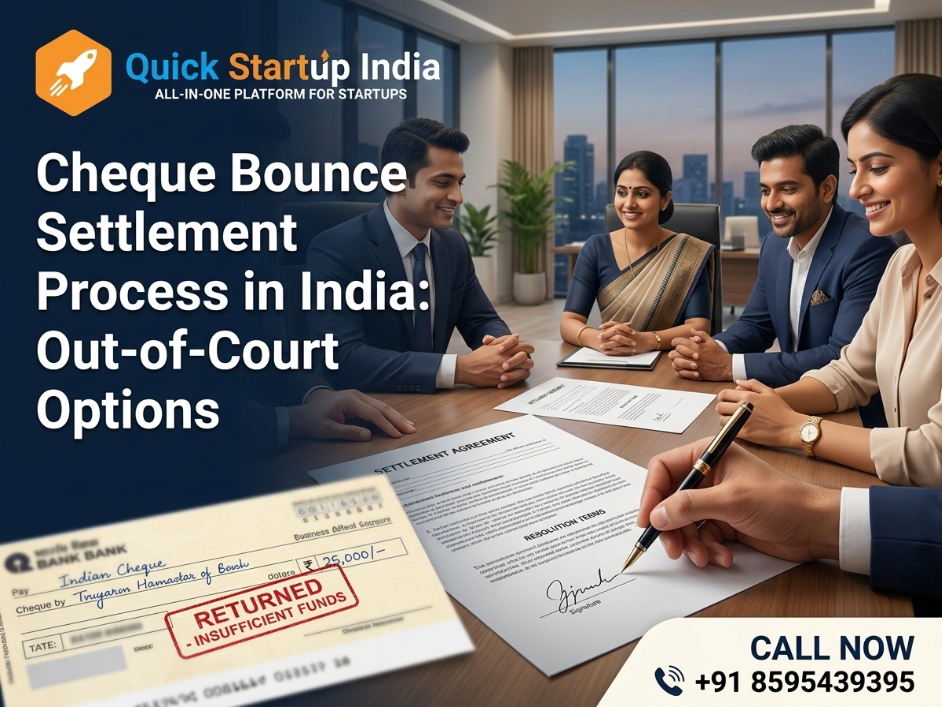
How to Draft a Settlement Agreement
When a cheque bounce matter is settled out of court, the settlement must be documented properly to protect both parties. A cheque bounce settlement agreement should include:
Essential clauses:
- Full names and addresses of both parties
- Details of the bounced cheque (number, date, amount, bank, reason for dishonour)
- The agreed settlement amount (which may include the cheque amount plus interest, legal costs, and compensation)
- Payment schedule — lump sum or instalments with specific dates and amounts
- Mode of payment — bank transfer with account details, or demand draft
- Consequences of default on the settlement terms
- Undertaking by the payee to withdraw any pending legal notice or complaint upon receipt of full payment
- Undertaking by the payee not to initiate any further legal proceedings in respect of the same cheque once full settlement is received
- Date and signatures of both parties with witnesses
A settlement agreement that is not properly drafted can leave the payee in a worse position — having given up the legal remedy without receiving full payment. Always have a qualified lawyer review the settlement agreement before signing.
When Out-of-Court Settlement Is Not Possible
Despite the best efforts of the payee, out-of-court settlement may not be achievable in every case. Situations where formal legal action becomes unavoidable include:
- The drawer denies issuing the cheque or claims the cheque was stolen or forged
- The drawer disputes that any debt or liability exists
- The drawer has absconded or is untraceable
- The drawer makes partial payment but refuses to pay the full amount and negotiation has broken down
- The drawer agrees to settle but repeatedly defaults on settlement commitments
- The drawer is deliberately using delay tactics to avoid payment
In these situations, filing a criminal complaint under Section 138 is the appropriate next step. A conviction under Section 138 carries the possibility of imprisonment, which is a far more serious consequence than the civil remedy of a money decree, and is correspondingly a stronger incentive for the drawer to settle even after the complaint is filed.
Section 138 Complaint: What Happens in Court
Even after a court complaint is filed, settlement remains possible and is in fact encouraged by the courts. Key features of Section 138 proceedings:
- The complaint is filed in the court of the Judicial Magistrate First Class (JMFC) or Metropolitan Magistrate having jurisdiction
- The court issues summons to the drawer (accused)
- At any stage before conviction, the parties can settle and the payee can compound (withdraw) the complaint
- Compounding of Section 138 offences is permitted under Section 147 of the Negotiable Instruments Act, with the court’s permission
- Upon compounding, the accused is acquitted and the matter ends
- Courts actively encourage settlement and may refer cases to mediation even at the trial stage
Important: Even if the criminal complaint is filed and the accused is convicted, the court’s sentence is often directed at securing payment to the complainant. Practical recovery through the criminal route, while available, can take years.
Cheque Bounce Settlement: Common Scenarios
Scenario 1: Business Payment Cheque A supplier receives a cheque from a buyer for ₹3,00,000 for goods supplied. The cheque bounces due to insufficient funds. The supplier’s advocate sends a legal notice. The buyer, facing the prospect of criminal prosecution, contacts the supplier and offers to pay ₹3,00,000 plus ₹15,000 toward the supplier’s legal costs in two instalments over 30 days. The supplier accepts, a settlement agreement is signed, and upon receipt of full payment, the supplier confirms in writing that the matter is settled. Total resolution time: 45 days. Court involvement: none.
Scenario 2: Loan Repayment Cheque An individual gives post-dated cheques for monthly EMIs on a personal loan. Three cheques bounce consecutively. The lender’s legal team sends a Section 138 notice. The borrower approaches the lender and requests an OTS, offering to pay the outstanding principal in a lump sum with a partial waiver of interest and penalties. The lender’s committee approves the OTS. The borrower pays and the lender withdraws the legal notices. Resolution through: direct negotiation with lender, OTS approval. Court involvement: none.
Scenario 3: Property Security Cheque A tenant gives a security deposit cheque that bounces when the landlord attempts to encash it at the end of the tenancy. The landlord sends a legal notice. The tenant disputes that the landlord is entitled to the full deposit and claims deductions for repairs. The parties agree to mediation. A mediator facilitates a discussion, both parties present their positions, and a settlement is reached for a partial payment by the tenant. A settlement agreement is signed and payment is made. Court involvement: none.
Key Deadlines to Remember
| Action | Deadline |
|---|---|
| Send legal demand notice | Within 30 days of receiving bank’s return memo |
| Drawer’s window to pay without criminal liability | 15 days from receipt of legal notice |
| File criminal complaint if unpaid | Within 30 days after the 15-day notice period expires |
| Cheque validity for presentation | 3 months from the date on the cheque |
⚠️ Warning: Missing the 30-day deadline for sending the legal notice forfeits the remedy under Section 138 entirely. Even if settlement negotiations are ongoing, send the notice on time. Receipt of payment after the notice is sent simply means the notice has served its purpose — it does not create any problem for the payee.
Frequently Asked Questions
1. Can a cheque bounce case be settled out of court after a complaint is filed?
Yes. Section 147 of the Negotiable Instruments Act explicitly permits compounding of cheque bounce offences at any stage before conviction, with the permission of the court. Settlement after filing is common and actively encouraged by courts.
2. What is the limitation period for filing a Section 138 complaint?
The complaint must be filed within 30 days of the expiry of the 15-day notice period. If this deadline is missed, the complaint may be time-barred, although courts have some discretion in condoning delay in certain circumstances.
3. Is a cheque bounce settlement agreement legally binding?
Yes, a properly drafted and signed settlement agreement is a binding contract. If the drawer defaults on settlement terms, the payee can sue for breach of contract in civil court and may also revive or file a fresh Section 138 complaint if the time limits permit.
4. Can the payee claim interest and costs in addition to the cheque amount in a settlement? Yes. A settlement is a negotiated outcome and the payee can negotiate for the cheque amount plus interest at a reasonable rate from the date of dishonour to the date of payment, plus actual legal costs incurred. The drawer may or may not agree to these additional amounts — it depends on the negotiation.
5. What happens if the drawer pays part of the cheque amount during settlement?
Part payment does not extinguish the Section 138 liability for the remaining amount. If the payee accepts part payment without a written settlement agreement clearly documenting the outstanding balance and payment schedule, it can complicate subsequent legal proceedings. Always document partial payment arrangements in a written agreement.
6. Can a company be prosecuted under Section 138? Yes. When a cheque is drawn by a company, every person who was in charge of and responsible for the conduct of the business of the company at the time of the offence — including directors, managers, and the company secretary — can be prosecuted along with the company under Section 141 of the Negotiable Instruments Act.
Conclusion
Cheque bounce disputes in India have a clear legal framework and a well-defined process. The criminal law under Section 138 exists not merely to punish but to create a strong incentive for the drawer to pay. The out-of-court settlement options — direct negotiation, legal notice, Lok Adalat, mediation, and conciliation — exist to resolve these disputes quickly and efficiently without burdening the courts or the parties with prolonged litigation.
For the payee, the priority is always the same: protect the legal remedy by sending the demand notice on time, and pursue settlement simultaneously through every available channel. For the drawer, the priority is equally clear: the cost of settlement — the cheque amount plus reasonable interest and costs — is always lower than the cost of criminal prosecution, potential imprisonment, and the reputational damage that follows.
Know your deadlines. Document every settlement. Engage a qualified advocate for the legal notice and the settlement agreement. Resolve disputes at the negotiation table, not the courtroom.
Need Help With Cheque Bounce Notice, Settlement, or Legal Action?
🟡 Quick Startup India provides complete cheque bounce legal support — demand notice drafting, settlement agreement preparation, Lok Adalat representation, and Section 138 complaint filing for individuals and businesses across all states in India.
Legal and Dispute Resolution Services
👉 Cheque Bounce Legal Notice 👉 Section 138 Complaint Filing 👉 Settlement Agreement Drafting 👉 Lok Adalat Representation 👉 Civil and Commercial Dispute Resolution 👉 Contract Drafting and Review
Business Registration and Compliance
👉 Private Limited Company Registration 👉 LLP Registration 👉 MSME / Udyam Registration 👉 GST Registration and Filing
Protect Your Business Brand
👉 Trademark Registration 👉 Copyright Registration 👉 Patent Registration
IT and Digital Services
👉 Website Development 👉 SEO Services 👉 Social Media Marketing 👉 Lead Generation
Call Now: +91 8595439395 | Free Consultation: Monday to Saturday, 9 AM to 6 PM

Anjali is a Digital Marketing Expert at Quick Startup India who builds websites that rank and convert. She specializes in SEO-driven web development, helping people find the right legal help online.


