

Views: 0
Table of Contents
- 1 Introduction
- 2 What is Design Registration and What Does It Protect?
- 3 What Can Be Registered as a Design in India?
- 4 What Cannot Be Registered as a Design in India?
- 5 Design Classification in India: The Locarno Classification System
- 6 Complete Government Fee Structure for Design Registration in India 2026
- 7 Professional Fees for Design Registration: What to Budget Beyond Government Charges
- 8 Total Cost Summary: Design Registration from Application to Certificate
- 9 The Design Registration Process: Step by Step
- 10 Key Differences Between Design Registration and Patent Protection
- 11 Design Registration vs. Copyright: Understanding the Overlap
- 12 Common Mistakes Businesses Make in Design Registration
- 13 International Design Protection: The Hague System
- 14 Design Registration as Part of a Complete IP Strategy
- 15 FAQs
- 16 Conclusion
- 17 Register Your Design with Expert IP Specialists
Introduction
You have created something visually distinctive. A product with a unique shape, a packaging design that stands out on the shelf, an industrial component with an ornamental form unlike anything else in the market, or a consumer product with an aesthetic identity that your customers recognise immediately. You know the visual appearance of your product has commercial value. And you know that without legal protection, a competitor can copy that appearance and benefit from the goodwill and investment you have built.
In India, the legal mechanism for protecting the visual appearance of a product is Design Registration under the Designs Act, 2000. Design registration gives the owner exclusive rights over the visual features of a product — its shape, configuration, pattern, ornamentation, or composition of colours — and prevents competitors from copying or imitating that appearance for commercial gain.
But like most areas of intellectual property law, the process has specific requirements, procedural steps, and fee structures that are not immediately obvious to a business owner approaching it for the first time. And unlike patents, which receive considerable attention, design registration is frequently overlooked — leaving businesses exposed to visual copying that could have been prevented at a fraction of the cost of litigation.
This guide provides a complete breakdown of design registration costs in India in 2026, the step-by-step process from application to certificate, what qualifies for protection, the common mistakes businesses make, and how design registration fits into a broader intellectual property strategy.
For complete design registration support from experienced IP specialists, the design registration team at LegalIP.in handles the full process from application to certificate across all product categories.
What is Design Registration and What Does It Protect?
Under the Designs Act, 2000, a design means the features of shape, configuration, pattern, ornamentation, or composition of lines or colours applied to any article by any industrial process, whether manual, mechanical, or chemical — separate or combined — which in the finished article appeal to and are judged solely by the eye.
In simpler terms: design registration protects how a product looks, not how it works. The functional aspects of a product are the domain of patent law. The visual, ornamental, and aesthetic aspects are the domain of design law.
A registered design gives the owner:
🔒 Exclusive right to apply the registered design to the article for which it is registered 🔒 The right to prevent any person from applying the same or a fraudulent or obvious imitation of the registered design to any article for sale, import, or export 🔒 The right to license the registered design to others 🔒 The right to assign the registered design to another person or company 🔒 The right to sue for damages and obtain injunctions against infringers
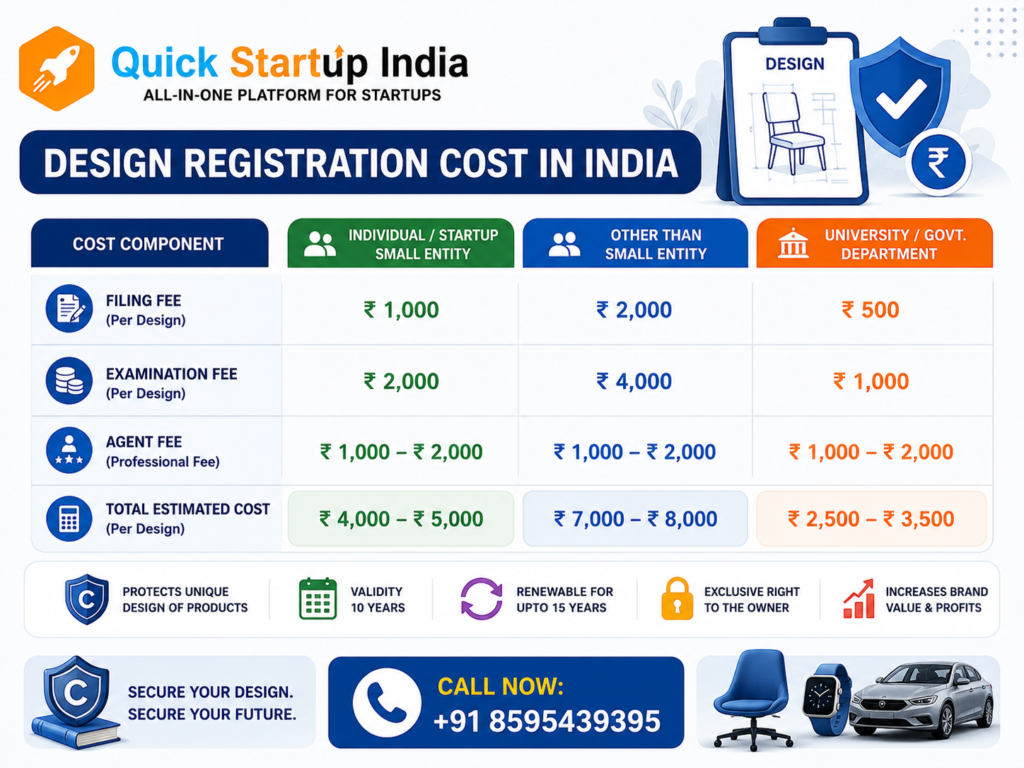
A registered design in India is protected for an initial period of 10 years from the date of registration, extendable by a further 5 years on payment of renewal fee — giving a maximum protection period of 15 years.
What Can Be Registered as a Design in India?
For a design to be registrable under the Designs Act, 2000, it must satisfy the following conditions:
Novelty and Originality The design must be new and original — not previously published or used in India before the date of application. A design that has been disclosed publicly, sold commercially, or published anywhere in the world before the application date may not qualify for registration.
Visual Appeal The design must appeal to the eye in the finished article. Purely functional features that have no aesthetic element cannot be registered as a design.
Application to an Article The design must be applied to a specific article — a physical product. A design cannot be registered in the abstract; it must be associated with a particular class of article.
Not Contrary to Public Order or Morality Designs that are obscene or contrary to public order cannot be registered.
What Cannot Be Registered as a Design in India?
The Designs Act excludes certain categories from registrability:
🚫 Artistic works as defined under the Copyright Act — paintings, sculptures, drawings, and similar works that are primarily artistic rather than industrial are protected under copyright, not design law
🚫 Purely functional features — features of shape or configuration dictated solely by the function the article performs, with no ornamental or aesthetic element
🚫 Flags, emblems, and official insignia — national flags, emblems of states, and official signs are excluded
🚫 Designs already published in India before the filing date — prior publication destroys registrability just as it destroys patentability
🚫 Designs not new or original — designs that are identical or substantially similar to existing registered designs or publicly known designs
Design Classification in India: The Locarno Classification System
India uses the Locarno International Classification for Industrial Designs to classify designs for registration purposes. The Locarno system consists of 32 classes covering all categories of articles, from food products and clothing to vehicles, machinery, and architectural structures.
The class of the article matters for design registration because each design registration covers a specific article within a specific class. If you want to protect the same design applied to articles in multiple classes, separate applications are required for each class.
Common Locarno Classes relevant to Indian businesses:
📋 Class 1 — Foodstuffs 📋 Class 2 — Articles of clothing and haberdashery 📋 Class 5 — Textile piece goods, artificial and natural sheet material 📋 Class 6 — Furnishing 📋 Class 7 — Household goods not elsewhere specified 📋 Class 8 — Tools and hardware 📋 Class 9 — Packages and containers for the transport or handling of goods 📋 Class 10 — Clocks, watches, and other measuring instruments 📋 Class 11 — Articles of adornment 📋 Class 12 — Transport or hoisting 📋 Class 13 — Equipment for production, distribution, or transformation of electricity 📋 Class 14 — Recording, communication, or information retrieval equipment 📋 Class 15 — Machines not elsewhere specified 📋 Class 19 — Stationery and office equipment 📋 Class 26 — Lighting apparatus 📋 Class 27 — Tobacco and smokers’ requisites 📋 Class 31 — Machines and appliances for preparing food or drink 📋 Class 32 — Graphic symbols and logos, surface patterns, ornamentation
The design registration specialists at LegalIP.in advise on correct class identification and filing strategy for multi-class design portfolios.
Complete Government Fee Structure for Design Registration in India 2026
Design registration fees under the Designs Act are significantly more straightforward than patent fees — there is no tiered applicant category structure based on startup or small entity status. Fees apply uniformly based on whether filing is done physically or online, and on the nature of the request.
All fees below are current government fees as of 2026.
Application Filing Fee
Application for Registration of a Design (Form 1)
💰 Small Entity (e-filing): Rs. 1,000 💰 Others (e-filing): Rs. 4,000 💰 Small Entity (physical filing): Rs. 2,000 💰 Others (physical filing): Rs. 5,000
The “small entity” category for design purposes corresponds broadly to MSMEs and natural persons, similar to patent law. Large companies and institutions fall under “Others.”
E-filing is the standard and recommended method, available through the IPO’s online portal at ipindiaonline.gov.in.
Representations and Drawings
Unlike patents where the specification drafting is the primary cost driver, design applications require high-quality visual representations — photographs, drawings, or computer-generated images — showing the design from all relevant views (front, rear, left side, right side, top, bottom, and perspective).
The representations must:
📋 Be on a white background with no shadows or decorative elements 📋 Show every feature of the design claimed for protection 📋 Be of sufficient quality for publication in the Official Designs Journal 📋 Follow the specific formatting requirements of the Indian Patent Office
The cost of preparing professional design representations — whether by a product photographer, industrial designer, or technical illustrator — is a significant professional fee component that varies by product complexity.
Certificate of Registration
No separate fee is charged for the issuance of the registration certificate. It is included in the application filing fee.
Renewal Fee (Extension of Registration)
A registered design has an initial term of 10 years. It can be extended by a further 5 years (maximum total term: 15 years) by filing a renewal application before the expiry of the initial 10-year term.
Renewal of Design Registration (Form 4 — Extension of Copyright in Design)
💰 Small Entity: Rs. 2,000 💰 Others: Rs. 5,000
If the renewal is not filed before expiry of the initial 10-year term, the design registration lapses and the design enters the public domain.
Restoration of Lapsed Design
If a design registration has lapsed due to non-payment of the renewal fee, it may be possible to restore the registration by filing a petition for restoration within one year of lapse, subject to satisfying the Controller that the failure to pay was unintentional.
💰 Petition for Restoration (Form 5): Small Entity: Rs. 3,000 | Others: Rs. 7,500
Other Miscellaneous Fees
Petition for Extension of Time (Form 22): 💰 Small Entity: Rs. 1,000 | Others: Rs. 2,500
Application for Cancellation of Design (Form 8): 💰 Any applicant: Rs. 1,500
Request for Inspection of Register: 💰 Rs. 500
Certified copy of entries in Register: 💰 Rs. 500 per copy
Professional Fees for Design Registration: What to Budget Beyond Government Charges
Government fees are only part of the total cost of design registration. Professional fees — charged by registered IP professionals for design search, application drafting, representation preparation, and prosecution — constitute a significant and often larger portion of the total investment.
Prior Design Search Before filing, a prior design search is strongly recommended to confirm that the design is novel and not identical or substantially similar to an already-registered design.
📋 Professional fee for prior design search: Rs. 5,000 to Rs. 15,000
Design Representation Preparation High-quality visual representations are the centrepiece of a design application. Depending on the product, these may require professional product photography, technical drawing, or computer-aided design (CAD) rendering.
📋 Photography-based representations (simple products): Rs. 5,000 to Rs. 15,000 📋 Technical drawing or CAD-based representations (complex products): Rs. 15,000 to Rs. 40,000
Application Drafting and Filing Preparing and filing the complete application including the statement of novelty, the representations, and all required forms.
📋 Simple article with clear design features: Rs. 5,000 to Rs. 15,000 📋 Complex article with multiple design elements: Rs. 15,000 to Rs. 30,000
Response to Examination Objections If the Controller raises objections regarding novelty, registrability, or formal requirements, a written response must be filed.
📋 Straightforward formal objections: Rs. 5,000 to Rs. 15,000 📋 Substantive objections on novelty or registrability: Rs. 15,000 to Rs. 35,000
Total Cost Summary: Design Registration from Application to Certificate
Scenario 1: Small Entity / MSME — Simple Consumer Product (e.g., kitchenware, packaging)
| Stage | Government Fee | Professional Fee (Approx.) |
|---|---|---|
| Prior design search | — | Rs. 7,000 |
| Representation preparation (photography) | — | Rs. 8,000 |
| Application filing (Form 1, small entity) | Rs. 1,000 | Rs. 8,000 |
| Response to objections (if any) | — | Rs. 8,000 |
| Total (approximate) | Rs. 1,000 | Rs. 31,000 |
| Grand Total | ~Rs. 32,000 |
Scenario 2: Large Company (“Others”) — Complex Industrial or Electronic Product
| Stage | Government Fee | Professional Fee (Approx.) |
|---|---|---|
| Prior design search | — | Rs. 12,000 |
| Representation preparation (CAD drawings, multiple views) | — | Rs. 30,000 |
| Application filing (Form 1, others) | Rs. 4,000 | Rs. 20,000 |
| Response to objections (if any) | — | Rs. 20,000 |
| Total (approximate) | Rs. 4,000 | Rs. 82,000 |
| Grand Total | ~Rs. 86,000 |
Scenario 3: Multi-Class Portfolio Filing — Fashion or Lifestyle Brand
A brand selling products across multiple article classes — for example, apparel, accessories, and packaging — would require separate design applications for each class.
For 5 designs across 3 classes (15 total applications, small entity):
| Stage | Government Fee | Professional Fee (Approx.) |
|---|---|---|
| Prior design searches (15 designs) | — | Rs. 60,000 |
| Representation preparation (15 sets) | — | Rs. 75,000 |
| Application filing (15 applications × Rs. 1,000) | Rs. 15,000 | Rs. 90,000 |
| Objection responses (where required) | — | Rs. 30,000 |
| Total (approximate) | Rs. 15,000 | Rs. 2,55,000 |
| Grand Total | ~Rs. 2,70,000 |
The Design Registration Process: Step by Step
Step 1: Conduct a Prior Design Search
Before filing, search the Indian Designs Register to confirm that no substantially similar design is already registered for the same class of article. The Indian Patent Office maintains a searchable designs database at ipindiaonline.gov.in.
A professional prior design search also covers international design databases — particularly the WIPO Hague System database and USPTO design patent database — to identify any publicly disclosed designs that could affect novelty.
Step 2: Prepare Design Representations
Prepare high-quality visual representations of the design from all required views. For a three-dimensional article, this typically means front, rear, left side, right side, top view, bottom view, and a perspective view. For a two-dimensional design (pattern, surface ornamentation), fewer views may be required.
The representations must clearly show every feature being claimed as part of the design. Features excluded from the claim (such as functional features you do not wish to protect) can be indicated using broken or dotted lines.
Step 3: Draft the Statement of Novelty
The Statement of Novelty is a concise statement identifying the novel and distinctive features of the design that distinguish it from prior art. This statement is critical because it defines the scope of protection — similar in concept to claims in a patent, though less detailed.
Step 4: File the Application
File Form 1 (Application for Registration of a Design) along with:
📄 The representations (photographs or drawings) in the prescribed format 📄 The Statement of Novelty 📄 A brief description of the article and design 📄 Form 21 (if claiming priority from a foreign application) 📄 Payment of the prescribed government fee
Applications are filed online through the IPO e-filing portal or physically at the relevant Patent Office (the same four offices as for patents — Kolkata, Mumbai, Chennai, Delhi — based on the applicant’s address).
Step 5: Examination
After filing, the application is examined by the Controller of Designs for compliance with the Designs Act and Rules. The examination covers:
📋 Formal requirements (correct forms, fee payment, representation quality) 📋 Classification of the article 📋 Novelty and originality of the design 📋 Whether the design falls within the excluded categories
If the Controller raises objections, the applicant must file a response within the prescribed time, typically with amended representations or arguments addressing the objections.
Step 6: Registration and Certificate
If the Controller is satisfied that the design meets all requirements, the design is registered and the applicant receives a Certificate of Registration. The registered design is also published in the Official Designs Journal of the Indian Patent Office.
From the date of registration, the owner has the full statutory rights to the design for the initial 10-year term.
Typical Timeline from Filing to Registration: In straightforward cases with no substantive objections: 6 to 12 months In cases with examination objections: 12 to 24 months
Key Differences Between Design Registration and Patent Protection
First-time applicants sometimes confuse design registration and patents, or are unsure which applies to their situation. The distinction is important:
| Design Registration | Patent | |
|---|---|---|
| Protects | Visual appearance of a product | Technical invention — how something works or is made |
| Duration | 10 years + 5 year extension (15 years max) | 20 years |
| Cost | Significantly lower | Significantly higher |
| Examination | Relatively faster | Multi-year process |
| Scope | Same class of article | All fields of use |
| Right trigger | Visual copying | Making, using, selling the invention |
Many products deserve both design registration (for the appearance) and patent protection (for the technical innovation). A new kitchen appliance, for example, might qualify for a patent on its novel cooking mechanism and a registered design on its distinctive visual form. The combination provides the most complete commercial protection.
Design Registration vs. Copyright: Understanding the Overlap
An important and frequently misunderstood area of Indian IP law is the relationship between design registration and copyright protection for industrial articles.
Under Section 15 of the Copyright Act, 1957, copyright protection for a design ceases once the design is applied to more than 50 articles by an industrial process. This means that if you produce your product at commercial scale without registering the design, you lose copyright protection and are left without any design-specific IP protection.
The practical implication: If your product has a distinctive visual appearance and will be produced commercially at scale, design registration is not optional — it is the only form of IP protection that will survive commercial production.
Common Mistakes Businesses Make in Design Registration
Not Filing Before Commercial Launch Design registration requires the design to be novel — not publicly disclosed before the filing date. Launching a product commercially before filing a design application destroys novelty and bars registration. File before launch, not after.
Poor Quality Representations The representations submitted with a design application define what is protected. Blurry photographs, inconsistent views, or representations that do not show the design clearly can result in rejection or — worse — a registration that does not protect what you intended because the representations were ambiguous. Professional representation preparation is essential.
Filing in the Wrong Class Filing a design application in the wrong Locarno class can result in rejection or, if the error is not caught, registration that can be challenged for invalidity. Correct classification requires knowledge of the Locarno system and the Controller’s classification practices.
Not Extending Before the 10-Year Term Expires Design registration must be renewed before the expiry of the initial 10-year term. Missing the renewal deadline causes the design to lapse and enter the public domain. Unlike some other IP rights, there is limited ability to restore a lapsed design registration.
Assuming Copyright Protects the Design at Commercial Scale As noted above, copyright protection for industrial designs ceases once the design is applied to more than 50 articles by an industrial process. Relying on copyright protection rather than design registration for commercial products is a common and costly mistake.
Not Enforcing Registered Design Rights A registered design certificate does not stop infringement automatically. Businesses must actively monitor the market for imitations and take enforcement action when copying is detected. The IP enforcement specialists at LegalIP.in advise on design infringement and coordinate enforcement actions.
International Design Protection: The Hague System
If you need design protection beyond India, the most efficient route is the Hague Agreement Concerning the International Registration of Industrial Designs, administered by WIPO. India is not currently a member of the Hague Agreement, which means Indian applicants cannot file a Hague international design application through the Indian Patent Office.
However, Indian businesses can file for international design protection through the following routes:
🌍 Direct national filing in each target country or jurisdiction 🌍 Hague System filing through a subsidiary, representative, or habitual residence connection in a Hague member country or jurisdiction (EU, USA, Japan, China, South Korea, and many others are Hague members) 🌍 Community Design Registration in the European Union through the EUIPO for pan-EU protection with a single application
The international IP filing specialists at LegalIP.in advise on international design protection strategies for Indian businesses seeking coverage in key export markets.
Design Registration as Part of a Complete IP Strategy
Design registration is most effective when it forms part of a coordinated IP strategy alongside other rights:
Patents protect how your product works — the technical innovation behind its function. The patent team at LegalIP.in handles full patent prosecution from prior art search to grant.
Trademarks protect your brand identity — the name, logo, and distinctive marks that identify your products in the market. Trademark registration services are available at LegalIP.in, LegalTax.in, and OnlineTrademark India across all 45 classes.
Copyrights protect original creative works including product manuals, advertising materials, software, and artistic content. Copyright registration and enforcement services at LegalIP.in.
Design Registration protects what your product looks like — the visual, ornamental, and aesthetic identity that makes your product distinctive in the market.
For a product with a distinctive design and a recognisable brand, combining design registration with trademark protection gives you enforceable rights against both direct copying of the visual appearance and unauthorised use of brand elements that could cause consumer confusion.
FAQs
What is the government fee for design registration in India?
The official government filing fee for individuals, startups, and small entities is generally ₹1,000 per class for e-filing, while larger companies usually pay ₹4,000. Additional professional charges may apply depending on the complexity of the design and legal assistance required.
How much does complete design registration cost including professional fees?
The total cost may range from ₹8,000 to ₹30,000 or more depending on attorney fees, CAD drawings, objection handling, and filing complexity. Self-filing without professional assistance can significantly reduce costs.
How long does design registration protection last in India?
A registered design is initially protected for 10 years from the registration date and can be extended by another 5 years after renewal, giving a maximum protection period of 15 years.
Is design registration mandatory for protection?
While not legally mandatory, registration provides exclusive legal rights and makes it easier to take action against copying or infringement. Unregistered designs receive very limited protection compared to registered designs.
Where can businesses file design registration applications online?
Businesses can file applications through the official IP India Designs Portal managed by the Indian Patent Office. The portal also provides access to forms, fee schedules, status tracking, and design journals.
Conclusion
Design registration in India is one of the most cost-effective forms of intellectual property protection available to businesses. For a total investment — government fees plus professional fees — that is a fraction of the cost of patent prosecution, a business can obtain 10 to 15 years of enforceable exclusive rights over the visual appearance of its products, with the right to stop competitors from copying that appearance and to claim damages when copying occurs.
The critical principles are straightforward: file before any public disclosure or commercial launch, invest in high-quality representations, file in the correct class, renew before the 10-year term expires, and combine design registration with trademark and patent protection for the most complete IP coverage.
The visual identity of your product is a commercial asset. Protect it with the same seriousness as any other asset your business owns.
Register Your Design with Expert IP Specialists
🟡 LegalIP.in provides complete design registration support for businesses across all product categories and Locarno classes — including prior design search, representation preparation, application filing, objection response, renewal, and enforcement.
👉 Design Registration at LegalIP.in 👉 Patent Registration at LegalIP.in 👉 Trademark Registration at LegalIP.in 👉 Copyright Registration at LegalIP.in 👉 IP Enforcement at LegalIP.in 👉 Litigation Support at LegalIP.in
🟡 Also Protect Your Brand 👉 LegalTax.in Trademark Registration 👉 OnlineTrademark India
🟡 Register Your Business 👉 Startup India Registration at LegalTax.in 👉 Private Limited Company Registration 👉 MSME Registration
📞 Call Now: +91 8595439395 🕐 Free Consultation: Monday to Saturday, 9 AM to 6 PM

Anjali is a Digital Marketing Expert at Quick Startup India who builds websites that rank and convert. She specializes in SEO-driven web development, helping people find the right legal help online.


