

Views: 1
Table of Contents
- 1 Introduction
- 2 What is a Patent and What Does It Protect?
- 3 What Can Be Patented in India?
- 4 What Cannot Be Patented in India?
- 5 The Complete Step-by-Step Patent Filing Process in India 2026
- 6 Government Fees for Patent Filing in India 2026
- 7 Realistic Timeline: How Long Does Patent Grant Take in India?
- 8 Post-Grant: Maintaining Your Patent
- 9 Post-Grant Opposition: Defending Your Grant
- 10 International Patent Protection: When India is Not Enough
- 11 The Most Common Mistakes First-Time Applicants Make
- 12 Connecting Patent Protection to Your Broader IP Strategy
- 13 FAQs
- 14 Conclusion
- 15 File Your Patent with Expert IP Specialists
Introduction
You have invented something new. Maybe it is a breakthrough product, a novel manufacturing process, a unique machine, or a smarter way to solve a problem that others have struggled with for years. You know it has commercial value. And you know you need to protect it before you show it to anyone — investors, manufacturers, potential partners — or take it to market.
But when you start researching how to protect your invention in India, you quickly discover that patent law is one of the most technically complex and procedurally demanding areas of intellectual property law. The terminology is unfamiliar. The process has multiple stages spread over years. The documentation requirements are precise and unforgiving. And the consequences of getting it wrong — from a poorly drafted claim to a missed statutory deadline — can permanently compromise the protection you are trying to obtain.
This guide is written for inventors, startup founders, and business owners in India who want to understand the complete patent filing process in 2026, from the very first step through to grant and beyond, in clear, straightforward language. It covers what a patent is, what qualifies for patent protection, the full step-by-step process, government fees, realistic timelines, common mistakes to avoid, and how to maintain your patent once it is granted.
For complete patent filing support from experienced IP specialists, the patent team at LegalIP.in handles every stage of the process — from prior art search to grant — across all technology domains.
What is a Patent and What Does It Protect?
A patent is a legally granted exclusive right given to an inventor by the government, in exchange for publicly disclosing the details of the invention. In India, patents are governed by the Patents Act, 1970, as amended by the Patents (Amendment) Act, 2005, and administered by the Indian Patent Office (IPO) under the Office of the Controller General of Patents, Designs and Trade Marks (CGPDTM).
A granted patent gives the patent holder the exclusive right to:
🔒 Make, use, sell, distribute, import, and export the patented invention in India 🔒 License the invention to others in exchange for royalties 🔒 Prevent any third party from making, using, selling, or importing the invention without authorisation 🔒 Assign the patent to another person or company
A patent in India is valid for 20 years from the date of filing. After 20 years, the invention enters the public domain and anyone can use it freely.
What a patent does not do: it does not give you the right to use your own invention if doing so would violate another law. It does not automatically prevent infringement — you must actively monitor and enforce your rights. And it does not protect your invention globally — a patent granted in India provides protection only within India.
What Can Be Patented in India?
Under Section 2(1)(j) of the Patents Act, 1970, a patentable invention must satisfy three fundamental criteria:
Novelty The invention must be new — not previously published, disclosed, publicly used, or known anywhere in the world before the date of filing. Even the inventor’s own prior public disclosure of the invention can destroy novelty, which is why filing before any public disclosure is the most important rule in patent law.
Inventive Step (Non-Obviousness) The invention must not be obvious to a person skilled in the relevant technical field. It must involve some technical advance or economic significance beyond what a skilled professional would arrive at through routine experimentation or logical deduction from existing knowledge.
Industrial Applicability The invention must be capable of being made or used in some kind of industry. A purely theoretical concept with no practical application does not qualify.
What Cannot Be Patented in India?
The Patents Act explicitly excludes certain categories from patentability under Sections 3 and 4. First-time applicants frequently assume their invention is patentable without checking these exclusions — and are surprised when objections are raised during examination.
Non-patentable subject matter in India includes:
🚫 Discoveries, scientific theories, and mathematical methods — Discovering a natural phenomenon or formulating an equation is not a patentable invention
🚫 Abstract ideas and mental acts — A business method or mental process cannot be patented on its own
🚫 Computer programs per se — Software code in isolation is not patentable in India, though a technical invention that uses software as part of a broader technical solution may qualify if it produces a technical effect
🚫 Methods of agriculture or horticulture — Farming techniques and agricultural methods are explicitly excluded
🚫 Methods of treatment of human or animal body — Medical, surgical, curative, diagnostic, and therapeutic methods cannot be patented (though pharmaceutical compounds and medical devices generally can be)
🚫 Plants, animals, and essentially biological processes — Traditional varieties and animal breeds are excluded, though microorganisms and certain biotechnology inventions may be patentable
🚫 Inventions contrary to public order or morality — Inventions prejudicial to human, animal, or plant life cannot be patented
🚫 Known substances with new use — Under Section 3(d), a new form or new use of a known substance is not patentable unless it results in enhancement of the known efficacy of that substance. This provision was specifically designed to prevent minor modifications to existing drugs from receiving fresh patent protection.
If you are uncertain whether your invention qualifies, the patent specialists at LegalIP.in can conduct a patentability assessment before you invest in the full filing process.
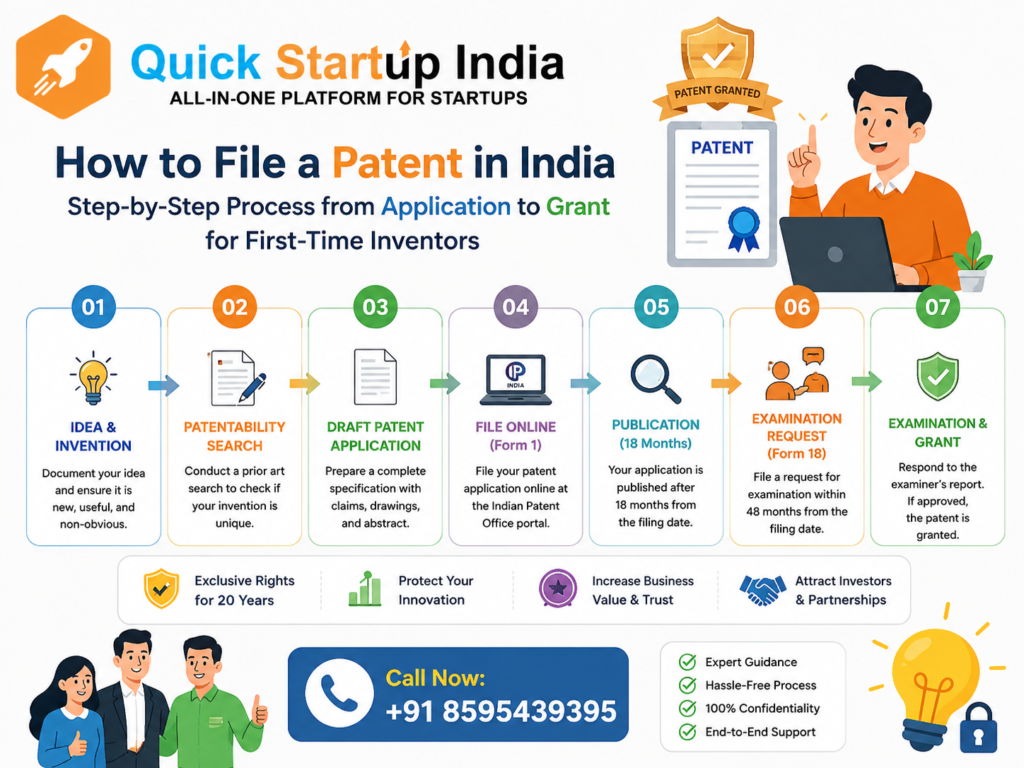
The Complete Step-by-Step Patent Filing Process in India 2026
Step 1: Conduct a Prior Art Search
Before filing anything, conduct a thorough prior art search to determine whether your invention — or something substantially similar — already exists in the published patent literature or the broader scientific and technical literature.
Prior art includes any publicly available information anywhere in the world that predates your filing date: granted patents, published patent applications, scientific journal articles, conference papers, product manuals, websites, and any other public disclosure that describes your invention or something close to it.
A comprehensive prior art search serves two purposes: it tells you whether your invention is novel enough to be worth filing, and it helps you understand the existing patent landscape so you can draft claims around the genuinely novel aspects of your invention.
Key databases for prior art searches:
🔍 Indian Patent Office: ipindiaonline.gov.in 🔍 Google Patents: patents.google.com 🔍 Espacenet (EPO): worldwide.espacenet.com 🔍 USPTO: patents.uspto.gov 🔍 WIPO PatentScope: patentscope.wipo.int
A professional prior art search by a patent specialist is strongly recommended for complex inventions. The patent team at LegalIP.in conducts thorough prior art searches as the first step in every filing engagement.
Step 2: Decide Between Provisional and Complete Application
Indian patent law offers two types of applications at the filing stage:
Provisional Application A provisional application is a simplified filing that establishes your priority date — the legally recognised date from which your invention is considered filed — without requiring a complete technical specification. It is used when an invention is not yet fully developed, or when you want to establish priority quickly while continuing to refine or test the invention.
Key facts about provisional applications:
📋 Does not require full claims or an abstract 📋 Contains only a basic description of the invention 📋 Must be followed by a Complete Specification within 12 months 📋 If the complete specification is not filed within 12 months, the provisional application is abandoned and the priority date is permanently lost 📋 Government fee is lower than for a complete application
Complete Application A complete application contains the full technical specification — detailed description, drawings, claims, and abstract. It can be filed directly without a provisional application if the invention is fully developed and all technical aspects are finalised.
When to file provisional: When your invention is still being refined, when you want to establish priority quickly before a public disclosure or investor pitch, or when you need more time to prepare the full specification.
When to file complete directly: When your invention is fully developed and you are confident in all its technical aspects and the commercial scope of protection you want to claim.
Step 3: Prepare the Complete Patent Specification
The patent specification is the most critical document in the entire patent process. It is the legally binding document that defines the scope of your protection, and it must be drafted with extraordinary precision. A poorly drafted specification can result in a patent that is easily challenged, easily designed around by competitors, or that provides far narrower protection than the invention deserves.
A complete patent specification contains the following sections:
Title of the Invention A concise, technical title that accurately describes the invention.
Field of the Invention A brief statement identifying the technical field to which the invention relates.
Background of the Invention A description of the prior art and the problem or limitation in existing technology that the invention addresses. This contextualises why the invention is needed.
Objects of the Invention A statement of the objectives that the invention achieves.
Summary of the Invention A brief, non-technical summary of what the invention is and how it achieves its objects.
Brief Description of the Drawings If drawings are included — which is the case for most mechanical, electrical, and electronic inventions — a brief description of what each drawing shows.
Detailed Description of the Preferred Embodiments The most detailed section. It describes the invention in full technical detail — how it is constructed, how it functions, and how it achieves its stated objects. The description must be sufficiently detailed that a person skilled in the relevant field can reproduce the invention from the description alone. This is the enablement requirement, and failure to meet it is a ground for refusal.
Claims The claims are the legally operative part of the patent. They define the exact scope of protection granted. What is claimed is protected. What is not claimed is not protected. Claims are classified as:
🔹 Independent claims — stand-alone claims that define the invention in its broadest form 🔹 Dependent claims — refer back to an independent claim and add further specific features, providing narrower but more defensible layers of protection
Claim drafting is the most technically and legally demanding part of patent preparation. Claims that are too broad will be rejected or invalidated. Claims that are too narrow may not provide meaningful commercial protection. This is the primary reason why engaging a qualified patent agent for specification and claim drafting is not optional — it is essential.
Abstract A brief summary (maximum 150 words) of the invention for publication purposes.
Drawings Technical drawings are required for most inventions involving physical structures, mechanisms, circuits, or processes. Drawings must meet the specific formatting requirements of the Indian Patent Office.
Step 4: File the Application at the Indian Patent Office
Patent applications in India are filed with the Indian Patent Office (IPO), which has four offices assigned by geography:
🏛 Kolkata — West Bengal, Sikkim, Andaman and Nicobar Islands, Northeast states 🏛 Mumbai — Maharashtra, Gujarat, Madhya Pradesh, Goa, Rajasthan 🏛 Chennai — Tamil Nadu, Andhra Pradesh, Telangana, Karnataka, Kerala, and other southern states 🏛 Delhi — All remaining states and Union Territories
Applications can be filed physically at the relevant office or online through the IPO’s e-filing portal at ipindiaonline.gov.in. Online filing is the standard and recommended method.
The application is filed using Form 1 (Application for Grant of Patent) along with:
📄 Form 2 (Provisional or Complete Specification) 📄 Form 5 (Declaration as to Inventorship) 📄 Form 26 (Authorization of Patent Agent, if filing through an agent) 📄 Priority document (if claiming priority from a foreign application) 📄 Form 8 (Statement regarding foreign applications, if applicable) 📄 Payment of prescribed government fee
Step 5: Publication of the Application
After filing, a patent application is ordinarily published in the Official Journal of the Indian Patent Office 18 months after the filing date (or priority date, whichever is earlier). Publication makes the application publicly visible but does not grant the patent.
If you want earlier publication — to establish public notice of your rights, or to enable licensing discussions before the 18-month window closes — you can file a Request for Early Publication (Form 9) with the prescribed fee. Early publication is typically processed within one month of the request.
Step 6: File a Request for Examination
Publication does not automatically trigger examination. You must actively request examination by filing Form 18 (Request for Examination) within 48 months from the priority date.
If Form 18 is not filed within 48 months, the application is treated as withdrawn — permanently. This is one of the most commonly missed deadlines in patent prosecution.
There is also an option to file a Request for Expedited Examination (Form 18A) if:
🚀 The applicant is a DPIIT-recognised startup 🚀 The applicant is a small entity 🚀 The applicant has chosen India as the International Searching Authority in a PCT application 🚀 The applicant is a female inventor
Expedited examination significantly reduces the waiting time for the First Examination Report — often by one to three years compared to standard examination timelines.
Step 7: Examination and First Examination Report (FER)
After the Request for Examination is filed, the application is assigned to a Patent Examiner who conducts a substantive review of the specification and claims for patentability, checks for prior art, and assesses compliance with all formal and substantive requirements of the Patents Act.
The examiner issues a First Examination Report (FER) which may contain:
📋 Objections relating to novelty, inventive step, or industrial applicability 📋 Objections under Sections 3 and 4 (non-patentable subject matter) 📋 Formal objections relating to the specification, claims, or drawings 📋 Requests for additional information or clarification
The FER is not a rejection. It is the beginning of a structured dialogue between the examiner and the applicant. Most Indian patent applications receive a FER with at least some objections, and most of those applications ultimately proceed to grant after a well-drafted response.
Step 8: Filing a Response to the First Examination Report
After receiving the FER, the applicant has 12 months from the date of the FER to file a written response addressing all of the examiner’s objections. This response — called the Statement and Amended Claims or simply the Reply to FER — is one of the most technically and legally demanding documents in the entire prosecution process.
A well-crafted FER response:
✅ Addresses every objection raised by the examiner with detailed technical and legal arguments ✅ Amends the claims where necessary to overcome prior art objections, without narrowing protection beyond what is commercially valuable ✅ Provides technical arguments explaining why the invention meets patentability criteria despite the prior art cited by the examiner ✅ May include declarations or affidavits from technical experts in complex cases
If the examiner is not satisfied with the written reply, a hearing may be scheduled. The patent hearing specialists at LegalIP.in represent applicants at patent hearings before all four offices of the Indian Patent Office.
Failure to respond to the FER within 12 months results in the application being deemed abandoned with no possibility of reinstatement.
Step 9: Grant of Patent
If the examiner is satisfied that all objections have been addressed and the invention meets all requirements of the Patents Act, the patent is granted and the grant is notified in the Official Journal of the Indian Patent Office.
Upon grant, the applicant receives the Letters Patent — the formal patent certificate — along with the published specification containing the claims as finally allowed.
From the date of grant, the patent holder has full statutory rights for the remaining term of the patent — 20 years from the original filing date.
Government Fees for Patent Filing in India 2026
Patent fees in India vary based on applicant category. The three concessional categories — Natural Person, Startup (DPIIT-recognised), and Small Entity — pay the same reduced rates, which are approximately 80% lower than the fees applicable to large companies and institutions (“Others”).
Key Government Fees (e-filing rates):
💰 Form 1 — Application Filing: Natural Person / Startup / Small Entity: Rs. 1,600 | Others: Rs. 8,000
💰 Form 2 — Provisional Specification: Natural Person / Startup / Small Entity: Rs. 1,600 | Others: Rs. 8,000
💰 Form 2 — Complete Specification (up to 30 pages, 10 claims): Natural Person / Startup / Small Entity: Rs. 4,000 | Others: Rs. 20,000
💰 Form 5 — Declaration as to Inventorship: Natural Person / Startup / Small Entity: Rs. 400 | Others: Rs. 2,000
💰 Form 9 — Request for Early Publication: Natural Person / Startup / Small Entity: Rs. 2,500 | Others: Rs. 12,500
💰 Form 18 — Request for Examination: Natural Person / Startup / Small Entity: Rs. 4,000 | Others: Rs. 20,000
💰 Form 18A — Request for Expedited Examination: Natural Person / Startup / Small Entity: Rs. 8,000 | Others: Rs. 40,000
💰 Annual Renewal Fees (from Year 3 onwards): Fees are progressive, increasing from approximately Rs. 800 per year in Year 3 to Rs. 10,400 per year in Year 20 for natural persons and startups, with significantly higher fees for the “Others” category.
These are government fees only. Professional charges for prior art search, specification drafting, claim drafting, FER response, and hearing representation are separate and constitute a significant portion of total patent costs.
Realistic Timeline: How Long Does Patent Grant Take in India?
Provisional to Complete Specification: 12 months maximum (mandatory statutory deadline)
Filing to Publication: 18 months from priority date (or earlier if early publication is requested)
Request for Examination to FER: Typically 12 to 48 months depending on backlog and technology field. The IPO has been reducing examination backlogs in recent years, and expedited examination significantly shortens this wait.
FER Response to Grant (if no hearing required): 3 to 12 months after a satisfactory response
Total Estimated Timeline from Filing to Grant: Without expedited examination: 4 to 7 years in many technology fields With expedited examination (for eligible applicants): 2 to 4 years
The long timeline makes early filing and consistent deadline management critically important. The patent prosecution specialists at LegalIP.in manage the complete prosecution calendar for clients to ensure no statutory deadline is ever missed.
Post-Grant: Maintaining Your Patent
Obtaining grant is not the end of your obligations. To maintain a patent for its full 20-year term, annual renewal fees must be paid from the third year onwards. If the renewal fee is not paid for any year, the patent lapses and can be permanently lost.
Renewal fees increase progressively each year to encourage commercialisation of patents rather than indefinite holding. The Patent Renewal specialists at LegalIP.in manage renewal calendars and payments for patent holders across all technology domains.
Post-Grant Opposition: Defending Your Grant
After a patent is granted, any person can file a post-grant opposition within 12 months of the date of publication of the grant in the Official Journal. Opposition grounds include lack of novelty, lack of inventive step, non-patentable subject matter, and insufficiency of disclosure.
If a post-grant opposition is filed against your patent, you must respond with detailed technical and legal arguments to defend the grant. The patent litigation and opposition specialists at LegalIP.in represent patent holders in post-grant opposition proceedings before the IPO.
International Patent Protection: When India is Not Enough
A patent granted in India protects your invention only within India. For protection in other countries, the most efficient route is the Patent Cooperation Treaty (PCT), administered by WIPO.
A PCT application:
🌍 Establishes a filing date that serves as the priority date in all PCT member countries 🌍 Includes an International Search Report and Written Opinion assessing patentability 🌍 Allows you to delay national phase entry decisions for up to 30 months from the priority date 🌍 Can be filed through the Indian Patent Office as the Receiving Office
The PCT system gives Indian inventors time to assess commercial potential in different markets before committing to the cost of filing in multiple individual countries.
The international patent filing specialists at LegalIP.in handle PCT applications and national phase entry in key markets including the USA, Europe, China, Japan, and Gulf countries.
The Most Common Mistakes First-Time Applicants Make
Publicly Disclosing the Invention Before Filing This is the most devastating and most common mistake. Once you publicly disclose your invention — in a conference presentation, a published paper, a product demonstration, a social media post, or a conversation with an investor without an NDA — you may permanently destroy the novelty of your invention and bar it from patent protection. File before you disclose. Always.
Filing Without a Prior Art Search Filing without understanding the existing patent landscape is expensive and often futile. A thorough prior art search helps you assess patentability, identify the genuinely novel aspects of your invention, and draft claims that are both broad enough to provide real protection and narrow enough to avoid prior art.
Drafting Claims Without Professional Help Patent claims are legal documents with precise technical content. Claims that are too broad will be rejected or invalidated. Claims that are too narrow will not protect you commercially. Professional claim drafting is not a luxury for first-time applicants — it is essential.
Missing the 12-Month Deadline for Complete Specification If you file a provisional application, you have exactly 12 months to file the complete specification. Missing this deadline means losing your priority date permanently with no possibility of reinstatement.
Missing the 48-Month Deadline for Request for Examination The Request for Examination must be filed within 48 months from the priority date. Missing this deadline results in the application being deemed withdrawn. Set calendar reminders for every critical deadline from the day you file.
Missing the 12-Month Deadline to Respond to the FER Once the First Examination Report is issued, you have 12 months to respond. Missing this deadline results in permanent abandonment. The patent prosecution team at LegalIP.in monitors all prosecution deadlines and ensures no FER response is ever missed.
Not Recording a Patent Assignment When Inventor and Owner Differ If an inventor assigns the patent to their company or employer, a formal Patent Assignment must be recorded with the Indian Patent Office. Failure to record creates ownership ambiguity that can become severely problematic in licensing negotiations, litigation, or investor due diligence. The Patent Assignment specialists at LegalIP.in handle the complete assignment recording process.
Connecting Patent Protection to Your Broader IP Strategy
Patent protection is one component of a comprehensive intellectual property strategy. Most businesses need a combination of IP protections working together:
Patents protect the technical invention — how something works, how something is made, or how a process is performed.
Trademarks protect the brand identity associated with the product — the name, logo, and other source identifiers. Trademark services are available at LegalIP.in, LegalTax.in, and OnlineTrademark India across all 45 classes.
Copyrights protect original creative and literary works including software code, technical manuals, and marketing materials. Copyright services at LegalIP.in cover registration and enforcement.
Design Registration protects the visual appearance of a product. The Design Registration team at LegalIP.in handles design filing and prosecution.
A product launch strategy that combines patent protection for the technology, trademark protection for the brand, and design registration for the visual appearance gives you the most comprehensive legal protection available in India.
FAQs
What is a patent?
A patent is a legal right granted to an inventor for a new invention. It prevents others from making, using, selling, or copying the invention without permission for a limited period.
How long is a patent valid in India?
A patent in India is valid for 20 years from the filing date, provided renewal fees are paid regularly.
What is the difference between a provisional and complete patent application?
Provisional Application: Filed when the invention is not fully complete; secures an early filing date.
Complete Application: Contains full technical details, claims, and final invention description.
How much does it cost to file a patent in India?
Government filing fees usually start from around ₹1,600 for individuals/startups. Additional professional drafting and attorney fees may apply.
How long does the patent approval process take?
The process may take around 2–5 years depending on examination speed, objections, and application type.
Conclusion
Filing a patent in India in 2026 is a multi-year process that demands technical precision, legal expertise, and consistent attention to statutory deadlines at every stage. For a first-time inventor or a startup founder navigating this process for the first time, understanding the full journey before beginning — from provisional application to examination response to grant and beyond — is the foundation of a successful patent strategy.
The most important principles to carry with you: file before you disclose, conduct a prior art search before you file, get your specification and claims professionally drafted, and never miss a statutory deadline. These four principles, consistently applied, give your invention the strongest possible chance of emerging from the Indian patent system with the broad, commercially meaningful protection it deserves.
Your invention represents something genuinely new. Protect it accordingly.
File Your Patent with Expert IP Specialists
🟡 LegalIP.in provides complete patent filing support for inventors, startups, and businesses across all technology domains — including prior art search, provisional and complete specification drafting, FER response, hearings, renewal, and assignment.
👉 Patent Registration at LegalIP.in 👉 Patent Objection Reply 👉 Patent Hearing 👉 Patent Renewal 👉 Patent Assignment
🟡 Complete Your IP Protection Strategy 👉 Trademark Registration at LegalIP.in 👉 Copyright Registration at LegalIP.in 👉 Design Registration at LegalIP.in 👉 IP Enforcement at LegalIP.in 👉 Litigation Support at LegalIP.in
🟡 Also Protect Your Brand 👉 LegalTax.in Trademark Registration 👉 OnlineTrademark India
🟡 Register Your Business and Get Startup India Recognition 👉 Startup India Registration at LegalTax.in 👉 Private Limited Company Registration 👉 MSME Registration
📞 Call Now: +91 8595439395 🕐 Free Consultation: Monday to Saturday, 9 AM to 6 PM

Anjali is a Digital Marketing Expert at Quick Startup India who builds websites that rank and convert. She specializes in SEO-driven web development, helping people find the right legal help online.


