

Views: 3
Table of Contents
- 1 Introduction
- 2 What Is a Landing Page
- 3 What Is a Full Website
- 4 Core Differences at a Glance
- 5 When a Landing Page Is the Right Choice
- 6 When a Full Website Is the Right Choice
- 7 The Hybrid Approach: Landing Pages Within a Full Website Strategy
- 8 Cost Comparison
- 9 SEO Implications of Each Choice
- 10 Conversion Rate Considerations
- 11 Mobile Optimisation: A Non-Negotiable for Both
- 12 Making the Decision: A Practical Framework
- 13 Frequently Asked Questions
- 14 Conclusion
- 15 Get Expert Website and Digital Marketing Support
Introduction
Every business that goes online faces an early and consequential decision: should we build a full website or start with a landing page? The answer is not as straightforward as it might appear, and getting it wrong in either direction has real costs. A business that builds an elaborate multi-page website when it needs a focused, conversion-optimised single page wastes time and budget on complexity it does not need. A business that launches with only a landing page when its customers expect the depth and credibility of a full website loses trust before it earns a sale.
The choice is not permanent. Most businesses evolve from one to the other as their needs develop. But understanding which is appropriate for a specific stage of business, a specific campaign objective, or a specific audience expectation determines how effectively the digital presence serves its commercial purpose.
This guide breaks down what landing pages and full websites each are, what they are designed to do, where each excels and where each falls short, and how to make the right choice for your specific business situation. It also addresses the hybrid approaches that many mature digital strategies use, treating landing pages and full websites not as alternatives but as complementary tools with different functions.
For website development and digital marketing support, Quick Startup India provides complete website and landing page development services for businesses across all sectors.
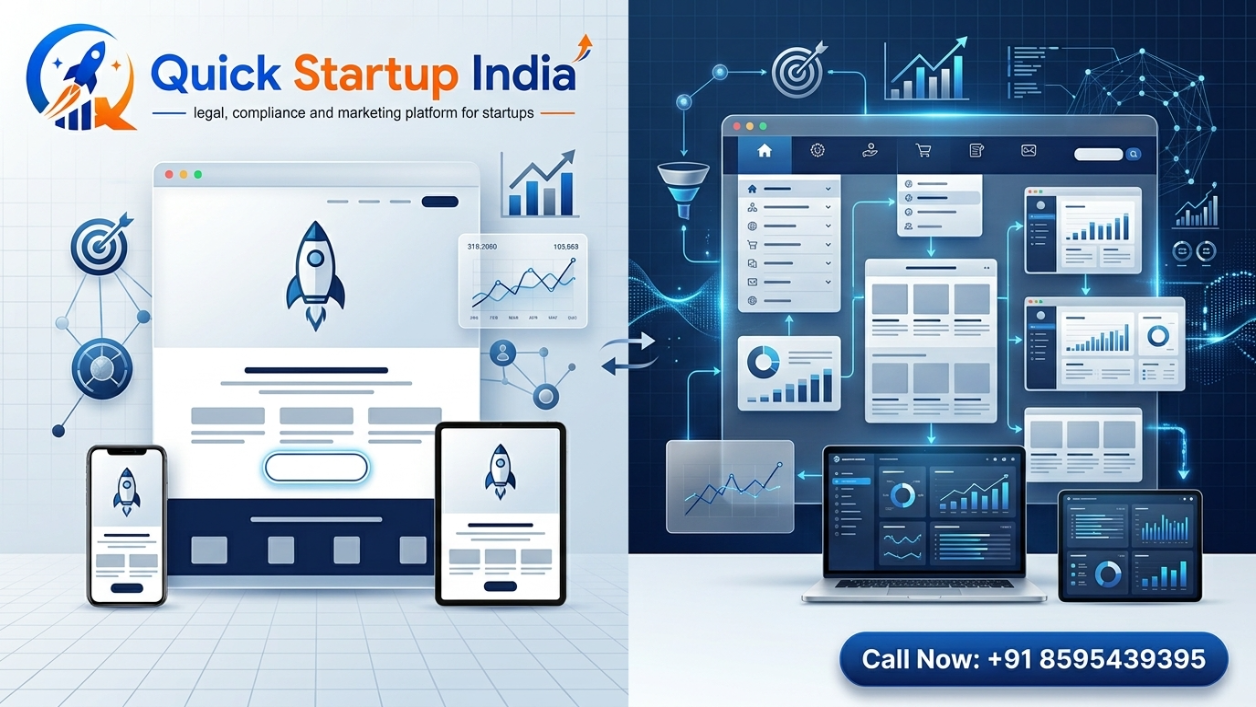
What Is a Landing Page
A landing page is a standalone web page designed with a single, focused objective. It exists to convert visitors into a specific outcome: a purchase, a sign-up, a consultation booking, a download, or a lead enquiry. Every element of a landing page, from the headline to the copy to the call-to-action button, is designed to move the visitor toward that single conversion goal.
Landing pages are typically reached through a specific traffic source: a paid advertisement, an email campaign, a social media link, or a search engine result for a specific keyword. The specificity of both the traffic source and the page’s objective is what makes landing pages effective conversion tools. A visitor who clicks on an advertisement for a specific product and lands on a page entirely focused on that product is far more likely to convert than a visitor who is taken to a general homepage and left to navigate.
What a Landing Page Typically Contains
- A single, clear headline that matches the advertisement or link the visitor came from.
- A subheadline that reinforces the primary value proposition.
- Focused, benefit-oriented copy that addresses the visitor’s specific need or pain point.
- Social proof elements: testimonials, reviews, client logos, case studies, or trust badges.
- A single, prominent call-to-action that tells the visitor exactly what to do next.
- A form, button, or contact mechanism that enables the conversion action.
- Minimal navigation, typically no main navigation menu, to prevent visitors from leaving the page without converting.
What a Landing Page Does Not Typically Contain
- A full navigation menu linking to other sections of the site.
- Extensive information about the company’s history, team, or full product range.
- Multiple calls-to-action competing for the visitor’s attention.
- Blog content, resource libraries, or informational content not directly relevant to the conversion goal.
What Is a Full Website
A full website is a multi-page digital presence that comprehensively represents the business, its products or services, its story, its team, and its relationship with customers and the public. It serves multiple audiences simultaneously: potential customers at different stages of the purchase journey, existing customers seeking support or account management, journalists and investors researching the company, job seekers, and partners.
A full website is designed to be discovered, explored, and trusted, rather than to convert a specific visitor from a specific source within a single session. It builds credibility through depth, provides information that addresses a wide range of questions, and creates the foundation of the brand’s digital identity.
What a Full Website Typically Contains
- Home page that communicates the brand’s core value proposition and directs visitors to relevant sections.
- Product or service pages that describe the full range of offerings in detail.
- About page that communicates the company’s story, mission, team, and values.
- Contact page with multiple contact options.
- Blog or resources section for content marketing and SEO.
- Case studies or portfolio showcasing past work and results.
- FAQ section addressing common customer questions.
- Privacy policy, terms of service, and other legal pages.
- Career pages where relevant.
Core Differences at a Glance
| Dimension | Landing Page | Full Website |
|---|---|---|
| Primary purpose | Convert a specific visitor action | Represent the business comprehensively |
| Number of pages | One (or a small sequence of connected pages) | Multiple, often ten to hundreds |
| Navigation | Minimal or none | Full navigation menu |
| Calls-to-action | Single, focused | Multiple across different pages |
| Traffic source | Specific: ads, email, campaigns | Multiple: organic search, direct, referral |
| Build time | Days to weeks | Weeks to months |
| Cost | Lower | Higher |
| SEO value | Limited (narrow keyword focus) | High (multiple pages, content depth) |
| Credibility signal | Moderate | High |
| Best for | Specific campaigns, product launches, lead generation | Established businesses, complex offerings, B2B sales |
When a Landing Page Is the Right Choice
You Are Running a Paid Advertising Campaign
Paid traffic, whether from Google Ads, Meta Ads, or any other paid channel, is expensive. Every visitor who clicks an advertisement costs money. Sending paid traffic to a general homepage that does not specifically address what the advertisement promised wastes that spend and reduces conversion rates.
A landing page that mirrors the advertisement’s message, headline, and offer creates message match, the alignment between what the visitor expected when they clicked and what they find when they arrive. Message match is one of the most reliable drivers of conversion rate improvement in paid campaigns.
You Are Launching a Single Product or Offer
A product launch, a limited-time offer, a new service introduction, or a specific promotional campaign benefits from a dedicated landing page rather than a new page added to an existing website. The landing page can be built, tested, and optimised independently of the broader website, and it can be taken down or replaced when the campaign ends without affecting the overall site structure.
You Are Testing Market Demand
Before investing in a full product or service, many businesses use landing pages to test whether there is genuine demand. A landing page describing the proposed product or service, with a call-to-action for pre-orders, waitlist sign-ups, or expressions of interest, allows the business to measure demand before committing to full development. This is a common approach for startups and D2C brands validating new product concepts.
You Need to Move Quickly
Building a full website takes weeks or months. A professional landing page can be built in days. When speed to market matters, such as a seasonal promotion, a conference deadline, or a product launch with a fixed date, a landing page allows the business to establish its digital presence without waiting for a full website to be completed.
Your Conversion Goal Is Single and Specific
If the only thing you want visitors to do is fill in a form, book a call, download a document, or buy a specific product, a landing page’s single-focus design is superior to a full website. A full website gives visitors options; a landing page gives them one choice.
When a Full Website Is the Right Choice
Your Business Sells a Complex or High-Consideration Product or Service
B2B services, professional services (legal, financial, medical, consulting), high-value consumer purchases, and complex technology solutions require buyers to do significant research before committing. A buyer considering a legal service provider or a software platform for their business will want to understand the company’s credentials, team, client history, pricing approach, and values before initiating contact. A single landing page cannot provide this depth. A full website can.
Your Business Needs to Be Found Through Organic Search
Search engine optimisation requires content depth. Google’s algorithm rewards websites that comprehensively address topics across multiple pages with relevant, expert content. A single-page landing page can rank for one or two very specific search terms. A full website with a blog, detailed service pages, case studies, and FAQ content can rank for dozens or hundreds of relevant search terms, driving sustained organic traffic without paid advertising spend.
For SEO services that build organic visibility for full websites, Quick Startup India provides complete search engine optimisation support.
Your Business Serves Multiple Audiences or Products
A business with multiple product lines, multiple customer segments, or a mix of B2C and B2B customers cannot serve all these audiences with a single landing page. A full website allows each audience to navigate to the content most relevant to them while maintaining a coherent brand identity.
You Need to Build Long-Term Brand Credibility
For businesses where trust is a significant factor in the purchasing decision, such as financial services, legal services, healthcare, and professional consulting, a full website provides the depth of information and the professional presentation that builds credibility over time. A landing page can support specific campaigns but does not replace the brand foundation that a full website creates.
You Plan to Use Content Marketing
Content marketing, publishing blog posts, guides, case studies, and other educational content to attract and engage potential customers, requires a website infrastructure. Landing pages do not have the structural capacity for content marketing programmes. A business that intends to build organic traffic and thought leadership needs a full website as the platform for this content.
The Hybrid Approach: Landing Pages Within a Full Website Strategy
The most sophisticated digital strategies use landing pages and full websites as complementary tools rather than alternatives.
Campaign-Specific Landing Pages Alongside the Main Website
An established business with a full website creates dedicated landing pages for specific campaigns that require focused conversion environments. A financial services company might have a comprehensive website covering all its services but create a dedicated landing page for a specific loan product promotion that is targeted through a paid search campaign. The landing page converts; the website builds credibility for visitors who arrive through other channels.
The Website Homepage Is Not a Landing Page
A common mistake is trying to make the website homepage serve as a landing page by stripping out navigation and focusing it on a single conversion. This creates an unsatisfying experience for visitors who arrive through organic search or direct referral and expect a navigable website. Homepages and landing pages serve different purposes and should be designed accordingly.
Using Landing Pages to Test Before Building
Before committing to the full website development budget, using a landing page to validate that there is sufficient demand for the business and that the value proposition resonates with the target audience reduces the risk of investing in a full website for an offer that does not convert. Once demand is validated, the full website is built on a more informed understanding of what customers respond to.
Cost Comparison
The cost difference between a landing page and a full website is significant, though both vary widely based on quality, complexity, and the service provider.
Landing Page Cost
A professionally designed and developed landing page typically costs:
- Template-based: Rs. 5,000 to Rs. 20,000.
- Custom designed: Rs. 20,000 to Rs. 80,000.
- High-conversion, A/B tested: Rs. 80,000 to Rs. 2,00,000 and above.
Full Website Cost
A professionally developed full website typically costs:
- Basic informational website (5 to 10 pages, template-based): Rs. 25,000 to Rs. 80,000.
- Mid-tier business website (10 to 20 pages, custom design): Rs. 80,000 to Rs. 3,00,000.
- Complex website (e-commerce, custom functionality, large content): Rs. 3,00,000 and above.
These ranges are wide because the actual cost depends heavily on the design complexity, the number of pages, the functionality required (e-commerce, membership, booking systems, integrations), and the capability of the development partner.
For website development at competitive pricing with professional design and technical quality, We provides complete website development services for businesses of all sizes.
SEO Implications of Each Choice
Landing Pages and SEO
A single landing page can be optimised for a very specific search term and can rank well for that term if the page content, technical optimisation, and backlink profile are strong. However, it cannot compete for a broad range of search terms, cannot capture the full breadth of organic search demand, and does not build the topical authority that signals expertise to search engines.
Landing pages are therefore SEO tools of limited scope, appropriate for very targeted paid and organic campaigns but not as substitutes for a comprehensive SEO strategy.
Full Websites and SEO
A full website, particularly one with a regularly updated blog or resource section, creates the content depth and internal linking structure that allows for ranking across a broad range of relevant search terms. Each page can target different keywords, the internal linking between pages builds topical authority, and the accumulation of content over time creates compounding SEO value that a landing page cannot replicate.
For businesses where organic search is a significant customer acquisition channel, a full website with an active content strategy is not optional. It is the foundation of the SEO programme.
For SEO services tailored to business websites, We provides comprehensive search engine optimisation including keyword strategy, on-page optimisation, and content planning.
Conversion Rate Considerations
Landing pages consistently outperform full websites in conversion rate for specific, targeted traffic. A visitor who arrives on a landing page through a relevant advertisement and finds a page that directly addresses their need, with no navigational distractions, converts at a higher rate than a visitor who arrives on a homepage and must navigate to the relevant product or service page.
This is why paid advertising campaigns should almost always use dedicated landing pages rather than sending traffic to the main website. The incremental investment in building a landing page for each significant campaign typically produces a return through improved conversion rates that far exceeds the development cost.
However, conversion rate should not be the only metric that determines the choice. A business that achieves 3% conversion on its landing page but gets 10,000 visitors per month from organic search to its full website may generate more total conversions from the website than from any individual landing page campaign.
Mobile Optimisation: A Non-Negotiable for Both
More than 70% of web traffic in India comes from mobile devices. Both landing pages and full websites must be fully optimised for mobile: fast loading, touch-friendly design, readable text without zooming, and easy form completion on a phone screen.
Mobile optimisation is typically easier to achieve on a landing page (fewer elements, simpler layout) than on a full website with complex navigation and large amounts of content. But in both cases, it is non-negotiable. A website or landing page that does not perform well on mobile in the Indian market in 2026 is losing the majority of its potential visitors before they even engage with the content.
Making the Decision: A Practical Framework
Ask these questions to determine the right starting point for your specific situation:
Do you have a single, specific conversion goal for this digital presence? If yes, a landing page is likely appropriate. If the goal is broad (build brand awareness, serve multiple customer segments, enable organic discovery), a full website is needed.
Are you running paid advertising campaigns? If yes, you need dedicated landing pages for each campaign regardless of whether you also have a full website.
How complex is your buying process? Simple, impulse, or single-product purchases: landing page may suffice. Complex, researched, or high-value purchases: full website is likely necessary.
How important is organic search as a customer acquisition channel? Critical: invest in a full website. Secondary or irrelevant: a landing page may be sufficient for now.
What is your timeline? Days: landing page. Months: full website.
What is your development budget? Very limited: start with a landing page. Adequate budget: invest in a full website if your business needs one.
Frequently Asked Questions
Can a landing page hurt SEO?
A standalone landing page with thin content and no internal linking to other pages will not build significant SEO value. It will not harm your existing website’s SEO if it is hosted on a separate subdomain or URL, but it will not contribute to it either. For SEO purposes, a content-rich full website is the appropriate investment.
Should I use a website builder or hire a developer?
Website builders (such as Wix, Squarespace, and Webflow) are appropriate for businesses with very limited budgets and relatively simple needs. For businesses that need custom design, performance optimisation, integration with business systems, or ongoing SEO support, professional development provides a higher quality outcome and better long-term return.
How long does it take to see results from a landing page?
A landing page connected to paid advertising can begin generating leads or conversions from the day it is launched, as soon as the ad campaign is live. Organic traffic to a landing page builds more slowly and depends on the competitiveness of the target keyword.
Should a D2C brand start with a landing page or a full website?
Many D2C brands launch with a landing page or a simple Shopify store to validate demand and begin generating revenue, then invest in a more comprehensive website as the brand scales. This is a sensible sequencing that prioritises commercial validation over upfront investment in infrastructure.
Conclusion
A landing page and a full website are not competing choices but tools designed for different jobs. A landing page is the right tool when the objective is specific, the traffic source is defined, and conversion is the immediate priority. A full website is the right tool when the business needs to be discovered, explored, and trusted by multiple audiences over time.
Most businesses need both at different stages of their growth: they start with focused pages that generate early revenue, and they build comprehensive websites as their brand, customer base, and content strategy mature. The decision of which to invest in first depends on where the business is now, what its most pressing commercial need is, and what its customers expect when they encounter the brand online.
Start with what serves your current commercial objective. Build toward what your business will need as it grows. And invest in quality at both stages, because the first impression your digital presence makes is the one that determines whether a visitor becomes a customer.
Get Expert Website and Digital Marketing Support
🟡 Quick Startup India provides complete website development, landing page design, SEO, social media marketing, and digital advertising support for businesses across all sectors.
👉 Website Development 👉 SEO Services 👉 Social Media Marketing 👉 Google and Facebook Ads 👉 Logo Design 👉 Branding Services 👉 Lead Generation 👉 LinkedIn Services
👉 Trademark Registration 👉 Copyright Registration 👉 Design Registration 👉 Brand Protection and Anti-Counterfeiting
📞 Call Now: +91 8595439395 🕐 Free Consultation: Monday to Saturday, 9 AM to 6 PM

Anjali is a Digital Marketing Expert at Quick Startup India who builds websites that rank and convert. She specializes in SEO-driven web development, helping people find the right legal help online.


