

Views: 0
Table of Contents
- 1 Introduction
- 2 What Is a Static Website?
- 3 What Is a Dynamic Website?
- 4 Key Differences: Static vs Dynamic
- 5 The JAMstack and Headless CMS: Bridging the Gap
- 6 Which Type of Website Does Your Indian Business Actually Need?
- 7 Popular Platforms for Each Approach in India
- 8 SEO Implications for Indian Businesses
- 9 Common Mistakes Indian Businesses Make
- 10 Frequently Asked Questions
- 11 Conclusion
- 12 Need Help Building the Right Website for Your Indian Business?
Introduction
Every Indian business that decides to build a website faces an early and consequential choice — often without realising it is a choice at all. The web developer asks a few questions, proposes a solution, and the business owner says yes. A few weeks later, a website exists. But whether that website is the right type of website for the business’s actual needs — that question is rarely asked clearly before the work begins.
The fundamental distinction in website architecture is between static websites and dynamic websites. These are not just technical categories — they represent genuinely different approaches to what a website is, what it does, how it is built, what it costs to build and maintain, and how well it serves different types of businesses.
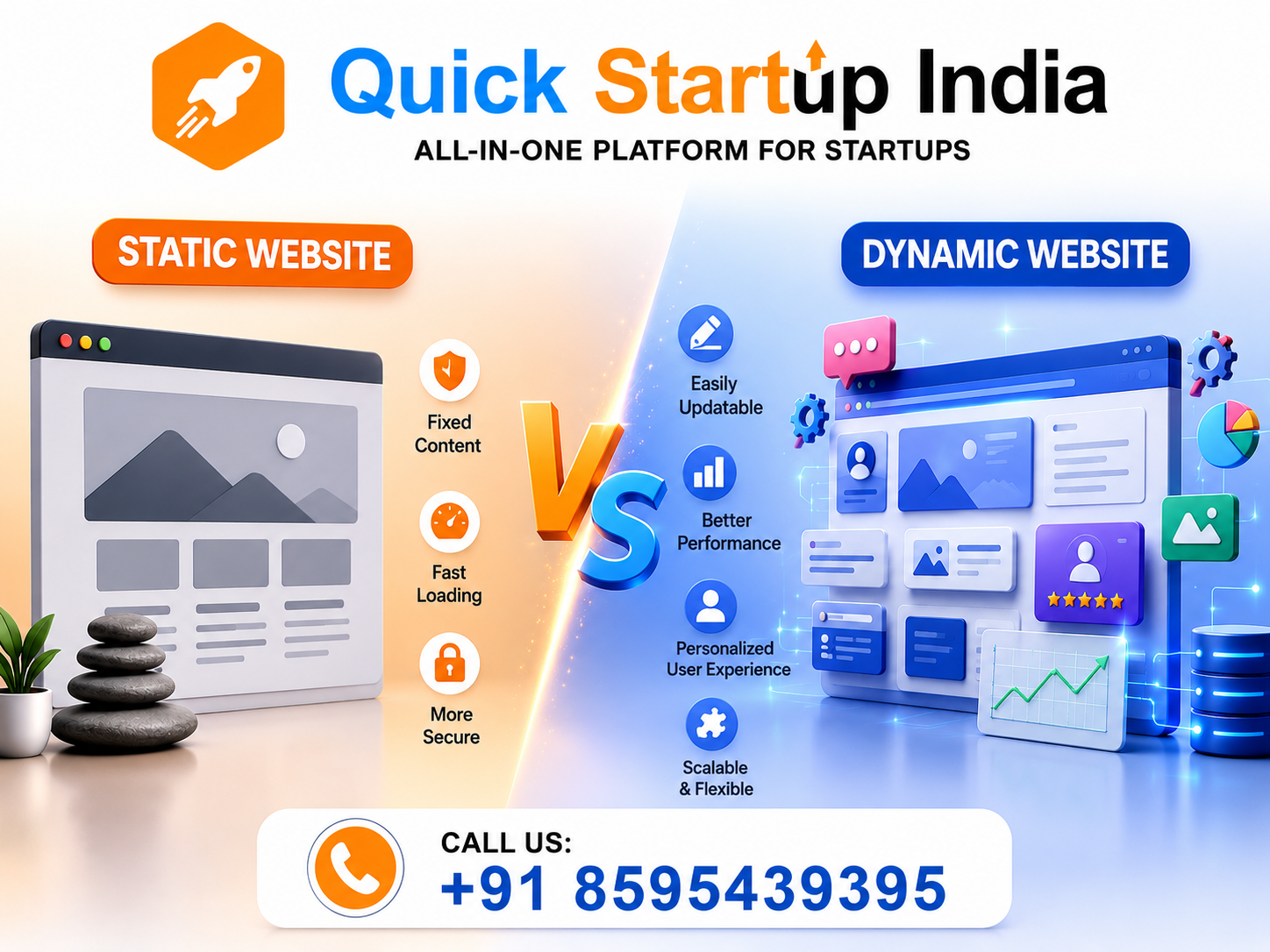
A static website is fixed — its pages are pre-built and delivered to every visitor in the same form. A dynamic website generates content in real time, pulling from databases, responding to user inputs, and presenting different content to different visitors based on context. The difference matters enormously for cost, performance, security, scalability, and fit for purpose.
In India in 2026, the website decisions that businesses make — small manufacturers, local service providers, e-commerce startups, professional firms, educational institutions — have more options and more complexity than ever. No-code builders, content management systems, progressive web apps, headless CMS architectures, and AI-assisted site builders have expanded the range of choices available. Understanding the foundational distinction between static and dynamic is the starting point for making sense of all of it.
This guide is written for Indian business owners, decision-makers, and entrepreneurs who need a clear, practical answer to a practical question: for my business, at this stage, what kind of website do I actually need?
What Is a Static Website?
A static website consists of fixed files — HTML, CSS, and JavaScript — that are stored on a web server and delivered to every visitor exactly as they are stored. When a visitor requests a page, the server sends that pre-built file directly to the browser. Nothing is generated at the time of the request. Nothing changes based on who is visiting, when they are visiting, or what they have done before.
The word “static” refers to the server-side behaviour of the website — the files do not change when served. A static website can still have visual animations, interactive elements, and engaging design — these are handled by JavaScript in the browser. But the underlying content of each page is fixed at the time the site is built or last updated.
How Static Websites Are Built
Historically, static websites were built by writing HTML files by hand. Today, most static websites are built using Static Site Generators (SSGs) — tools that take content (written in Markdown or pulled from a CMS) and templates, and compile them into a set of static HTML files ready for deployment.
Popular static site generators include:
📋 Next.js (with static export) — widely used for React-based static sites 📋 Gatsby — React-based, popular for content-heavy static sites 📋 Hugo — extremely fast build times, popular for documentation and blogs 📋 Jekyll — one of the earliest SSGs, used by GitHub Pages 📋 Astro — a newer SSG optimised for content-focused websites with minimal JavaScript
Static websites are typically deployed on Content Delivery Networks (CDNs) — platforms like Netlify, Vercel, Cloudflare Pages, or AWS CloudFront that distribute the website’s files across servers globally, delivering them to visitors from the nearest server location.
Examples of Static Websites
📋 A portfolio website for a freelance designer or photographer 📋 A brochure website for a law firm or accounting practice 📋 A product landing page for a single product or service 📋 A documentation site for a software product 📋 A personal or company blog where content is published infrequently 📋 A wedding or event website
What Is a Dynamic Website?
A dynamic website generates its pages in real time — at the moment a visitor makes a request, the server queries a database, processes logic, assembles the relevant content, and sends the resulting page to the browser. Different visitors may see different content. The same visitor may see different content on different visits. Content changes without requiring the site files to be rebuilt and redeployed.
The word “dynamic” refers to the server-side behaviour — the content is dynamically assembled for each request based on data, user context, and application logic.
How Dynamic Websites Are Built
Dynamic websites are built using server-side technologies — programming languages and frameworks that run on the web server and process requests in real time:
📋 PHP — the most widely used server-side language for web applications, powering WordPress, Magento, and millions of custom sites 📋 Python — used with frameworks like Django and Flask for web applications 📋 Node.js — JavaScript on the server side, used with frameworks like Express 📋 Ruby on Rails — popular for rapid application development 📋 Java and .NET — used in enterprise web applications
Dynamic websites typically rely on a database — MySQL, PostgreSQL, MongoDB, or similar — to store and retrieve content, user data, product information, and other variable data.
Popular Content Management Systems (CMS) — WordPress, Drupal, Joomla — are dynamic website platforms that allow non-technical users to manage content through an admin interface without touching code.
Examples of Dynamic Websites
📋 An e-commerce store where product inventory, prices, and availability change in real time 📋 A news or media website publishing dozens of articles daily 📋 A job portal where employers post listings and job seekers create profiles and apply 📋 A banking or financial services portal where users log in and see their own account data 📋 A booking platform for hotels, flights, or appointments 📋 A learning management system where students access courses and track progress 📋 A social media platform
Key Differences: Static vs Dynamic
Understanding the core differences between static and dynamic websites across the dimensions that matter most to a business decision:
Performance and Speed
📋 Static websites are inherently faster. Since there is no server-side processing — no database query, no page assembly — the time to deliver a page to the browser is minimal. Static files served from a CDN reach visitors at near-optimal speed from servers geographically close to them.
📋 Dynamic websites have more latency because every page request involves server processing and database queries. A well-optimised dynamic website with good caching can be fast — but it requires more engineering effort and infrastructure investment to achieve the same baseline speed as a static site.
For Indian businesses serving users across a geographically diverse country — from metro cities to Tier 2 and Tier 3 towns — website speed matters enormously. Google’s Core Web Vitals, which directly affect search rankings, reward fast-loading pages. A static site on a good CDN naturally performs well on these metrics.
Security
📋 Static websites have a much smaller attack surface. There is no database to inject, no server-side code to exploit, no CMS admin panel to brute-force. A static site served from a CDN is essentially immune to the most common categories of web attacks — SQL injection, remote code execution, authentication bypass.
📋 Dynamic websites are more vulnerable — not because dynamic sites are inherently insecure, but because they have more components that can be attacked. A poorly maintained WordPress installation — with outdated plugins, weak admin passwords, and no security hardening — is one of the most common vectors for web compromise in India and globally. Proper security for a dynamic website requires ongoing vigilance: updates, patches, security scanning, and access controls.
For Indian businesses that do not have dedicated IT or web security resources — which is most small and medium businesses — the lower security maintenance burden of a static site is a meaningful practical advantage.
Cost
📋 Static websites cost less to build and host. Hosting a static site on platforms like Netlify, Vercel, or Cloudflare Pages is free or very low cost — typically Rs. 0 to Rs. 2,000 per month for most business websites. There is no server to manage, no database to maintain, no CMS to license.
📋 Dynamic websites cost more — both in initial development and ongoing hosting and maintenance. A VPS or cloud server to run the application and database, database maintenance, CMS updates and plugin management, and occasional developer time for fixes and updates add up. Hosting a properly configured dynamic website costs Rs. 2,000 to Rs. 20,000 per month or more depending on traffic and complexity.
For an Indian startup or small business where every rupee of operating cost matters, the lower total cost of ownership of a static website is a real consideration — particularly for websites that do not need dynamic functionality.
Scalability
📋 Static websites scale effortlessly. Because they are just files on a CDN, serving 100 visitors or 100,000 visitors simultaneously requires no infrastructure changes. The CDN handles the load automatically. A viral product launch or a feature in a major publication cannot bring down a static site.
📋 Dynamic websites require more infrastructure planning to scale. Under high traffic, the server processing requests and querying databases becomes a bottleneck. Scaling requires load balancers, database optimisation, caching layers, and horizontal scaling of application servers — all of which add complexity and cost.
Ease of Content Updates
📋 Static websites are less convenient for frequent content updates — particularly for non-technical users. Updating content typically requires editing code or Markdown files and redeploying. Modern static site generators connected to headless CMS platforms (like Contentful, Sanity, or Netlify CMS) have reduced this friction — but it is still more complex than a WordPress dashboard.
📋 Dynamic websites with a CMS are much easier to update for non-technical staff. Adding a blog post, updating a product description, changing a price — these can be done through a browser-based admin interface by anyone who can use a word processor. For businesses that publish content frequently, this ease of update is a significant operational advantage.
Functionality and Features
📋 Static websites have inherent limitations in terms of server-side functionality. They cannot process form submissions natively (though third-party services like Formspree or Netlify Forms can handle this), cannot manage user accounts and authentication without third-party services, and cannot generate personalised content server-side.
📋 Dynamic websites can do anything — user registration and login, personalised dashboards, real-time inventory management, payment processing, search with complex filters, recommendation engines, and every other feature that requires server-side logic and data persistence.
The JAMstack and Headless CMS: Bridging the Gap
A significant development in web architecture that is highly relevant to Indian businesses evaluating their options is the rise of the JAMstack approach — and the related concept of the headless CMS.
JAMstack (JavaScript, APIs, and Markup) is an architecture where the frontend of a website is built as a static site — fast, secure, cheap to host — but dynamic functionality is provided through APIs called from the browser via JavaScript. User authentication, form processing, payments, search, and personalisation are handled by specialised third-party services (APIs) rather than by a custom server-side application.
A headless CMS separates the content management function (the backend where editors create and manage content) from the presentation layer (the frontend that visitors see). Content is managed in the CMS and delivered to the static frontend via API. The result: the content editing experience of a dynamic CMS combined with the performance and security of a static frontend.
For Indian businesses, the JAMstack and headless CMS approach offers a compelling middle ground:
📋 Fast, secure, inexpensive static frontend with global CDN delivery 📋 Easy content management through a familiar CMS interface 📋 Dynamic functionality (forms, payments, search) through specialised API services 📋 Lower total cost of ownership than a traditional dynamic CMS
Popular headless CMS options used in India include Contentful, Sanity, Strapi (open source, self-hosted), and WordPress in headless mode (using its REST API or GraphQL API to feed content to a static frontend).
Which Type of Website Does Your Indian Business Actually Need?
With the technical foundations established, the practical question for business owners is: which approach is right for my specific situation?
Choose a Static Website If:
📋 Your website is primarily informational — you want visitors to learn about your business, your services, your team, and how to contact you. A law firm, a chartered accountancy practice, a consulting firm, a manufacturing company’s corporate website, or a medical clinic’s information site — these are all informational websites that do not need dynamic server-side functionality.
📋 You have a limited budget — if website hosting and maintenance cost is a significant consideration, a static site’s near-zero hosting cost and lower maintenance overhead is a real advantage.
📋 Website speed and SEO performance are priorities — for businesses that depend on organic search traffic, the inherent speed advantages of static sites translate directly to better Core Web Vitals scores and potentially better search rankings.
📋 You do not need user accounts or personalised content — if every visitor sees the same content and there is no need for login, profiles, or personalisation, there is no functional reason to build a dynamic site.
📋 Security is a concern and IT resources are limited — for businesses that cannot dedicate resources to ongoing CMS security maintenance, a static site’s minimal attack surface is a practical security advantage.
📋 Your content updates are infrequent — if the website content changes monthly or quarterly rather than daily, the convenience of a dynamic CMS is less important and the simplicity of a static site is more appealing.
Choose a Dynamic Website If:
📋 You need an e-commerce store — product catalogues with inventory, shopping carts, order management, payment processing, and customer accounts require dynamic functionality. There is no practical way to build a full-featured e-commerce store as a purely static site.
📋 You publish content frequently — a news website, a blog with daily posts, an educational platform with regularly updated content — these benefit from the easy content management that a dynamic CMS provides.
📋 You need user registration and accounts — if your business model requires users to register, log in, manage profiles, track orders, access personalised content, or interact with each other, you need a dynamic application.
📋 You need complex search and filtering — product search with multiple filters, job search by location and category, property search by size and price — these require server-side database queries that static sites cannot perform natively.
📋 You are building a web application — booking systems, appointment scheduling, customer portals, CRM integrations, real-time dashboards — all of these are web applications that require dynamic server-side logic.
📋 Your content is driven by a database — if your website displays data that changes frequently and programmatically — stock prices, live scores, product availability, user-generated content — dynamic architecture is the appropriate choice.
The Indian Business Decision Matrix
Small service businesses (local retailers, salons, clinics, coaches, consultants): Static website — informational, fast, inexpensive to maintain, sufficient for the need.
Professional firms (law firms, CA firms, architects, engineers): Static or JAMstack — professional presentation, possibly a blog, contact forms handled via API. No need for dynamic server infrastructure.
Manufacturing companies (B2B manufacturers, exporters): Static or JAMstack — product catalogue, company profile, export inquiry form. Dynamic only if a dealer portal or B2B ordering system is needed.
E-commerce businesses (selling products online): Dynamic — Shopify, WooCommerce, Magento, or a custom-built store. No practical alternative.
Educational institutions (schools, coaching centres, EdTech startups): Dynamic if student portals, course management, or admissions systems are needed. Static if the website is just informational.
Restaurants and food businesses (local restaurants, cloud kitchens, food brands): Static or JAMstack if the website is informational with a menu. Dynamic if online ordering and table booking are required.
Startups (SaaS products, platform businesses, marketplaces): Dynamic — web applications by definition require dynamic architecture. Marketing pages can be static (JAMstack), the application itself will be dynamic.
Real estate businesses (builders, agents, property portals): Dynamic — property search, filtering by location and budget, enquiry management, and agent portals all require dynamic functionality.
Popular Platforms for Each Approach in India
Static Website Platforms
📋 Webflow — visual design tool that generates clean static code, popular with design-conscious businesses and agencies in India 📋 Framer — newer visual design and publish platform, gaining popularity in India’s startup and design community 📋 GitHub Pages + Jekyll/Hugo — free hosting, popular for technical documentation and developer portfolios 📋 Netlify / Vercel — deployment platforms for JAMstack sites, used by development teams building custom static sites
Dynamic CMS Platforms
📋 WordPress — the most widely used CMS in India — flexible, well-supported, with a large ecosystem of Indian developers and agencies 📋 Shopify — the dominant platform for e-commerce in India for small and medium sellers — fully hosted, no server management required 📋 WooCommerce — WordPress-based e-commerce, preferred by businesses that want more control than Shopify provides 📋 Magento / Adobe Commerce — used by larger Indian e-commerce businesses with complex catalogues and custom requirements 📋 Drupal — used by government websites, large enterprises, and organisations with complex content structures
No-Code / Low-Code Builders (Hybrid)
📋 Wix — popular among small Indian businesses for its ease of use, offers both informational and e-commerce capabilities 📋 Squarespace — used by Indian creative professionals and small businesses for polished visual presentation 📋 Dukaan — Indian platform for setting up simple online stores, popular among small D2C brands
SEO Implications for Indian Businesses
Search engine optimisation is a priority for most Indian businesses building websites — organic traffic from Google is the primary discovery channel for many business categories. The static vs dynamic choice has direct SEO implications.
📋 Page speed — static sites are inherently faster, and Google’s Core Web Vitals (Largest Contentful Paint, Cumulative Layout Shift, Interaction to Next Paint) directly affect search rankings. A faster static site has a structural advantage on this dimension.
📋 Crawlability — static HTML pages are easily crawled and indexed by Google. Some dynamic frameworks that rely heavily on client-side JavaScript rendering can create indexing delays — though Google has significantly improved its JavaScript rendering capability.
📋 Content freshness — dynamic websites that publish content frequently signal freshness to Google, which benefits news and content-heavy sites. Static sites that update infrequently may be crawled less often.
📋 Technical SEO control — both static and dynamic sites can implement proper meta tags, schema markup, sitemap generation, and canonical URLs. Static site generators and modern CMS platforms both support these requirements.
For most Indian business websites — informational, service-focused, local SEO oriented — a well-built static site will perform as well or better than a dynamic site on search rankings, primarily because of its speed advantage.
Common Mistakes Indian Businesses Make
Building a dynamic CMS site when a static site would suffice: Many Indian web developers default to WordPress for every project because it is familiar — even for simple informational websites that have no need for dynamic functionality. The result is a heavier, slower, more expensive, and more maintenance-intensive website than the business actually needs.
Choosing a platform based on what the developer knows rather than what the business needs: The right website is the one that fits the business’s requirements — not the one that the available developer is most comfortable building.
Underestimating ongoing maintenance costs of dynamic sites: A WordPress website is not a one-time cost. Security updates, plugin updates, hosting costs, occasional developer time for fixes, and backups are recurring costs that many business owners do not anticipate when the site is first built.
Overbuilding for current needs: An early-stage business that builds a complex dynamic web application before validating its product-market fit wastes resources. A static marketing site or simple landing page is often sufficient for the validation stage — the complex application can be built once there is a proven business need.
Ignoring mobile performance: India’s internet users are predominantly mobile — a website that loads slowly on a 4G or 5G mobile connection fails a majority of visitors. Static sites served from CDNs are naturally well-optimised for mobile delivery. Dynamic sites require specific mobile performance optimisation.
Frequently Asked Questions
Which type of website is cheaper in India?
Static websites are generally cheaper because they require less development, maintenance, and server resources compared to dynamic websites.
Why do businesses prefer dynamic websites?
Businesses choose dynamic websites for flexibility, regular updates, customer interaction, online payments, and advanced business features.
Can a static website be converted into a dynamic website later?
Yes, businesses can upgrade from a static website to a dynamic website as their operations and online requirements grow.
Is a dynamic website necessary for e-commerce businesses?
Yes, e-commerce websites usually need dynamic features like product management, shopping carts, payment gateways, and customer accounts.
Which website is more secure?
Static websites are generally more secure because they have fewer backend systems and databases that hackers can target.
Conclusion
The static vs dynamic question does not have a universal answer — it has the right answer for your specific business, your specific budget, your specific content needs, and your specific functional requirements.
For the majority of small and medium Indian businesses — professional service firms, local businesses, B2B companies, and early-stage startups — a static or JAMstack website provides everything that is needed: fast performance, low cost, strong security, good SEO, and a professional online presence. The instinct to default to WordPress for every website project is worth questioning.
For businesses with genuine dynamic needs — e-commerce, user accounts, frequent content publishing, booking systems, or web applications — a dynamic platform is the appropriate choice, and the investment in the infrastructure and maintenance it requires is justified by the functionality it delivers.
The most expensive mistake is not choosing the wrong technical architecture — it is building a website without thinking clearly about what the website is actually supposed to do for the business. Answer that question first. The technical choice follows naturally.
Know what your website needs to do. Choose the architecture that does it — efficiently, affordably, and well.
Need Help Building the Right Website for Your Indian Business?
🟡 Quick Startup India provides complete IT solutions for startups and small businesses — from website development and SEO to Google Ads and social media marketing — so your online business is built, grown, and managed under one roof, 24/7.
👉 Website Development 👉 SEO Services 👉 Google / Meta Ads 👉 Social Media Marketing 👉 GMB & Local SEO 👉 Logo Design 👉 Marketing & Branding 👉 Lead Generation 👉 All IT Services
📞 Call Now: +91 8595439395 🕐 Support Available: 24/7 — Always Online

Anjali is a Digital Marketing Expert at Quick Startup India who builds websites that rank and convert. She specializes in SEO-driven web development, helping people find the right legal help online.


