

Views: 2
Table of Contents
- 1 Introduction
- 2 Why Fake Trademark Agents Specifically Target Small Businesses
- 3 10 Warning Signs of a Fake Trademark Agent
- 4 How to Verify a Trademark Agent’s Legitimacy in India
- 5 Common Scams Fake Trademark Agents Run in India
- 6 What to Do If You Have Already Been Scammed
- 7 What Legitimate Trademark Registration Actually Looks Like
- 8 How to Choose a Trusted Trademark Agent in India
- 9 Protecting Your Brand Beyond Trademark Registration
- 10 FAQs
- 11 Conclusion
- 12 Register Your Trademark Safely with Verified Experts
Introduction
Every year in India, thousands of small business owners, startup founders, and entrepreneurs lose money to fake trademark agents operating online. Some lose a few thousand rupees. Others lose lakhs. Almost all of them lose something even more valuable: months or years of time during which their brand remains completely unprotected while they believe it is registered.
The trademark registration industry in India has seen an explosion of fraudulent operators in recent years. They build professional-looking websites, run targeted advertisements on Google and Instagram, promise guaranteed trademark registration at suspiciously low prices, collect your documents and money, and then disappear, file incomplete applications, file in the wrong class, or simply pocket the fees and never file anything at all.
By the time you discover the fraud, it is often too late. Your brand may have been copied. A competitor may have registered the same name. Your business reputation may be at risk. And the fake agent is long gone, unreachable on every number and email they provided.
This is not a rare occurrence. It is one of the most common forms of legal fraud targeting small businesses in India today, and it is getting worse as more entrepreneurs move online to seek legal services.
This guide gives you everything you need to identify fake trademark agents, understand the red flags that signal a fraudulent operation, verify the legitimacy of any trademark service provider before paying them a single rupee, and protect yourself from one of the most preventable frauds in the Indian business ecosystem.
For safe, verified, and expert trademark registration, the IP specialists at LegalTax.in, LegalIP.in, and OnlineTrademark India are fully registered, transparent, and trusted by thousands of businesses across India.
Why Fake Trademark Agents Specifically Target Small Businesses
Before understanding how to spot them, it is important to understand why fake trademark agents are so effective at deceiving people.
Information asymmetry is their biggest weapon. Most small business owners filing a trademark for the first time have no idea what the process involves, how long it takes, what legitimate fees look like, or what documents they should receive. Fake agents exploit this knowledge gap ruthlessly.
The trademark process is naturally slow. A legitimate trademark application takes 12 to 24 months to reach registration. This gives fake agents an enormous window of time before their fraud is discovered. By the time a client realises their application was never filed or was filed incorrectly, the agent has already collected fees from hundreds of other victims.
Fake certificates are easy to fabricate. A professional-looking fake trademark registration certificate can be created in minutes using basic design software. Many fraud victims continue to believe their brand is protected for months or even years while displaying a completely fabricated certificate.
The legal fee structure creates opportunities for confusion. Government fees for trademark registration are Rs. 4,500 per class for individuals and MSMEs and Rs. 9,000 for companies. Total professional service charges vary widely, from a few thousand to tens of thousands of rupees depending on the service provider. This variation gives fake agents room to quote prices that seem legitimate.
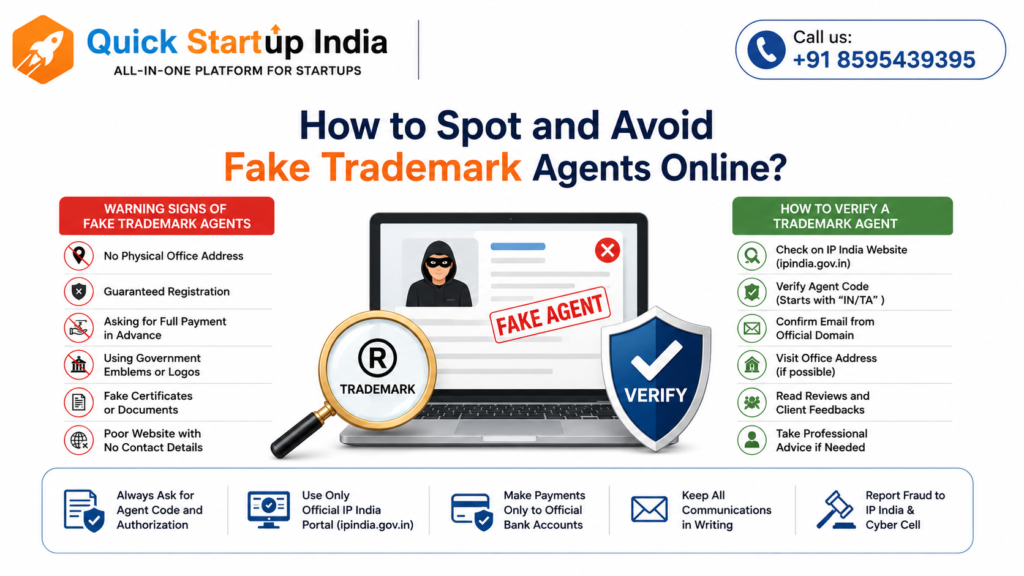
10 Warning Signs of a Fake Trademark Agent
Warning Sign 1: Suspiciously Low Prices With Guaranteed Registration
Legitimate trademark registration involves government fees of Rs. 4,500 to Rs. 9,000 per class plus professional service charges. Any agent offering complete trademark registration for Rs. 500, Rs. 999, or even Rs. 1,500 all-inclusive is either lying about what they are providing or planning to never file anything at all.
More importantly, no legitimate trademark agent can guarantee registration. Trademark registration involves examination by the Trade Marks Registry, which may raise objections. If a trademark is too similar to an existing registered mark, it may not be registrable at all. Any agent promising 100% guaranteed registration is making a promise they cannot legally or honestly keep.
Warning Sign 2: No Physical Address or Verifiable Office
A legitimate legal service firm has a real, verifiable office address. Look for the address on their website and verify it on Google Maps. Call the listed number. Ask for an in-person meeting. Fake agents typically list fake addresses, PO boxes, or use addresses of coworking spaces they have no real connection with. Many have no phone number at all, only a WhatsApp number.
Warning Sign 3: No Registration Details for the Agent or Firm
In India, trademark agents who represent others before the Trade Marks Registry must be registered trademark agents under the Trade Marks Act, 1999. A registered trademark agent has a unique registration number issued by the Trade Marks Registry. Ask any agent for their trademark agent registration number and verify it on the official IP India website at ipindia.gov.in.
If an agent cannot provide their registration number, or if the number does not match any record on the official portal, they are not authorised to file trademark applications on behalf of clients. Filing by an unregistered agent can lead to the application being treated as invalid.
Warning Sign 4: They Send You a Certificate Immediately After Payment
The trademark registration process in India takes a minimum of 12 to 18 months. If an agent sends you a “Trademark Registration Certificate” within days or weeks of your payment, it is almost certainly a fabricated document.
The only legitimate document you should receive quickly after filing is the trademark filing receipt or the application number from the IP India portal, which you can verify yourself at ipindiaonline.gov.in by entering your application number. If an agent sends you a colourful certificate with a stamp and signature but cannot give you a verifiable application number, the certificate is fake.
Warning Sign 5: They Ask for Payment Only Through UPI to Personal Accounts
Legitimate legal service firms accept payments through bank transfers to corporate accounts, credit and debit cards, or other formal payment methods. They provide GST invoices for every payment. If an agent insists on payment only through UPI to a personal mobile number, or through cash, and cannot provide a GST invoice, this is a serious red flag.
Always ask for a GST-registered invoice before paying any legal service provider. An invoice with a valid GSTIN can be verified on the GST portal at gst.gov.in.
Warning Sign 6: No Written Agreement or Service Terms
A legitimate legal service provider will give you a written engagement letter or service agreement before beginning work. This document outlines what services will be provided, the timeline, the fees, and the refund policy. Fake agents avoid written commitments because written commitments create legal liability.
If an agent refuses to give you anything in writing or provides only verbal assurances, do not proceed.
Warning Sign 7: They Cannot Explain the Process in Detail
A genuine trademark professional can explain the entire trademark registration process in clear, specific terms: the examination timeline, what an objection is and how it is handled, what the opposition period means, how to track the application status, and what the final certificate looks like. If an agent gives vague answers, changes the subject, or becomes evasive when you ask specific process questions, they do not have the knowledge to legitimately provide the service.
Warning Sign 8: The Website Has No Genuine Reviews, No Team Information, and No Case Studies
Fake trademark agents typically have recently created websites with no genuine client testimonials, no team information, no case studies, and no verifiable track record. They may have a handful of generic five-star reviews that appear to be fabricated. Do not rely on reviews on the agent’s own website. Check Google Reviews, Justdial, and other independent platforms. Look for a verifiable track record of actual trademark registrations.
Warning Sign 9: They Pressure You to Pay Immediately
Urgency and pressure tactics are classic signs of fraud. A fake agent may tell you that your preferred trademark name is about to be taken by someone else and you must pay immediately to block it. They may offer a massive discount that expires in the next few hours. They may claim that a government fee increase is coming tomorrow. Legitimate professionals never use high-pressure tactics to rush your decision. They give you time to verify their credentials and make an informed choice.
Warning Sign 10: They Cannot Show You Your Application Status on the Official Portal
Every trademark application filed with the Trade Marks Registry of India gets a unique application number that is immediately visible and trackable on the official IP India portal at ipindiaonline.gov.in. A legitimate agent should be able to show you your application status on this portal within days of filing.
If an agent says the portal is down, or that your application will appear later, or that you need to trust them because the government system is slow, they have not filed your application. Always verify your application number on the official government portal yourself.
How to Verify a Trademark Agent’s Legitimacy in India
Here is a step-by-step verification process you should follow before engaging any trademark agent:
Step 1: Check the IP India Registered Trademark Agent List Visit the official IP India website at ipindia.gov.in and check the list of registered trademark agents. A legitimate registered trademark agent will appear in this database. This is the single most reliable verification step you can take.
Step 2: Verify Their GST Registration Ask for the firm’s GSTIN and verify it on the GST portal at gst.gov.in. A legitimate legal service firm will have a valid, active GST registration. The GSTIN will also confirm the firm’s legal name and registered address.
Step 3: Search for the Firm on the MCA Portal If the agent claims to be a company or LLP, search for their company name or CIN on the MCA portal at mca.gov.in. This will confirm whether the company actually exists as a registered legal entity.
Step 4: Verify Their Physical Address Search the firm’s address on Google Maps. Check whether the address corresponds to a real office building. Look for the firm’s name on the building directory or online listings. Call the landline number listed on their website.
Step 5: Check Independent Review Platforms Search for the firm’s name on Google Reviews, Justdial, IndiaMART, and other independent review platforms. Look for genuine, detailed reviews from real clients. Be wary of a pattern of very short, generic, five-star reviews with no specific details.
Step 6: Ask for References Ask the agent for contact details of two or three existing clients whose trademarks they have successfully registered. A legitimate agent with a genuine track record will have no hesitation providing references. A fake agent will refuse or provide contacts that cannot be reached.
Step 7: Verify Previous Trademark Filings Ask the agent for examples of trademark applications they have filed. They should be able to provide application numbers that you can verify on the IP India portal. If they cannot provide any verifiable application numbers, they have not actually filed any trademark applications.
Common Scams Fake Trademark Agents Run in India
The Fake Certificate Scam The agent collects your fees, sends you a beautifully designed certificate with stamps and signatures within a few days, and disappears. The certificate is completely fabricated. Your trademark has never been filed. You discover this only when a competitor copies your brand and you try to enforce your rights.
The Partial Filing Scam The agent actually files your trademark application but does so incorrectly: wrong class, wrong applicant name, incomplete description of goods or services, or missing documents. The application is objected to or abandoned. The agent then either disappears or demands additional fees to fix the problem, claiming it is a new issue.
The Fake Objection Scam You receive a message from an agent claiming that your trademark has received an objection from the registry and you must pay an urgent additional fee to respond to it. In reality, no objection exists. The agent is fabricating urgency to extract more money. Always verify any objection claim by checking your application status directly on the IP India portal.
The Renewal Scam You receive a call or email from someone claiming to represent the Trade Marks Registry, saying your trademark is about to expire and you must renew it immediately by paying a fee to them. The Trade Marks Registry of India never contacts trademark holders directly by phone or unsolicited email for renewal. All renewal processes go through registered agents or the official portal.
The Monitoring Scam An agent offers a “trademark monitoring service” claiming they will watch for conflicting applications and alert you. They collect an annual fee and do nothing. Legitimate trademark monitoring is a real service, but it must be provided by verifiable, established IP firms with transparent reporting.
What to Do If You Have Already Been Scammed
If you believe you have been defrauded by a fake trademark agent, take the following steps immediately:
📋 Gather all evidence — Save all communications including WhatsApp messages, emails, payment receipts, and any documents received from the agent.
🔍 Check the IP India portal — Go to ipindiaonline.gov.in and search for any trademark application filed in your name. If no application exists, your money was taken without any filing being made.
🚔 File a police complaint — Visit your nearest police station and file an FIR under the relevant sections of the Indian Penal Code including cheating and fraud. Cybercrime complaints can also be filed at cybercrime.gov.in.
⚖ File a consumer complaint — File a complaint with the National Consumer Disputes Redressal Commission (NCDRC) or your state consumer forum. Online complaints can be filed at consumerhelpline.gov.in.
📢 Report to IP India — Report the fake agent to the Trade Marks Registry at the Office of the Controller General of Patents, Designs and Trade Marks (CGPDTM).
🔄 Engage a legitimate agent immediately — File your trademark application correctly as soon as possible through a verified, registered trademark agent to begin protecting your brand from the date of the new filing.
The legal team at LegalTax.in has helped numerous clients who were previously defrauded by fake agents, assisting them in checking their application status, filing fresh applications where necessary, and pursuing legal remedies against fraudulent operators.
What Legitimate Trademark Registration Actually Looks Like
To help you distinguish genuine service from fraud, here is what the legitimate trademark registration process looks like when handled by a verified professional:
Day 1 to 3: Initial consultation, trademark class identification, comprehensive trademark search conducted on the IP India database, written service agreement provided, GST invoice issued upon payment.
Day 3 to 7: Application prepared with correct applicant details, correct class specification, accurate description of goods or services, and all required documents. Application filed on the IP India portal.
Day 7: Application number shared with client. Client can independently verify application status on ipindiaonline.gov.in. Filing receipt provided.
Month 3 to 6: Examination report issued by Trade Marks Registry. If objection is raised, client is informed immediately and objection reply is prepared and filed within the deadline.
Month 6 to 9: If no objection or after successful objection resolution, trademark is advertised in the Trademark Journal for 4 months for public opposition.
Month 10 to 24: If no opposition is filed during the journal period, trademark registration certificate is issued by the Trade Marks Registry and delivered to the client. This is the genuine, official certificate.
Every step of this process is transparent, verifiable, and documented. There are no shortcuts. There is no guaranteed instant registration. And there is no legitimate reason for a trademark agent to take your money and go silent.
How to Choose a Trusted Trademark Agent in India
When choosing a trademark agent, apply this checklist:
✅ Registered trademark agent number verifiable on ipindia.gov.in ✅ Valid GST registration verifiable on gst.gov.in ✅ Registered company or LLP verifiable on mca.gov.in ✅ Physical office address verifiable on Google Maps ✅ Transparent pricing with written service agreement ✅ GST invoice provided for all payments ✅ Corporate bank account for payments (not personal UPI) ✅ Verifiable past trademark filings with application numbers ✅ Genuine independent reviews on Google and other platforms ✅ Clear explanation of the process including realistic timelines ✅ Direct access to a named professional, not just a call centre ✅ No pressure tactics, no guaranteed registration promises, no instant certificates
LegalTax.in, LegalIP.in, and OnlineTrademark India meet every single item on this checklist. Our trademark filings are verifiable on the IP India portal, our GST registration is active and verifiable, our office address is real and reachable, and our track record of successful trademark registrations across all 45 classes speaks for itself.
Protecting Your Brand Beyond Trademark Registration
Once your trademark is legitimately registered, there are additional steps to fully protect your brand:
Monitor for Conflicting Applications The Trade Marks Registry publishes new trademark applications in the Trademark Journal. Monitoring these publications allows you to identify and oppose any application that conflicts with your registered trademark within the four-month opposition window. The Trademark Opposition specialists at LegalTax.in provide monitoring and opposition services.
Register Your Design If your product has a unique visual design or shape, register it under the Designs Act, 2000 for additional protection. The Design Registration team at LegalTax.in handles the complete process.
Register Your Copyright Original creative works including logos, artistic designs, literary content, and software code are protected by copyright. While copyright arises automatically upon creation, registration provides evidentiary advantage in disputes. The Copyright services team at LegalTax.in can assist with copyright matters.
Renew Your Trademark on Time A registered trademark in India is valid for 10 years and must be renewed before expiry. The Trademark Renewal specialists at LegalTax.in ensure your trademark is renewed on time so your protection never lapses.
FAQs
Who are fake trademark agents?
Fake trademark agents are unauthorized individuals or fraudulent companies that pretend to provide trademark registration services without proper legal qualifications, government authorization, or professional expertise. They often mislead businesses with false promises and cheap pricing.
How do fake trademark agents usually scam businesses online?
Fake agents commonly use spam calls, fake government emails, misleading advertisements, hidden charges, and false claims like “guaranteed trademark approval” or “instant registration” to attract business owners.
How can I verify whether a trademark agent is genuine in India?
You should verify whether the agent is a registered Trademark Attorney, Advocate, or authorized Trademark Agent listed with the Controller General of Patents, Designs & Trade Marks (CGPDTM). Always check business reviews, office details, and official credentials before making payment.
What should I do if I suspect trademark fraud?
You should stop sharing documents immediately, avoid making further payments, collect proof of communication, and report the fraud to cybercrime authorities or the Trademark Registry if necessary.
How can businesses protect themselves from fake trademark agents in 2026?
Businesses should research service providers carefully, verify credentials, avoid unrealistic offers, use official government portals, and work only with trusted legal professionals or reputed trademark consultants for secure registration services.
Conclusion
Fake trademark agents are a serious and growing problem in India, and they deliberately target the entrepreneurs and small business owners who can least afford to lose money and time to fraud. But they survive and thrive only because of the information gap between what clients know and what they need to know.
Now that you know the warning signs, the verification steps, the common scam patterns, and what legitimate trademark registration actually looks like, you have everything you need to protect yourself.
Your brand deserves real protection. Work only with verified, registered, and transparent trademark professionals.
Register Your Trademark Safely with Verified Experts
🟡 LegalTax.in — Verified trademark registration across all 45 classes with transparent pricing, GST invoices, and verifiable filings on the IP India portal. 👉 Trademark Registration at LegalTax.in 👉 Trademark Objection Reply 👉 Trademark Hearing 👉 Trademark Renewal 👉 Trademark Opposed 👉 Trademark Assignment 👉 Design Registration 👉 Copyright Objection Reply
🟡 Specialist IP Services 👉 LegalIP.in 👉 OnlineTrademark India
🟡 Reduce Your Trademark Fees by 50% with MSME Registration 👉 MSME Registration at LegalTax.in
📞 Call Now: +91 8595439395 📧 Email: info@legaltax.in 🕐 Free Consultation: Monday to Saturday, 9 AM to 6 PM

Anjali is a Digital Marketing Expert at Quick Startup India who builds websites that rank and convert. She specializes in SEO-driven web development, helping people find the right legal help online.


