

Views: 1
⚠️ Did You Know? A trademark status of “Objected” is not a rejection — it is a formal objection that must be replied to within 30 days. Missing this deadline can result in your application being permanently abandoned, and all your filing fees and months of waiting going to waste.
Table of Contents
- 1 Introduction
- 2 What Is a Trademark Objection?
- 3 How to Check Trademark Objection Status Online
- 4 What Your Application Number Looks Like
- 5 Understanding Every Trademark Status Code
- 6 Complete Trademark Status Flow Chart
- 7 What Causes a Trademark Objection?
- 8 How to Respond to a Trademark Objection
- 9 Fees for Trademark Objection Reply
- 10 Common Mistakes to Avoid When Responding to a Trademark Objection
- 11 Common Trademark Objection Scenarios
- 12 Timeline: From Filing to Registration
- 13 Frequently Asked Questions
- 14 Conclusion
- 15 Need Help With Trademark Objection Reply or Registration?
Introduction
Filing a trademark application is the first step in protecting your brand in India. But the journey from filing to registration involves multiple stages, and the most critical — and most misunderstood — is the Objected status.
The Intellectual Property India (IP India) Registry operates through a series of status updates that signal where your application stands. Understanding these updates is crucial because each one often comes with a set of mandatory actions and strict statutory deadlines. A status of “Objected” requires a legal response within 30 days; an “Opposition” requires a counter-statement within two months. Missing these windows leads to the immediate “Abandonment” of your mark, rendering months of effort and significant government fees useless.
Every year, thousands of trademark applications in India are abandoned — not because the mark was unregistrable, but because the applicant did not check the status in time, did not understand what “Objected” meant, or failed to respond within the deadline. A brand that could have been registered and protected is instead left unprotected, and competitors are free to use and register a similar name.
In 2026, the IP India portal has been significantly upgraded and most status checks are available online in real time, without the need for any login. This guide covers exactly how to check trademark objection status online in India, what every status code means, what to do when your application is objected, and how to respond effectively to protect your brand.
What Is a Trademark Objection?
A trademark objection is a formal objection raised by the Trademark Registrar during the trademark registration process. This legal hurdle arises when the trademark application does not comply with specific legal norms or overlaps with an existing trademark as per the Trade Marks Act, 1999.
A trademark objection is issued through a document called the Examination Report. This report is prepared by the Trademark Examiner after substantive examination of your application. The report sets out the specific reasons why the examiner believes your mark should not be registered in its present form.
Objection vs. Opposition — A Critical Distinction
The two terms are frequently confused. They arise at entirely different stages of the registration process and involve different parties.
| Parameter | Objection | Opposition |
|---|---|---|
| Raised by | Trademark Examiner (Registry) | Any third party (a business or individual) |
| Stage | During examination, before publication | After publication in the Trademark Journal |
| Deadline to respond | 30 days from date of Examination Report | 4 months from date of publication |
| Portal action | Reply via MIS-R online | Counter-statement via TM-O |
| Risk if ignored | Application abandoned | Application abandoned |
Understanding this distinction is essential. If your status shows “Objected,” you are dealing with an examiner’s objection and must file a written reply. If your status shows “Opposed,” a third party has challenged your mark after publication and you must file a counter-statement.
How to Check Trademark Objection Status Online
Method 1: IP India eRegister Portal (Primary Method)
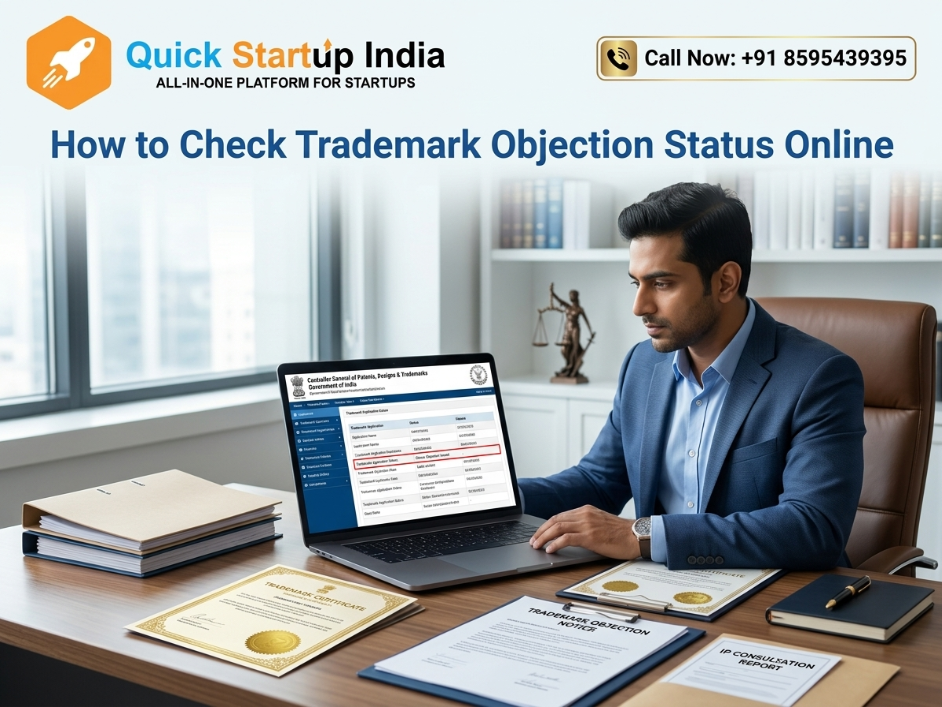
The primary tool for checking trademark status is the IP India eRegister portal: ipindiaonline.gov.in/eregister/eregister.aspx. Enter your application number and captcha. It is free, instant, and no login is required.
Step-by-Step Process:
Step 1: Visit the official Trademark eRegister portal at the E-Register & Application Status page. Step 2: Enter any valid email address or mobile number to receive a one-time password (OTP). This OTP is session-specific and does not need to match the address on file with the Registry. Step 3: Enter the OTP to authenticate the session. Step 4: Enter your trademark application number. The TM status displayed on the portal reflects the current stage of your application. Step 5: If the status is Registered, a ‘View Registration Certificate’ link appears at the top of the record.
The portal displays:
- Current application status
- Date of last status change
- Name and class of the trademark
- Name of the applicant and agent
- Vienna Codification (for device/logo marks)
- History of all previous statuses
Method 2: IP India Public Search Portal (If You Don’t Have Your Application Number)
If you have misplaced your application number, you can retrieve it through the public search portal.
Use the Public Search portal: search.ipindia.gov.in/tmrpublicsearch. Search by trademark name, applicant name, or agent name. The search results show application numbers. Note the number and use the eRegister portal for detailed status.
Method 3: IP India Official Website
- Go to www.ipindia.gov.in
- Click on the “Trademarks” section in the top navigation menu
- Select “Trademark Status” or “eRegister”
- Enter your application number and complete the OTP process
💡 Practical Tip: How often you check the status of a trademark application should depend on what stage it is at. While the status shows “Marked for Exam,” checking every two to three weeks is sufficient. Once the status changes to “Objected,” check daily — the 30-day reply deadline runs from the date of the examination report, and every day counts.
What Your Application Number Looks Like
Your trademark application number is a 7 or 8-digit number assigned at the time of filing. It is printed on:
- The acknowledgement receipt issued at the time of filing
- Any correspondence from your trademark agent or attorney
- The Form TM-A filing confirmation email from the IP India portal
If you cannot locate your application number through any of these sources, use the public search portal to find it by searching your brand name and applicant name.
Understanding Every Trademark Status Code
The IP India portal uses specific status codes that have precise legal meanings. Here is what each status means and what action — if any — you need to take:
New Application
The application has been received and filed. Administrative processing is in progress. No action required at this stage.
Formalities Check Pass
The application has cleared the formal administrative check. It is now in the queue awaiting allocation to an examiner for substantive examination. No action required.
Formalities Check Fail
The application has failed the administrative check due to a deficiency — missing documents, incorrect form, incomplete information, or unpaid fees. The applicant must respond to the formalities objection promptly or the application will not proceed.
⚠️ Warning: A Formalities Check Fail is time-sensitive. Check the specific deficiency noted on the portal and rectify it immediately. Prolonged inaction can result in the application being treated as withdrawn.
Send Back to Formalities / Marked for Exam
The application is in the examination queue, waiting for an examiner to be assigned. The examination queue in India currently runs 12–14 months as of early 2026, though this varies by class. A status that appears stuck between “Marked for Exam” and “Objected” is almost always sitting in the queue, not stalled due to a problem.
Objected ⚠️ — ACTION REQUIRED
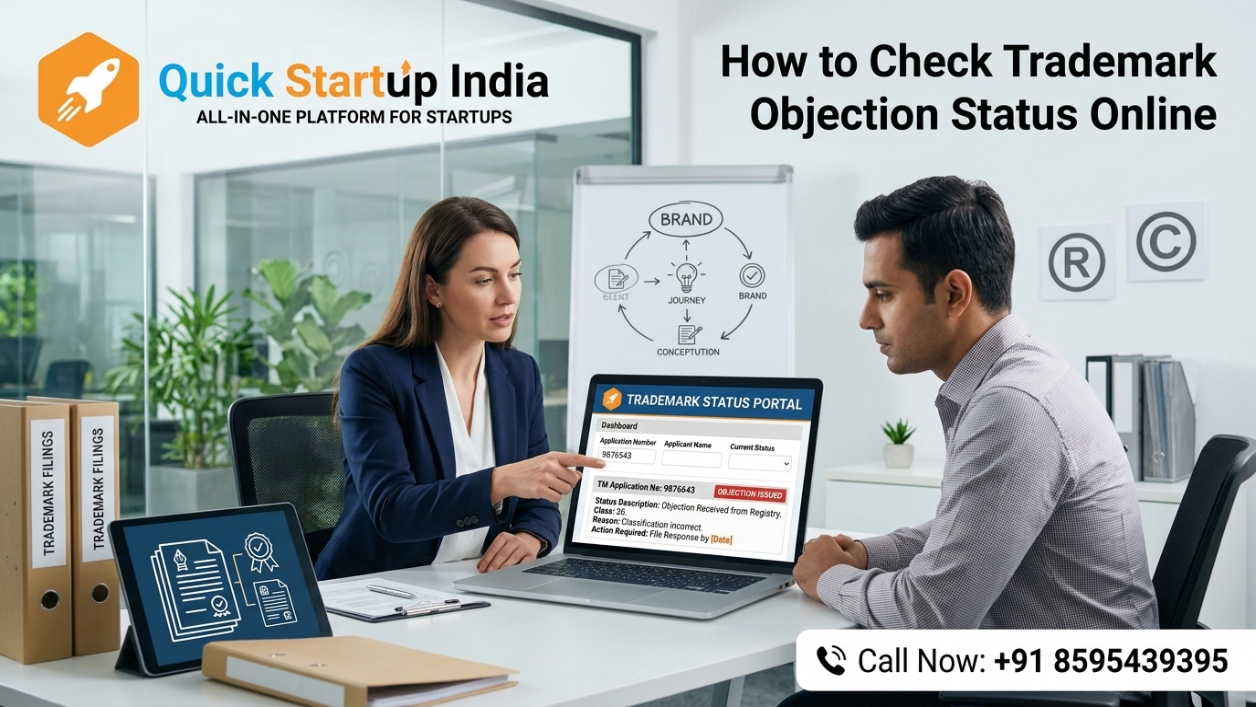
The status “Objected” in a trademark application means the Trademark Registry has issued an Examination Report and expects you to reply within 1 month.
This is the most critical status in a trademark application. The 30-day clock starts from the date the Examination Report was issued — not the date you saw the status online. Check the Examination Report immediately to confirm the exact date it was issued and calculate your deadline.
Examination Report Issued
The Examination Report has been formally issued and dispatched. The application is now in the “Objected” stage. If your status shows “Examination Report Issued,” treat it identically to “Objected” — the 30-day deadline is running.
Accepted and Advertised
The application has cleared all objections (or was not objected to) and has been published in the Trade Marks Journal for public notice. A 4-month opposition window is now open. Any person or business that believes your trademark conflicts with their rights can file opposition during this period. If no opposition is filed, the status moves to “Registered.” You cannot use the ® symbol until registration — only ™.
Opposed
A third party has filed a notice of opposition against your trademark during the 4-month opposition window. You must file a counter-statement within 2 months of receiving the opposition notice. This is a contested proceeding and requires legal assistance.
Registered 🎉
Your trademark has been successfully registered. The ® symbol can now be used. The registration is valid for 10 years from the date of application and must be renewed before expiry.
Abandoned
The application has been abandoned due to failure to respond to an objection, failure to file a counter-statement in opposition proceedings, or administrative withdrawal. An abandoned application loses all priority and filing benefits. A fresh application must be filed.
Withdrawn
The applicant has voluntarily withdrawn the application.
Refused
The Registrar has refused registration after an examination or hearing, finding the mark unregistrable on absolute or relative grounds that the applicant could not overcome.
Renewed
The trademark was previously registered, has completed its 10-year term, and has been successfully renewed for another 10 years.
Complete Trademark Status Flow Chart
New Application
      ↓
Formalities Check Pass / Fail
      ↓ (if Pass)
Marked for Exam
      ↓
Examined → Accepted directly (if no issues)
      ↓ (if issues found)
Objected ← 30-day reply deadline starts
      ↓ (after reply)
Hearing (if examiner not satisfied with reply)
      ↓
Accepted and Advertised (published in TM Journal)
      ↓
4-month opposition window
      ↓ (if opposed)       ↓ (if not opposed)
Opposed → Counter-statement    Registered ®
What Causes a Trademark Objection?
Objections are generally raised under Section 9 (Absolute Grounds) or Section 11 (Relative Grounds) of the Trade Marks Act, 1999.
Section 9 Objections — Absolute Grounds
Section 9 objections relate to the inherent nature of the mark itself, independent of any other trademark. Common Section 9 grounds:
- The mark is descriptive of the goods or services (e.g., “Fresh Juice” for a juice brand)
- The mark is a common word in the relevant trade (e.g., “Quality” for a manufacturing business)
- The mark is geographic — it merely identifies a place (e.g., “Mumbai Spices” for a spice brand)
- The mark is a surname — a common Indian surname without acquired distinctiveness
- The mark is a laudatory term (e.g., “Excellent,” “Best,” “Super”)
- The mark lacks distinctiveness and cannot function as a source identifier
Section 9 continues to be the most frequently invoked “Absolute Ground” for refusal in India. That said, a Section 9 objection is not the end of the road. With a well-planned legal approach and strong proof of “Acquired Distinctiveness,” many trademarks can successfully move forward toward registration.
Section 11 Objections — Relative Grounds
Section 11 objections are raised when the examiner finds that your mark is similar to an existing registered trademark:
- The mark is identical or similar to a registered trademark in the same class
- The mark is deceptively similar to an existing mark — likely to cause confusion among consumers
- The mark is similar to a well-known trademark (e.g., marks similar to Apple, Tata, Reliance)
- The mark is similar to a mark registered in a different class where the registered mark has a reputation
In 2026, AI-driven examination also means that “Relative Grounds” (Section 11) objections are more precise and frequent.
Other Common Grounds
Other common reasons for objection include: same name or proposed trademark already exists; single word whether prefix or suffix (e.g., “Newsnow” or “Nownews”) — trademark name should be distinctive; trademark logo is not clear or its dimension is not according to guidelines; failure to file Form TM-48 (Power of Attorney); and objection raised if the name is a common or geographical name.
How to Respond to a Trademark Objection
Step 1: Download and Read the Examination Report
The Examination Report is available for download directly from the IP India eRegister portal on the same page where the “Objected” status is shown. Download it immediately and read it carefully.
The report should be read very thoroughly to understand the precise reason for the objection. Determine if it is under Section 9, Section 11, or both.
Step 2: Calculate the Exact Reply Deadline
Under Rule 33(4) of the Trade Marks Rules, 2017, you have one month from the date of receipt of the Examination Report. Within that window you can either file a written reply via MIS-R or apply directly for a show cause hearing.
The deadline runs from the date of the report, not from the date you downloaded it or saw the status change. If the date of the Examination Report is, say, 1 June 2026, your reply must be filed by 1 July 2026 at the latest.
Step 3: Prepare the Reply
Your reply has to be logical and provide proper reasons for overcoming the objection with legal precedents, usage proof, and distinctiveness claims mentioned.
For Section 9 Objections (Absolute Grounds):
In 2026, the Trademark Registry gives significant importance to digital and commercial evidence. Your reply should ideally include: invoices (earliest available invoices showing use of the mark); advertising spend data from Meta Ads, Google Ads, and social media analytics; media coverage (mentions in newspapers, blogs, or industry publications); and a notarized user affidavit under Rule 25 confirming continuous use since the claimed “User Date.”
For Section 11 Objections (Relative Grounds):
- Prepare a detailed comparison chart showing visual, phonetic, and conceptual differences between your mark and the cited mark
- Demonstrate that the goods or services are in different trade channels or consumer segments
- If you have been using the mark for a long time, submit evidence of prior use and market recognition
- Obtain a letter of consent or coexistence agreement from the owner of the cited mark if possible
Step 4: File the Reply Online
Once the reply is uploaded on Form TM-M with the prescribed fee, the examiner reviews it and decides on one of three outcomes: the mark is accepted and advertised in the Trade Marks Journal for opposition (the ideal outcome); the mark is accepted subject to conditions, such as a disclaimer on a descriptive part of the mark; or the examiner calls a show cause hearing.
How to file the reply online:
- Log in to the IP India e-filing portal: ipindiaonline.gov.in
- Navigate to “Reply to Examination Report” (MIS-R)
- Enter your application number
- Upload the reply document (PDF format)
- Upload supporting evidence as attachments
- Pay the prescribed government fee (if applicable)
- Submit and download the acknowledgement
Step 5: Attend the Hearing (If Called)
The hearing is now held mostly through video conference, with physical hearings only on request. If the examiner is not satisfied with the written reply, a show cause hearing notice is issued with at least fifteen days’ notice. The hearing is an oral proceeding where the applicant presents the case, responds to the hearing officer’s questions, and may file additional written submissions with the permission of the officer.
Attending the hearing through a qualified trademark attorney is strongly recommended. A well-prepared hearing argument, supported by evidence and legal precedents, significantly improves the probability of acceptance.
⚠️ Warning: If no reply is received, the application will typically be treated as abandoned under Section 132 of the Trade Marks Act, 1999. As of 2026, the Registry sends up to three automated reminders under Section 132 before treating the application as abandoned. Do not rely on reminders — file your reply proactively before the deadline.
Fees for Trademark Objection Reply
Where an amendment to the application is filed alongside the reply using Form TM-M, the government fee is ₹900 for e-filing as on the current date, per the latest Trade Marks Rules. A request for a hearing, if filed by the applicant, carries a fee of ₹900 as well. These are Registry fees only and are subject to revision by the IP India office at any time.
Common Mistakes to Avoid When Responding to a Trademark Objection
After years of filing objection replies, the same five mistakes account for the majority of avoidable refusals:
1. Filing a template reply that does not address the specific objection A one-page generic response citing Section 9 and Section 11 without engaging with the cited marks is read by the examiner as a non-reply and almost always leads to a hearing at best, refusal at worst.
2. Missing the 30-day deadline Every day lost after the date of the Examination Report counts against your deadline. Set a calendar reminder the moment you see the “Objected” status.
3. Not downloading and reading the full Examination Report Responding to what you assume the objection is, rather than what it actually says, is a common and costly error.
4. Failing to submit evidence of use For Section 9 objections, a purely legal argument without commercial evidence of use is rarely sufficient. Invoices, advertising records, and social media analytics are powerful supporting material.
5. Confusing objection with opposition Responding with a TM-O counter-statement when an MIS-R reply is required — or vice versa — is a procedural error that delays or derails the application.
Common Trademark Objection Scenarios
Scenario 1: Descriptive Mark — Section 9 Objection A startup registers the mark “CloudStore” for cloud storage services. The examiner raises a Section 9 objection that the mark is descriptive of the services. The applicant responds with evidence of 3 years of commercial use, advertising spend records, Google Analytics showing brand name searches, and a notarized affidavit. The examiner accepts the mark on the basis of acquired distinctiveness through use.
Scenario 2: Similar Mark — Section 11 Objection A clothing brand applies to register “ZEERA.” The examiner cites an existing registered mark “ZEERA” in a different class (food products). The applicant prepares a detailed comparison showing that clothing and food products move in entirely different trade channels, target different consumers, and have no overlap. The examiner accepts the mark with a disclaimer that no claim is made to exclusive use of the word “ZEERA” for food products.
Scenario 3: Missed Deadline — Application Abandoned A small business owner files a trademark application and then does not check the status for 4 months. The “Objected” status was assigned 35 days ago. The 30-day reply window has closed. The application is abandoned. The owner must file a fresh application, losing the original priority date and paying filing fees again.
Scenario 4: Hearing Required A company files a reply to a Section 11 objection. The examiner is not fully satisfied with the written reply and issues a show cause hearing notice. The company’s trademark attorney appears at the video conference hearing, presents a comprehensive argument, and submits additional evidence. The hearing officer accepts the mark and it proceeds to publication in the Trademark Journal.
Timeline: From Filing to Registration
The full process from filing to registration takes 6–12 months if no objections or opposition are raised (best case), and 12–24+ months if objections are raised and a hearing is required. The 4-month opposition window is a fixed period that cannot be shortened.
| Stage | Approximate Timeline |
|---|---|
| Filing to Formalities Check | 1–4 weeks |
| Formalities Check to Examination | 8–14 months |
| Examination Report issued | Day 0 of 30-day clock |
| Reply to Examination Report | Within 30 days |
| Examiner review of reply | 1–3 months |
| Hearing (if required) | 6–12 months after reply |
| Accepted and Advertised | After hearing or reply acceptance |
| Opposition window | 4 months (fixed) |
| Registration certificate | 1–2 months after opposition window |
Frequently Asked Questions
1. What is a trademark objection?
A trademark objection is an issue raised by the trademark examiner during the examination of a trademark application. The examiner may object to the application due to similarities with existing trademarks, incorrect classification, descriptive terms, or other legal reasons. The applicant must respond to the objection within the prescribed time limit.
2. How can I check my trademark objection status online?
You can check your trademark objection status by visiting the official website of the Intellectual Property India (IP India). Navigate to the trademark application/status search section, enter your trademark application number, and view the current status of your application.
3. What does “Objected” status mean in a trademark application?
An “Objected” status means the trademark examiner has raised concerns regarding the application and has issued an examination report. The applicant must review the report and submit an appropriate reply to overcome the objection.
4. How long does it take for the trademark status to update after filing a reply?
The status update timeline varies depending on the workload of the trademark registry and the complexity of the objection. It may take several weeks to several months for the registry to review the response and update the application status online.
5. Can I download the trademark examination report online?
Yes. Through the official IP India portal, applicants can usually access and download the examination report associated with their trademark application. This report contains the reasons for the objection and the examiner’s observations.
Conclusion
Checking your trademark objection status online is a simple, free, and instant process through the IP India eRegister portal. The process takes under two minutes. What is not simple is the consequence of missing a status update — a permanently abandoned application, a lost priority date, and a brand left unprotected.
The “Objected” status is a hurdle, not a rejection. The majority of trademark objections in India are successfully resolved with a well-prepared, evidence-supported reply that specifically addresses the examiner’s concerns. The key is to check regularly, act within the 30-day window, and respond with legal precision.
If your application faces an objection, it’s crucial to respond within the given time frame. Addressing the objection promptly will help you avoid delays. Do not leave your brand unprotected through inaction. A trademark attorney’s reply to an objection is one of the most valuable investments you can make in your brand’s future.
Check your status every two weeks. Act within 30 days when objected. Respond with evidence. Your trademark is worth protecting.
Need Help With Trademark Objection Reply or Registration?
🟡 Quick Startup India provides complete Trademark Registration, Objection Reply, Opposition Proceedings, Trademark Hearing Representation, and IP enforcement support for businesses and creators across all sectors in India.
IP Protection Services
👉 Trademark Registration 👉 Trademark Objection Reply 👉 Design Registration 👉 Patent Registration 👉 Copyright Registration
Business Registration and Tax Services
👉 GST Registration and Filing 👉 Income Tax Filing 👉 Private Limited Company Registration 👉 LLP Registration 👉 MSME / Udyam Registration 👉 Startup India Registration
IT and Digital Services
👉 Website Development 👉 SEO Services 👉 Social Media Marketing 👉 Lead Generation
Call Now: +91 8595439395 Free Consultation: Monday to Saturday, 9 AM to 6 PM

Anjali is a Digital Marketing Expert at Quick Startup India who builds websites that rank and convert. She specializes in SEO-driven web development, helping people find the right legal help online.


